The car is on an elliptic heliocentric orbit that crosses the Earth orbit at its perihelion and crosses Mars' orbit at its aphelion. It is not in orbit around either planet.
It's a Hohmann transfer orbit. It will be orbiting the sun, with a periapsis (point of closest approach) at Earth's orbit an apoapsis at Mars's orbit. It's not going to circularize at Mars, and indeed will intersect Mars orbit quite a ways behind Mars.
I think right now the car is in a low Earth orbit. There will be a second ignition of the top stage later to shift it to the Mars orbit. The timeline ends with…
Mission continues on an experimental long coast and third stage two burn to target a precessing Earth-Mars elliptical orbit around the sun … which I can't completely decode. Update: SpaceX says "Upper stage restart nominal, apogee raised to 7000 km. Will spend 5 hours getting zapped in Van Allen belts & then attempt final burn for Mars."
The target orbit will be a ellipse around the sun.
The closest point to the sun will be about 1AU (Earth-Sun distance). The furthest point from the sun will be something like 1.5AU (Mars-Sun distance). This orbit will precess, meaning that it will slowly rotate its axis around the sun, rather than staying locked into the exact same path.
This. AIUI, they didn't bother setting up the "spacecraft" as an actual deep space probe, and it's likely missing electrical power for an extended mission, plus all of the hardware necessary to orient itself, track time and position, perform further burns to insert into Mars orbit, and communicate with Earth about all of that.
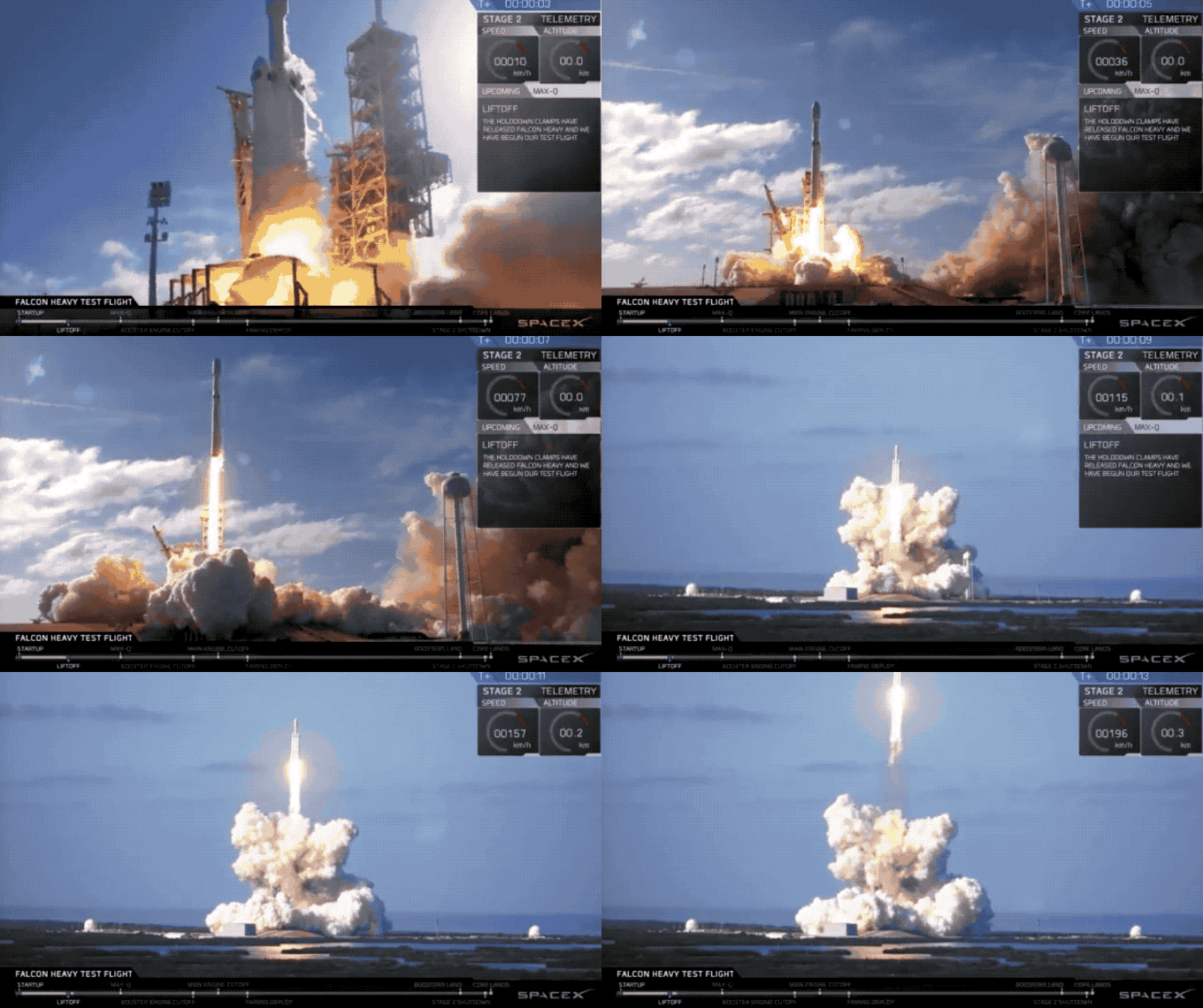
But I have this one observation on watching the launch, and landing and I hope someone can explain the discrepancy to me: How come the two boosters when they stick-landed have different colors than when they were launched - so soon? I mean, they were all real shinny white when blasting upwards from the launch pad. Are those the same ones that stick-landed to perfectly?
This is kind of a "big deal" but on the other hand it's also just an intermediate step. The really cool thing here is that this brings another contender into the heavy lift launch market, which has traditionally been an incredibly small space, especially recently (with NRO launches dominating). More than that, it dramatically reshapes the cost structure in that market. If you want a Delta IV Heavy launch normally you're looking at spending around a billion dollars, and generally the only customers who could even have the option to use that vehicle would be the US government anyway. So, of course, that means it's been a very restrictive field.
Falcon Heavy is, on the other hand, nominally a $90 million launch cost. That's cheaper than the typical launch cost for a Falcon 9, Atlas V, or Ariane 5 class vehicle, so that's crazy cheap. A lot of that is down to the fact that 90% of the hardware cost of the Falcon Heavy stack comes from reusable rocket stages (the 3 main cores). On top of that, the Falcon Heavy side boosters are just regular Falcon 9 cores, so as SpaceX gets better at reusing Falcon 9 rockets it'll also become easier to launch Falcon Heavy rockets because there will just always be a stack of appropriate components sitting around in inventory ready to go. Meaning that the potential flight rate on Heavy launches could be quite high. The Delta IV Heavy launches maybe around once every year or every other year or so. The Falcon Heavy could potentially fly many times per year. Together that's kind of a "big deal". It'll crack open the heavy lift market to a lot of people who previously lacked the means or the access to launch big payloads. If launching 20 tonnes to LEO is something that costs 10 figures and happens literally less often than every blue moon then you tend to only launch things like multi-billion dollar spy satellites. But if launching much more than that mass costs less than a traditional comsat launch and can happen every other month or perhaps more often if there's the demand, then you're going to get a lot of folks coming out of the woodwork to take advantage of that capability (and, as well, that'll still include NRO and US national defense folks as well, they won't miss out either). So, what are some things that become more possible with Falcon Heavy? * Space station components. After the Shuttle program ended there was much less capacity for launching station components, it was restricted to small bits and pieces (a docking adapter here, a small inflatable module there) and Russian components launched via Proton. With Falcon Heavy in the mix it becomes more practical to launch new space stations and new station components. So that's more of an option now. * Deep space missions. Falcon Heavy is capable of launching reasonable payloads on interplanetary trajectories to the outer planets. So that means it could make new missions to asteroids, comets, the gas and ice giant planets (or their moons), as well as KBOs and TNOs much more cost effective. NASA, ESA, etc. could look to using Falcon Heavy for those sorts of missions in the near future. It also makes things like "ordinary" Mars rover missions cheaper, of course, and allows them to be larger and more capable. * Space telescopes. Launching big space telescopes like Hubble and its successors will become much cheaper. So instead of having just one or two or even a handful of big top tier observatory class space telescopes we could have many of them. * Crewed interplanetary missions. In theory you could do something like a crewed cislunar mission similar to Apollo 8 using a single Falcon Heavy launch. More realistically if you wanted to do a "proper" interplanetary mission you'd assemble something in low Earth orbit. You'd put up separate boost stages as well as the crewed spacecraft component and the return vehicle on separate flights and bring them together then set off somewhere. If you're, say, NASA and you have a paltry $2 billion or something to pull off a crewed mission to an asteroid, perhaps, then being able to buy a half-dozen Falcon Heavy flights and put up a crap-ton of payload into LEO with only a quarter of your budget is hugely advantageous. * And, of course, all the standard stuff like spysats and big national defense payloads. This isn't such a huge deal for "the future" but it'll be a substantial revenue stream for SpaceX. As for sending humans to Mars, SpaceX won't be using Falcon Heavy for that. They have a next generation launch architecture planned that is more or less specifically designed for mars colonization (the BFR/BFS). That system will be much larger and able to put about 150 tonnes into LEO in a single (reusable) launch. It'll be fully reusable, including the 2nd stage (the BFS). It'll use LOX/Methane instead of LOX/Kerosene because of the superior performance, significantly improved longevity of engine components (less soot and coking in piping) to enhance reusability, and compatability with a Mars exploration architecture that includes utilization of the Martian atmosphere to produce propellant for return trips (which is actually surprisingly easy). They will begin the first stages of manufacturing that rocket sometime this year but it will be a few years before it even has a test flight.
Comments (871) 132 threads
Earlier commentsTL;DR: Elliptical solar orbit.
Mission continues on an experimental long coast and third stage two burn to target a precessing Earth-Mars elliptical orbit around the sun
… which I can't completely decode.
Update: SpaceX says "Upper stage restart nominal, apogee raised to 7000 km. Will spend 5 hours getting zapped in Van Allen belts & then attempt final burn for Mars."
The closest point to the sun will be about 1AU (Earth-Sun distance). The furthest point from the sun will be something like 1.5AU (Mars-Sun distance).
This orbit will precess, meaning that it will slowly rotate its axis around the sun, rather than staying locked into the exact same path.
But I have this one observation on watching the launch, and landing and I hope someone can explain the discrepancy to me:
How come the two boosters when they stick-landed have different colors than when they were launched - so soon? I mean, they were all real shinny white when blasting upwards from the launch pad. Are those the same ones that stick-landed to perfectly?
Falcon Heavy is, on the other hand, nominally a $90 million launch cost. That's cheaper than the typical launch cost for a Falcon 9, Atlas V, or Ariane 5 class vehicle, so that's crazy cheap. A lot of that is down to the fact that 90% of the hardware cost of the Falcon Heavy stack comes from reusable rocket stages (the 3 main cores). On top of that, the Falcon Heavy side boosters are just regular Falcon 9 cores, so as SpaceX gets better at reusing Falcon 9 rockets it'll also become easier to launch Falcon Heavy rockets because there will just always be a stack of appropriate components sitting around in inventory ready to go. Meaning that the potential flight rate on Heavy launches could be quite high. The Delta IV Heavy launches maybe around once every year or every other year or so. The Falcon Heavy could potentially fly many times per year.
Together that's kind of a "big deal". It'll crack open the heavy lift market to a lot of people who previously lacked the means or the access to launch big payloads. If launching 20 tonnes to LEO is something that costs 10 figures and happens literally less often than every blue moon then you tend to only launch things like multi-billion dollar spy satellites. But if launching much more than that mass costs less than a traditional comsat launch and can happen every other month or perhaps more often if there's the demand, then you're going to get a lot of folks coming out of the woodwork to take advantage of that capability (and, as well, that'll still include NRO and US national defense folks as well, they won't miss out either).
So, what are some things that become more possible with Falcon Heavy?
* Space station components. After the Shuttle program ended there was much less capacity for launching station components, it was restricted to small bits and pieces (a docking adapter here, a small inflatable module there) and Russian components launched via Proton. With Falcon Heavy in the mix it becomes more practical to launch new space stations and new station components. So that's more of an option now.
* Deep space missions. Falcon Heavy is capable of launching reasonable payloads on interplanetary trajectories to the outer planets. So that means it could make new missions to asteroids, comets, the gas and ice giant planets (or their moons), as well as KBOs and TNOs much more cost effective. NASA, ESA, etc. could look to using Falcon Heavy for those sorts of missions in the near future. It also makes things like "ordinary" Mars rover missions cheaper, of course, and allows them to be larger and more capable.
* Space telescopes. Launching big space telescopes like Hubble and its successors will become much cheaper. So instead of having just one or two or even a handful of big top tier observatory class space telescopes we could have many of them.
* Crewed interplanetary missions. In theory you could do something like a crewed cislunar mission similar to Apollo 8 using a single Falcon Heavy launch. More realistically if you wanted to do a "proper" interplanetary mission you'd assemble something in low Earth orbit. You'd put up separate boost stages as well as the crewed spacecraft component and the return vehicle on separate flights and bring them together then set off somewhere. If you're, say, NASA and you have a paltry $2 billion or something to pull off a crewed mission to an asteroid, perhaps, then being able to buy a half-dozen Falcon Heavy flights and put up a crap-ton of payload into LEO with only a quarter of your budget is hugely advantageous.
* And, of course, all the standard stuff like spysats and big national defense payloads. This isn't such a huge deal for "the future" but it'll be a substantial revenue stream for SpaceX.
As for sending humans to Mars, SpaceX won't be using Falcon Heavy for that. They have a next generation launch architecture planned that is more or less specifically designed for mars colonization (the BFR/BFS). That system will be much larger and able to put about 150 tonnes into LEO in a single (reusable) launch. It'll be fully reusable, including the 2nd stage (the BFS). It'll use LOX/Methane instead of LOX/Kerosene because of the superior performance, significantly improved longevity of engine components (less soot and coking in piping) to enhance reusability, and compatability with a Mars exploration architecture that includes utilization of the Martian atmosphere to produce propellant for return trips (which is actually surprisingly easy). They will begin the first stages of manufacturing that rocket sometime this year but it will be a few years before it even has a test flight.
All comments shown.
Couldn't load more comments. Check your connection and try again.