Did they need to modify the Tesla to make it vacuum worthy?
Like, remove any fluids, remove any parts that might explode in the hot or cold of space, deflate the tires, etc. Note: I'm more interested in a scientific answer, as opposed to casual conjectures. Preferably from an engineer knowledgeable of such things. And specifically, the materials sciences aspect of how materials will survive in a vacuum.
They have a bigass vacuum test chamber, you can bet they did their homework and every container that might end up pressurized had a hole in it to allow the leveling of the pressure. No point taking chances with something like this, it only has to look good, it doesn't have to drive.
It's not like they're trying to keep it driveable? I would guess they'll have drained any fluids but I don't expect it to be fully operational after the van allen belts, for example.
amazing, is the car strapped to the outside of the rest of the ship? how does it remain so stable after the separation? by "sphere" i just meant the case it is shown inside of at the start, since the markings on the wall resemble motion tracking panels used for 3d projection. perhaps I just underestimate the precision and smoothness of the fairing separation, or am misunderstanding how the car is rigged so as to remain so stable.
As a mechanical design engineer (not of cars, of other vehicles) I can't think of any systems that you'd need to modify if you don't plan on driving the car again. This is all off-the-top-of-my-head theorycrafting, so I could be wrong.
Space is only -1 atmosphere and even then, it only affects sealed systems. For the rest, they'd equalise. Also, cooling in in space is actually fairly gradual as there's only radiation, not convection or conduction. Let's go through the systems and evaluate what that means: For structural components, nothing will really change. After all, we built spacecraft out of aluminium before. The ISS has to cope with this more, as it goes in and out of sunlight every 90 mins, so it gets something like 15 cycles of high/low temperature a day. The thermal shock of going from darkness to sunlight is the main issue, but this won't be passing through the earth's shadow constantly since it'll be orbiting the sun, so changes will be far more gradual. Bigger issues come from different materials joined together, such as steel to aluminium, since they expand at different rates, but that's not really a problem here and even if it is, it'll just crack a bit at the seam. That's not going to cause the car to explode into little fragments. For unsealed systems with fluids, they'd just boil away in the vacuum before desubliminating into little frozen droplets and bounce around or whatnot. The only sealed systems with fluids in them that I can think of are tyres and brake lines. Tyres tend to sit at about 30-35 PSI, which is ~2 atmospheres. They then have to endure significant heating/cooling, dynamic pressures of spinning, etc. so an extra atmosphere wouldn't cause issue from a pressure point of view. Ditto brake lines - you stomp on them with a mechanical advantage and they never rupture. I think you'll find the worst damage will be to the paint over time, which will fade more aggressively since it's not protected from UV sunlight any more. edit: I forgot the batteries, which I believe are a sealed unit. They might have just dropped the battery pack from the car. Not sure what a vacuum would do to them as I don't know enough about Li-Ion battery design to comment.
The metals in the are likely to sublimate significantly over the course of tens of thousands of years. Plastics and rubber might only last decades. Painted surfaces might survive longer than exposed metals.
The glass will eventually become clouded and discoloured due to radiation damage and scoring by micrometeorites. Some plastics can rapidly deteriorate in sunlight. Erosion from micrometeoroids (dust) and larger impacts is also a factor over timescales of thousands of years. I doubt it will last the millions of years that is suggested. http://www.dtic.mil/dtic/tr/fulltext/u2/266548.pdf
Makes my day that much better. Giving approval to that kind of lightheartedness shows great confidence in the team's ability and makes overall morale palpable. Well done.
I absolutely love that Musk is putting a car into Mars orbit. Assuming mankind doesn't have an extinction event (or dark ages event), it is extremely likely we'll populate the solar system over the next millenia. In 200 years, Martian children can look up in the sky and know that one of the quickly moving visible satellites is a hilarious, old-Earth car. Depending on how accessible orbit is from planets over the next couple hundred years, it could very well be some sort of space station museum.
Or, imagine we hit a dark age and bounce back, and this event is lost to history. Five hundred years later we manage to get some people to Mars orbit and they find a fucking car in a capsule with a little mannequin stuffed into it flinging around the planet at hundreds of kph. All while it's blasting David Bowie over their radios.
It would be cooler if it was going to be in Mars orbit, but it is just going into an elliptical solar orbit that will vary in distance from the sun between Earth orbit and and Mars orbit.
Hmm, they said heliocentric several times. But it’s a cool orbit no matter how you slice the the pork chop. Pretty sure this is intended to be similar to a “mars cycler” orbit. A “mars cycler” is an interplanetary space station which follows a sort of transfer orbit between earth and mars. This provides a cushy radiation shielded environment for interplanetary travelers and economizes on propulsion by leveraging gravity assist. IIRC some guy named Aldrin came up the gist of the design.
Opposition to non-bipedal forms of transport? Or is it opposition to the type of urban planning that is centered around the car more than the pedestrian?
Is it okay to put unnecessary stuff in the orbits around our or other planets? Isn't this space trash that can potentially be problematic for future endeavors? Are we creating problems for ourselves to satisfy our vanity?
Mars is really big relative to a car. You could probably put dozens or hundreds of cars in orbit around Mars without any added difficulty.
Anyway I wouldn't normally consider it to be space trash, but in this case it's pretty much just a big Tesla ad billboard orbiting the planet so I agree with you sentiment
It's going into a heliocentric orbit, and people will surely be tracking it.
If it gets to be a problem in the future, it will have so much historical value that someone will launch a mission to go fetch the Roadster and bring it home to Mars.
the standard cargo for these missions is a chunk of cement. If you want to test a rocket you have to throw something up there.
It probably does not add a measurable amount of junk to hit than is already up there in the form of natural rocks. Though if in the future human population hits the quadrillions and we are living on all 8 planets we should probably start worrying about our space trash.
It's not in orbit around Earth, and won't be visible from Earth. As soon as it boosts out of its parking orbit, it will be orbiting the sun between Earth and Mars.
Also, there is not any danger of stuff "crowding" out there because the amount of space between Earth and Mars is really quite extremely huge.
It's such a shame that so many people with Elon kind of money aren't doing anything to transform us into a spacefaring species. Why doesn't apple have a mars program? What the fuck are people doing with all the money?
Awesome work by spacex. They are peerless, except if you want to count massive superpower governments as peers.
Comments (871) 132 threads
Earlier commentsLike, remove any fluids, remove any parts that might explode in the hot or cold of space, deflate the tires, etc.
Note: I'm more interested in a scientific answer, as opposed to casual conjectures. Preferably from an engineer knowledgeable of such things. And specifically, the materials sciences aspect of how materials will survive in a vacuum.
After all, where it's going it won't need roads.
id imagine a 360-camera is projected onto the inside of the sphere/case the car is actually inside of.
Continue this thread — 4 replies
Space is only -1 atmosphere and even then, it only affects sealed systems. For the rest, they'd equalise. Also, cooling in in space is actually fairly gradual as there's only radiation, not convection or conduction. Let's go through the systems and evaluate what that means:
For structural components, nothing will really change. After all, we built spacecraft out of aluminium before. The ISS has to cope with this more, as it goes in and out of sunlight every 90 mins, so it gets something like 15 cycles of high/low temperature a day. The thermal shock of going from darkness to sunlight is the main issue, but this won't be passing through the earth's shadow constantly since it'll be orbiting the sun, so changes will be far more gradual.
Bigger issues come from different materials joined together, such as steel to aluminium, since they expand at different rates, but that's not really a problem here and even if it is, it'll just crack a bit at the seam. That's not going to cause the car to explode into little fragments.
For unsealed systems with fluids, they'd just boil away in the vacuum before desubliminating into little frozen droplets and bounce around or whatnot.
The only sealed systems with fluids in them that I can think of are tyres and brake lines. Tyres tend to sit at about 30-35 PSI, which is ~2 atmospheres. They then have to endure significant heating/cooling, dynamic pressures of spinning, etc. so an extra atmosphere wouldn't cause issue from a pressure point of view. Ditto brake lines - you stomp on them with a mechanical advantage and they never rupture.
I think you'll find the worst damage will be to the paint over time, which will fade more aggressively since it's not protected from UV sunlight any more.
edit: I forgot the batteries, which I believe are a sealed unit. They might have just dropped the battery pack from the car. Not sure what a vacuum would do to them as I don't know enough about Li-Ion battery design to comment.
"We didn't really test any of those materials [...] it's just literally a normal car in space"
The glass will eventually become clouded and discoloured due to radiation damage and scoring by micrometeorites. Some plastics can rapidly deteriorate in sunlight.
Erosion from micrometeoroids (dust) and larger impacts is also a factor over timescales of thousands of years.
I doubt it will last the millions of years that is suggested.
http://www.dtic.mil/dtic/tr/fulltext/u2/266548.pdf
https://twitter.com/elonmusk/status/936782477502246912
Source: http://m.dw.com/en/what-you-need-to-know-about-the-falcon-he...
Continue this thread — 1 reply
Continue this thread — 3 replies
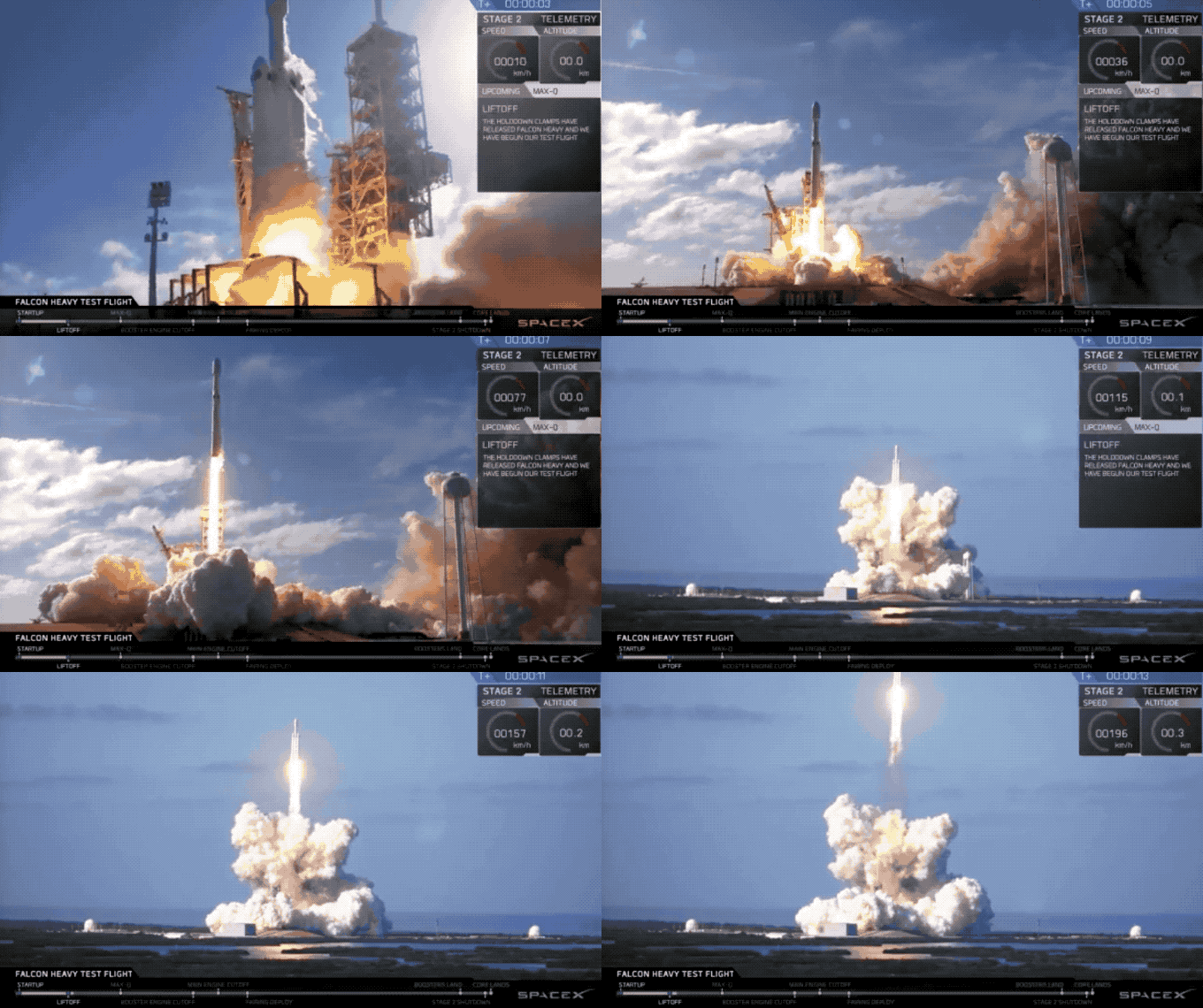
I posted more screen shots of launch: https://imgur.com/a/gh410
Or, imagine we hit a dark age and bounce back, and this event is lost to history. Five hundred years later we manage to get some people to Mars orbit and they find a fucking car in a capsule with a little mannequin stuffed into it flinging around the planet at hundreds of kph.
All while it's blasting David Bowie over their radios.
Opposition to non-bipedal forms of transport?
Or is it opposition to the type of urban planning that is centered around the car more than the pedestrian?
Anyway I wouldn't normally consider it to be space trash, but in this case it's pretty much just a big Tesla ad billboard orbiting the planet so I agree with you sentiment
Continue this thread — 2 replies
If it gets to be a problem in the future, it will have so much historical value that someone will launch a mission to go fetch the Roadster and bring it home to Mars.
Continue this thread — 3 replies
It probably does not add a measurable amount of junk to hit than is already up there in the form of natural rocks.
Though if in the future human population hits the quadrillions and we are living on all 8 planets we should probably start worrying about our space trash.
Also, there is not any danger of stuff "crowding" out there because the amount of space between Earth and Mars is really quite extremely huge.
Continue this thread — 2 more replies
Continue this thread — 1 more reply
Awesome work by spacex. They are peerless, except if you want to count massive superpower governments as peers.
Continue this thread — 12 replies
All comments shown.
Couldn't load more comments. Check your connection and try again.