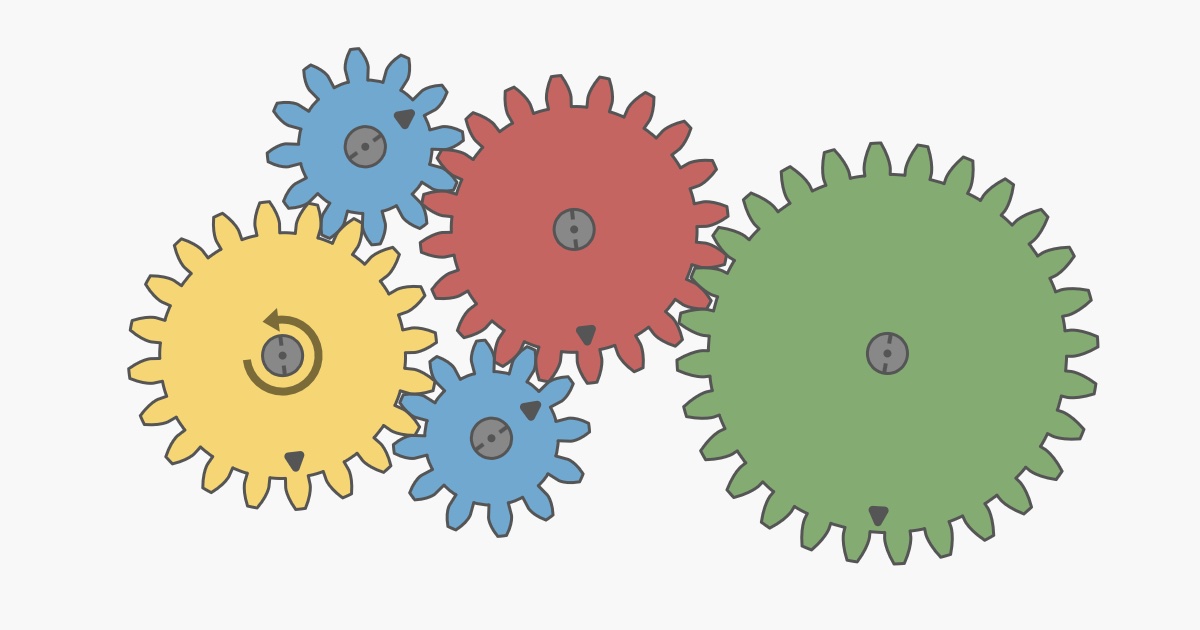
That gif at the top reminds me of an IQ test I took in 6th grade. There was an entire section where they would show you a sequence of gears and tell you what direction one of them was spinning. Then they would ask you what direction some other gear was spinning.
They all looked like that first gif (but not animated of course).
Maybe I’m misremembering but isn’t torque usually expressed as a cross product of force and radius?
(Making pound-feet the pedantic but correct phrasing of the colloquial “foot-pounds”) That way the torque vector points in the direction that a screw would move if you turned it in the direction it’s being forced.
That is the correct way to express torque with vectors.
The definitions in the blog post are not vectors, they are scalars and the dot is not a dot product, just multiplication. (F_t there is what is commonly notated as F_perpendicular). I agree it is confusing to those of us used to seeing bold letters usually used for vectors (and I would argue that using more conventional notation at even a basic level is better), but it's not wrong.
Comments (222) 78 threads
Earlier commentsThey all looked like that first gif (but not animated of course).
[1] http://worrydream.com/refs/Papert%20-%20Mindstorms%201st%20e...
(Making pound-feet the pedantic but correct phrasing of the colloquial “foot-pounds”)
That way the torque vector points in the direction that a screw would move if you turned it in the direction it’s being forced.
The definitions in the blog post are not vectors, they are scalars and the dot is not a dot product, just multiplication. (F_t there is what is commonly notated as F_perpendicular). I agree it is confusing to those of us used to seeing bold letters usually used for vectors (and I would argue that using more conventional notation at even a basic level is better), but it's not wrong.
https://mobile.twitter.com/moo9000/status/121019063004082176...
All comments shown.
Couldn't load more comments. Check your connection and try again.