Not saying this site is, but it makes me think of all the (less legit) file conversion websites which are basically portals to harvest your documents (or your aging parents' documents that they don't otherwise know how to convert), and you later find they appear on crappy sites like Scribd. Or worse.
Any chance you could elaborate a bit? This sounds interesting but I'm not in the know enough to read between the lines.
You were trying to see if someone was sniffing the documents uploaded (and confirmed they were).... or you realized you could use them as a vector though which others would post your materials on websites elsewhere (and they did)?
I find that digital books are simply too perfect. There should be pdf fonts where there are maybe 10 incantations of each character, and the display:
1. picks one incantation randomly for each display
2. slightly and randomly alters the position/rotation of each character
3. adds a tiny blotch now and then Like the print in a real book, especially ones printed before 1970. I also suggest that the background be an actual scanned image of a blank piece of paper. Those "paper color" backgrounds are too perfect. Take some blank pages out of an older book sometime and scan them, and you'll see what I mean.
Most of the "book simulation" features I've seen (background textures, page turn animations, the like) have come across as gimmicky and useless, meanwhile digital books tend to still suffer from conceptually simple formatting problems like poor responsive text reflow or baking detailed vector figures into tiny JPEGs.
I've sent many suggestions to the Kindle people of things they could improve on the Kindle, all of which were very simple to do. The years go by, they've done exactly 0 of them.
One of them, for example, was an option to eliminate the margin in a pdf display. The pdf already has a margin, so there's the pdf margin plus the margin the ereader puts around the pdf. This significantly reduces the number of pixels displaying information.
Yes. People wrongly argue that vinyl sounds are more accurate. CDs are more accurate. But CDs are perfect, and for us older folks, the sound of vinyl, with its scratches, pops, crackle, rumble, and crosstalk has a comfortable nostalgic appeal.
Thanks, I totally agree. That's why I made the code public so you can see what's being run. A friend very privacy-minded told me maybe a desktop app could be used by those who don't want to upload their documents so that's something I'm currently exploring
This is very cool, I have the same concern. Most documents I need to scan like this have my PHI or PII on them and I wouldn't trust uploading to a third party, and especially free, site. What I will add to the conversation is that seeing the source code and trusting that you're running that exact code are different thing. Would love to see this as something I could run locally after cloning the repo, as a python or npm script or some. Very cool work overall!
> made the code public so you can see what's being run
The thing is, sharing a repository does not prove that the server is running that same code. And someone worried about their document security wouldn't run some random binary locally either, because it could send the document off to a server. They would run the source code locally after reading it, which sharing the repository allows for.
This. I had no idea what this did until I read a couple of HN-comments.
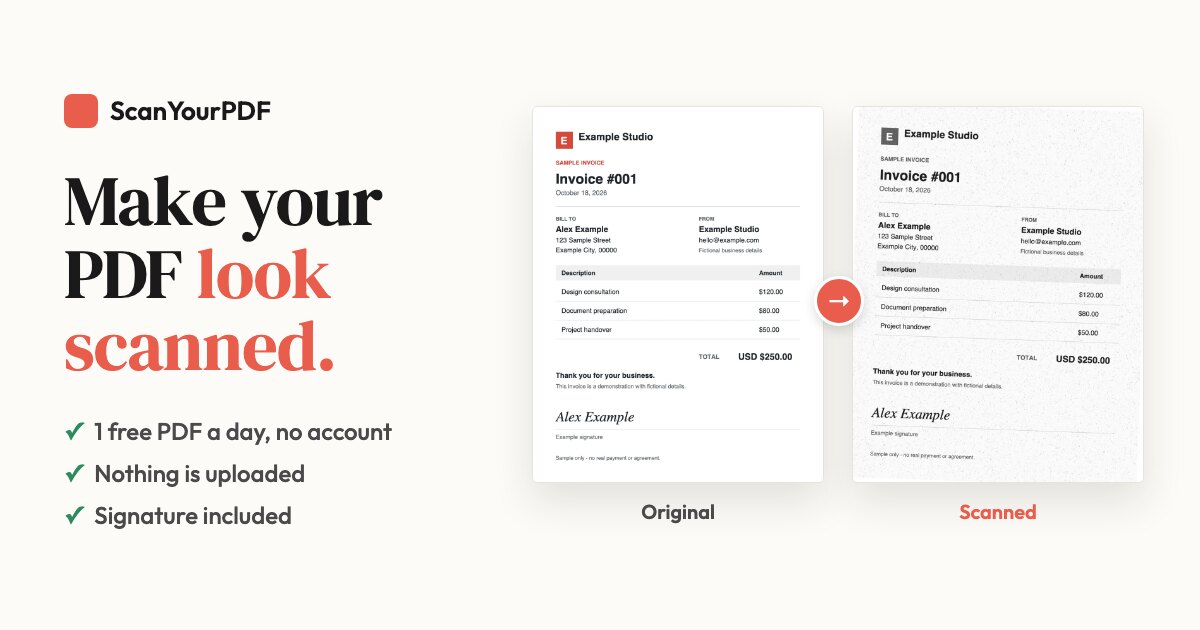
The short introduction could mean a couple of things:
Just downgrading the pdf? Looking for a signature-like part and turns this to pseduo-handwritten characters, maybe changing the color? Something completely different? Naturally, I did not want to upload a potentially confidential document to some random webservice. I actually had a pdf file containing several pages of "Lorem ipsum" that I needed for another thing, but I deleted it yesterday because I was done with it.
Comments (168) 45 threads
Earlier commentsYou were trying to see if someone was sniffing the documents uploaded (and confirmed they were).... or you realized you could use them as a vector though which others would post your materials on websites elsewhere (and they did)?
1. picks one incantation randomly for each display 2. slightly and randomly alters the position/rotation of each character 3. adds a tiny blotch now and then
Like the print in a real book, especially ones printed before 1970.
I also suggest that the background be an actual scanned image of a blank piece of paper. Those "paper color" backgrounds are too perfect. Take some blank pages out of an older book sometime and scan them, and you'll see what I mean.
I'd settle for "too perfect" in a heartbeat.
One of them, for example, was an option to eliminate the margin in a pdf display. The pdf already has a margin, so there's the pdf margin plus the margin the ereader puts around the pdf. This significantly reduces the number of pixels displaying information.
Continue this thread — 1 reply
Sadly, I'd also be extremely wary of sending the kind of documents that I need to print out and sign through some server-side black box.
The thing is, sharing a repository does not prove that the server is running that same code. And someone worried about their document security wouldn't run some random binary locally either, because it could send the document off to a server. They would run the source code locally after reading it, which sharing the repository allows for.
Just downgrading the pdf? Looking for a signature-like part and turns this to pseduo-handwritten characters, maybe changing the color? Something completely different?
Naturally, I did not want to upload a potentially confidential document to some random webservice.
I actually had a pdf file containing several pages of "Lorem ipsum" that I needed for another thing, but I deleted it yesterday because I was done with it.
All comments shown.
Couldn't load more comments. Check your connection and try again.