"[Hunter S. Thompson] chose, rather than writing original copy, to re-type books like The Great Gatsby and a lot of Norman Mailer, the Naked and the Dead, a lot of Hemingway. He would sit down there on an old type-writer and type every word of those books and he said, 'I just wanna feel what it feels like to write that we'll.'"
HST: "If you type out somebody's work, you learn a lot about it. Amazingly it's like music. And from typing out parts of Faulkner, Hemingway, Fitzgerald - these were writers that were very big in my life and the lives of the people around me - so yea I wanted to learn from the best I guess." http://brianjohnspencer.blogspot.com/2014/06/hunter-s-thomps...
This was explained by HST in one of his letters, which was collected in the excellent three book collection of letters he sent and received to his friends. Including many famous writers.
HST was always great in small rapid outputs of writing, which is captured well in his letters (similar to how his collection of articles are his most popular works, but these deserve a similar look). He obviously had some sort of ADD and later on combined with a long series of drug/alcohol addictions, so it makes sense he was better in short blurbs. Even his most famous novel Fear and Loathing in Las Vegas has a feeling of multiple long spurts on a typewriter. Which is always how he wrote. Always also at the very last minute of the magazine due date and/or because he was running out of money and needed the next advance. I believe this is common in creative fields. Long periods of meh and spurts of greatness. Anyway the book series is here, usually called the Gonzo Letters: https://www.goodreads.com/series/64386-the-fear-and-loathing... Only the 2nd one has a Wikipedia page for some reason (the 3rd one came out in 2014) but the first one (The Proud Highway: The Saga of a Desperate Southern Gentleman 1955–1967) as a young writer who is often desperate and broke was most interesting IMO, even though his life or writing wasn’t yet as it would become famous for (but definitely still as wild) https://en.wikipedia.org/wiki/Fear_and_Loathing_in_America
Still waiting for the third volume to actually drop? Can't find it available and all the amazon reviews are 5-star complaints about the delayed release :(
Oh weird, I wasn't aware they still haven't release it yet. It's been 19 years since the 2nd volume. That's really odd. They didn't fulfill the preorders in 2014 either https://www.amazon.com/gp/product/0684873176/
I thought making it through the other two 700+ pages of letters was quite an achievement. I was planning to read the 3rd one at some later point in my life. I guess I'll still have to wait ... the title was really great too "The Mutineer: Rants, Ravings, and Missives from the Mountaintop, 1977-2005".
I'm productive in bursts as well. I have the feeling that in between bursts things are still computing in the background so it looks like you're not doing anything but the brain is still churning. This type of bursty productivity is very hard to account for in a corporate environment where one's productivity should be accounted for on a daily basis and laid down in cookie cutter time slots. I often wonder whether I have ADHD since I can hyperfocus when Im in a productive burst. Unfortunately/fortunately I don't tick other boxes so I'm in a limbo with the diagnosis
Inspiration is lumpy, so I've adopted the Fieldstone method [1] (articulated by the prolific Gerald Weinberg).
In my implementation, I collect little thoughts (shower thoughts, observations, good turns of phrases, etc.) into a single continuous Google Doc. I revisit it often and guided by my current emotions and interests, try to coalesce like-ideas and rewrite them into a large idea. Some ideas eventually snowball into something substantial. Unless you're a columnist with a deadline (with innate talent driven by adrenalin), everybody knows how difficult it is to write an essay from scratch. However if you've been collecting ideas, and have been developing and coalescing and rewriting them over and over again (often for years), the essay almost writes itself. [1] https://www.skmurphy.com/blog/2016/05/04/weinberg-on-writing...
I have a similar workflow, but for a different reason. BJ Novak described in an interview how the ideation part of the process is totally different from the productive part. This spoke to me, and I've been approaching them separately ever since. When they get too inflated I either get writers/coders block or absolute spaghetti, so it's easy to see when I've grown less disciplined with the division.
The analogy with music is interesting. Superficially, the musical activity which looks most like typing is simply playing an instrument. And sight-reading does feel a bit like typing. But I wonder if he's talking about transcription in that quote. One can sight read complex music without learning anything about it if they happen to just be a good sight reader. But transcription really does force you to pay attention to structural nuances you otherwise wouldn't get just by listening to a piece of music.
I think the idea is that typing is much slower than reading, so one has forced downtime in which it is possible to consider structure and choices[1].
Compare https://news.ycombinator.com/item?id=23528483 Qui scribit, bis legit (Maybe your sight-reading is quicker than your playing? Mine is nearly the opposite.) [1] Quintilian even finds value in exercising criticism of popular examples (because of course, even way back in the first century, The Old Days Were Better. Elsewhere Quintilian complains that people in his day only repeat a Cliff's Notes knowledge of greek authors instead of reading the originals in full.) > "It will even at times be of value to read speeches which are corrupt and faulty in style, but still meet with general admiration thanks to the perversity of modern tastes, and to point out how many expressions in them are inappropriate, obscure, high-flown, grovelling, mean, extravagant or effeminate, although they are not merely praised by the majority of critics, but, worse still, praised just because they are bad." http://www.perseus.tufts.edu/hopper/text?doc=Perseus%3Atext%... and makes a good point about a pedagogical advantage to criticism of works other than one's own: > "I will venture to say that this particular form of exercise, if diligently pursued, will teach learners more than all the text-books of all the rhetoricians: these are no doubt of very considerable use, but being somewhat general in their scope, it is quite impossible for them to deal with all the special cases that are of almost daily occurrence. The art of war will provide a parallel: it is no doubt based on certain general principles, but it will none the less be far more useful to know the methods employed, whether wisely or the reverse, by individual generals under varying circumstances and conditions of time and place. For there are no subjects in which, as a rule, practice is not more valuable than precept. Is a teacher to declaim to provide a model for his audience, and will not more profit be derived from the reading of Cicero or Demosthenes? Is a pupil to be publicly corrected if he makes a mistake in declaiming, and will it not be more useful, and more agreeable too, to correct some actual speech? For everyone has a preference for hearing the faults of others censured rather than his own." http://www.perseus.tufts.edu/hopper/text?doc=Perseus%3Atext%... Im demang tili peroba pash im demang finyish vide fit.
Would be super interesting if this holds true for 'copying out' code as well... it's all the edge case handling that can get boring to re-type out without context / comments...
It does hold out! Here is a link to my research on retyping code [1]. To summarize my findings, students that regularly completed typing exercises earned higher course grades and submitted less erroneous code.
Reminds me ... in a computer nerd way ... of "python the hard way" (which used to be very open/free, now it has changed)
You would not read or download the lessons. You typed all the python in word by word. I think it really helped the learning process to type it out. It was slow and deliberate, even to mistyping and making mistakes (and fix them).
I still have a directory tree around from doing those lessons. Given how picky python is about indent spacing, I agreed somewhat with the philosophy behind those lessons, particular for people new to coding.
Yup! To learn music, cooking, martial arts, etc., you start by following someone else to build the muscle memory on doing the skill. As a follow-up, my own research [1] on retyping code showed students earned higher grades and submitted less erroneous code. Replicating technical skills is a common practice technique that seems to have been "lost" in current CS education.
Agreed that you learn much about a work (I've retyped a few articles and books simply to get a usable copy). But copying is not the same as creating --- you'll see the finished product, and may intuit hints as to how it was created, but what you're not getting is the creation process itself: research (especially for nonfiction), structure, plotting and character (for fiction), editing, rewriting, restructuring and reordering content, additions and deletions.
Writing (and reading) short disconnected bits is fairly easy: nothing interrelates strongly, composition is simple and forgiving. Longer works are complex: they have structure, arcs, need to retain interest, jumps and connections need to be plausible, the whole be consistent (unless inconsistency is used for effect), etc., etc. And you don't get this knowledge simply by copying out great works. I see a similar failure-to-grasp in some proposals for hypertext or advanced publishing systems. Reading is inherently serial, in that we follow lines of text on a page. Interactivity --- usually defined by the ability to skip between previously-written segments --- just offers more serial paths. The value of hypertext and related tools may be far more on the writing process, where vastly more sources can be referenced and cited with greater ease. Some might be incorporated into the final work, but an excess of interconnections and quotations is itself distracting. I see this as a particular blindness of Ted Nelson's Xanadu project, despite many fascinating and original elements to it.
> And you don't get this knowledge simply by copying out great works.
Well, I think the point is that you may get knowledge, but nt necessarily of the type that lets you make another great work. Doing is an act of learning, whether very small amounts of learning as you do something you've done countless times before, or possibly large amounts of learning as you try something absolutely new, or learning about yourself and what you like, what you don't, what you feel is worthwhile even if you dislike it, etc. Ultimately, there's something to be learned from everything. Even the book you read that purports to teach you someething that you find worthless for the task should be illustrative of either what things are not useful for you in learning that, or how to structure something in such a way that it's hard for you to take away good meaning from it, and ultimately, some hints about what to look for next time that doesn't have the same problems. So, copying isn't necessarily creating, but it should be an act of learning, and learning should hopefully help in creating, even if it's something totally divorced from what you were originally copying.
I think we're mostly in agreement: copying is useful. It is not complete.
And any learning process which focuses largely on output or product rather than process, shares this deficiency. To your other point, serendipitous discovery is very much a thing. I find that it is helped by haviing a conceptual structure or mental model which allows slotting new concepts from unrelated areas into a larger whole. Recent example: moralising pathologies fallacy, in wildfire: https://news.ycombinator.com/item?id=24684652 https://joindiaspora.com/posts/b4bbef90e8c60138513c002590d8e...
Amazing idea, really I'm impressed. This intrigued me at first glance as a fun typing exercise, as I've always struggled with typing - I started using computers way before they started teaching typing around here, so my typing is far from the optimal 10 finger method, but I've always found typing exercises mind numbingly boring.
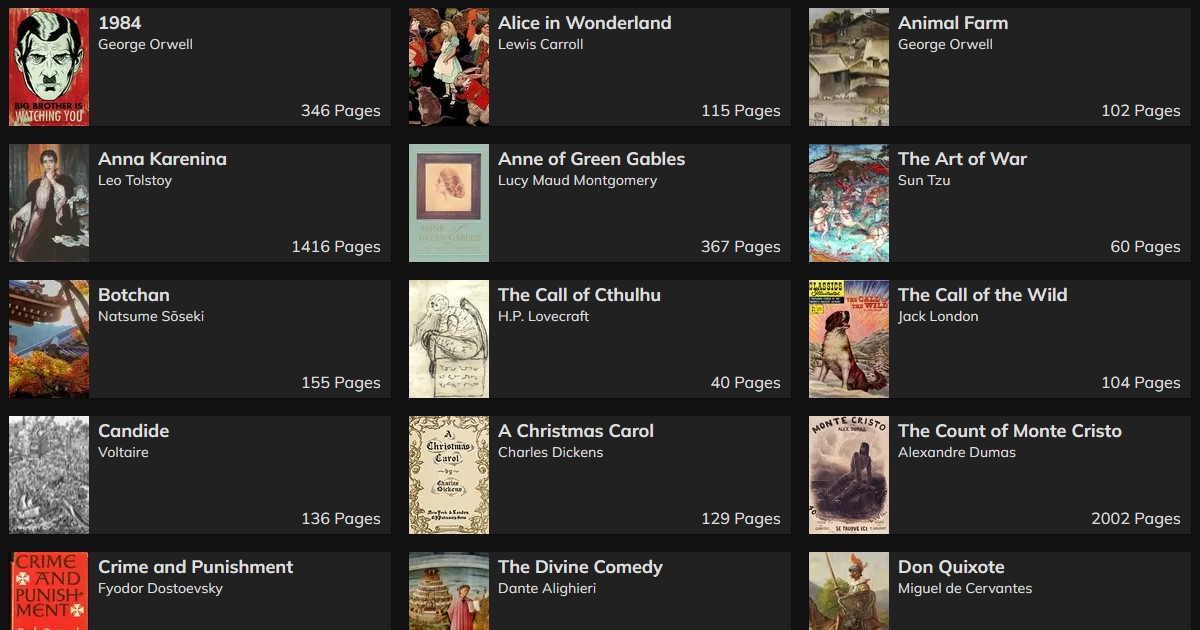
However, as I started typing The call of Cthulhu, I'm now much more intrigued by this as a new way to read books. It is a very different literary experience from just simply reading. I'm way more attentive to the text itself, rather than just the meaning, if that makes sense. Though it's very possible that this effect is going to go away as I get more used to it. Any chance of typing out custom uploaded books? Maybe copy pasted plaintext? Also kudos on the execution, the site is really nicely made.
I've always thought of typing lessons as being a thing from long before computers. Back then it was treated as a serious skill which could lead directly to employment. Now it's just something you're expected to know.
I had plenty of basic IT education at school, but was never taught how to type at all.
It’s an interesting idea that we still “need” typing practice. We do it every day why would we need to practice extra?
To provide an additional use case, my wife just got me an awesome and completely configurable ergonomic keyboard for my birthday and I’m considering switching to Dvorak or Coleman layouts after typing QWERY my entire life. I NEED a long form practice like this instead of just typing nonsense short blurbs of words as most typing practice provides. Super excited about this!
I practiced qwerty touch typing in school, but never really used it myself, rather using two-three fingers on each hand and letting them move around a lot across the keyboard.
I switched to dvorak over 10 years ago and since the letters on the keys didn't match, and because it's designed to make it easy to touch type, I quickly learned. But after a year or so of dvorak, I grew tired of being extremely slow when I had to switch back to qwerty when using a shared keyboard in a conference room (imagine reading and hitting single letters in a meeting in front of people), so I switched back to qwerty. I thought that my new touch typing skill would transfer, but it didn't. I still try now and again to properly touch type, but it's slow and with a lot of mistakes. So this practice site looks very interesting to me as well! Some people say that they can easily switch back and forth between qwerty and dvorak, but it turns out that I couldn't. I still miss the speed and ease of dvorak, but I also enjoy being able to quickly use any keyboard now.
> It’s an interesting idea that we still “need” typing practice. We do it every day why would we need to practice extra?
We all walk every day, but most people have terrible form and efficiency and would probably injure themselves if they tried to do it for long periods without practicing...
If you don't learn proper technique but type often, you will organically develop some method of typing that may work for you.
But it's easy when learning a skill without guidance to end up into a local maximum. It's easy to end up in a situation where you're typing reasonably well, but could do way better with training. I'd argue that typing occupies a big enough place in our life that we should be very efficient at it.
My educational experience was almost the exact opposite. Computer class was always typing or application focused, rather than IT focused; typing exercises and learning how to use ClarisWorks rather than anything about how actual computer worked.
Similar experience here in suburban southern California public schools around the 2010s, except for one class on digital art, which was 90% packet work (funnily enough almost the equivalent of just copying out novels, but for Illustrator/Photoshop. Today I use them regularly and adeptly.)
Have you tried reading books out loud? I found that made a surprising difference to experience of books, even just because I was devouring them much slower. Found it much easier to enjoy the 'craft' of the book too.
This is a cool site, though I did notice something that I haven't seen anywhere before: the URL paths are JSON objects. Is there a reason for this? For example, for "The Call of Cthulhu", the URL is this:
https://www.typelit.io/chapters/%7B%22bookTitle%22:%20%22The...
That's a cool idea. I once made a similar site but for a completely different purpose -- language learning. Unfortunately I never finished it but it's still in my TODO list.
The workflow was: - you read the sentence - the sentence disappears - then you type from memory - every time you mistype something -- the next couple of words appears for a few seconds and you keep typing That way you not only learn to type that foreign language. But you also memorise the sentence in your short-time memory and you get a feel for sentences are created (order of words, phrases, etc.). PS. Didn't finish the site, but I did made a simplified version as an Android app: https://github.com/tkrajina/10000sentences
Comments (378) 171 threads
HST: "If you type out somebody's work, you learn a lot about it. Amazingly it's like music. And from typing out parts of Faulkner, Hemingway, Fitzgerald - these were writers that were very big in my life and the lives of the people around me - so yea I wanted to learn from the best I guess."
http://brianjohnspencer.blogspot.com/2014/06/hunter-s-thomps...
HST was always great in small rapid outputs of writing, which is captured well in his letters (similar to how his collection of articles are his most popular works, but these deserve a similar look).
He obviously had some sort of ADD and later on combined with a long series of drug/alcohol addictions, so it makes sense he was better in short blurbs. Even his most famous novel Fear and Loathing in Las Vegas has a feeling of multiple long spurts on a typewriter.
Which is always how he wrote. Always also at the very last minute of the magazine due date and/or because he was running out of money and needed the next advance.
I believe this is common in creative fields. Long periods of meh and spurts of greatness.
Anyway the book series is here, usually called the Gonzo Letters:
https://www.goodreads.com/series/64386-the-fear-and-loathing...
Only the 2nd one has a Wikipedia page for some reason (the 3rd one came out in 2014) but the first one (The Proud Highway: The Saga of a Desperate Southern Gentleman 1955–1967) as a young writer who is often desperate and broke was most interesting IMO, even though his life or writing wasn’t yet as it would become famous for (but definitely still as wild) https://en.wikipedia.org/wiki/Fear_and_Loathing_in_America
I thought making it through the other two 700+ pages of letters was quite an achievement. I was planning to read the 3rd one at some later point in my life.
I guess I'll still have to wait ... the title was really great too "The Mutineer: Rants, Ravings, and Missives from the Mountaintop, 1977-2005".
Continue this thread — 27 replies
In my implementation, I collect little thoughts (shower thoughts, observations, good turns of phrases, etc.) into a single continuous Google Doc. I revisit it often and guided by my current emotions and interests, try to coalesce like-ideas and rewrite them into a large idea. Some ideas eventually snowball into something substantial.
Unless you're a columnist with a deadline (with innate talent driven by adrenalin), everybody knows how difficult it is to write an essay from scratch. However if you've been collecting ideas, and have been developing and coalescing and rewriting them over and over again (often for years), the essay almost writes itself.
[1] https://www.skmurphy.com/blog/2016/05/04/weinberg-on-writing...
Continue this thread — 1 reply
This is also why I always type in all the examples from programming books instead of cutting and pasting.
Compare https://news.ycombinator.com/item?id=23528483
Qui scribit, bis legit
(Maybe your sight-reading is quicker than your playing? Mine is nearly the opposite.)
[1] Quintilian even finds value in exercising criticism of popular examples (because of course, even way back in the first century, The Old Days Were Better. Elsewhere Quintilian complains that people in his day only repeat a Cliff's Notes knowledge of greek authors instead of reading the originals in full.)
> "It will even at times be of value to read speeches which are corrupt and faulty in style, but still meet with general admiration thanks to the perversity of modern tastes, and to point out how many expressions in them are inappropriate, obscure, high-flown, grovelling, mean, extravagant or effeminate, although they are not merely praised by the majority of critics, but, worse still, praised just because they are bad."
http://www.perseus.tufts.edu/hopper/text?doc=Perseus%3Atext%...
and makes a good point about a pedagogical advantage to criticism of works other than one's own:
> "I will venture to say that this particular form of exercise, if diligently pursued, will teach learners more than all the text-books of all the rhetoricians: these are no doubt of very considerable use, but being somewhat general in their scope, it is quite impossible for them to deal with all the special cases that are of almost daily occurrence. The art of war will provide a parallel: it is no doubt based on certain general principles, but it will none the less be far more useful to know the methods employed, whether wisely or the reverse, by individual generals under varying circumstances and conditions of time and place. For there are no subjects in which, as a rule, practice is not more valuable than precept. Is a teacher to declaim to provide a model for his audience, and will not more profit be derived from the reading of Cicero or Demosthenes? Is a pupil to be publicly corrected if he makes a mistake in declaiming, and will it not be more useful, and more agreeable too, to correct some actual speech? For everyone has a preference for hearing the faults of others censured rather than his own."
http://www.perseus.tufts.edu/hopper/text?doc=Perseus%3Atext%...
Im demang tili peroba pash im demang finyish vide fit.
[1] https://dl.acm.org/doi/pdf/10.1145/3373165.3373177
You would not read or download the lessons. You typed all the python in word by word. I think it really helped the learning process to type it out. It was slow and deliberate, even to mistyping and making mistakes (and fix them).
[1] https://dl.acm.org/doi/pdf/10.1145/3373165.3373177
Writing (and reading) short disconnected bits is fairly easy: nothing interrelates strongly, composition is simple and forgiving. Longer works are complex: they have structure, arcs, need to retain interest, jumps and connections need to be plausible, the whole be consistent (unless inconsistency is used for effect), etc., etc.
And you don't get this knowledge simply by copying out great works.
I see a similar failure-to-grasp in some proposals for hypertext or advanced publishing systems. Reading is inherently serial, in that we follow lines of text on a page. Interactivity --- usually defined by the ability to skip between previously-written segments --- just offers more serial paths.
The value of hypertext and related tools may be far more on the writing process, where vastly more sources can be referenced and cited with greater ease. Some might be incorporated into the final work, but an excess of interconnections and quotations is itself distracting.
I see this as a particular blindness of Ted Nelson's Xanadu project, despite many fascinating and original elements to it.
Well, I think the point is that you may get knowledge, but nt necessarily of the type that lets you make another great work. Doing is an act of learning, whether very small amounts of learning as you do something you've done countless times before, or possibly large amounts of learning as you try something absolutely new, or learning about yourself and what you like, what you don't, what you feel is worthwhile even if you dislike it, etc.
Ultimately, there's something to be learned from everything. Even the book you read that purports to teach you someething that you find worthless for the task should be illustrative of either what things are not useful for you in learning that, or how to structure something in such a way that it's hard for you to take away good meaning from it, and ultimately, some hints about what to look for next time that doesn't have the same problems.
So, copying isn't necessarily creating, but it should be an act of learning, and learning should hopefully help in creating, even if it's something totally divorced from what you were originally copying.
And any learning process which focuses largely on output or product rather than process, shares this deficiency.
To your other point, serendipitous discovery is very much a thing. I find that it is helped by haviing a conceptual structure or mental model which allows slotting new concepts from unrelated areas into a larger whole.
Recent example: moralising pathologies fallacy, in wildfire:
https://news.ycombinator.com/item?id=24684652
https://joindiaspora.com/posts/b4bbef90e8c60138513c002590d8e...
Continue this thread — 2 replies
The downside is that it's easy to 'overfit' and lose your own voice.
Continue this thread — 6 more replies
However, as I started typing The call of Cthulhu, I'm now much more intrigued by this as a new way to read books. It is a very different literary experience from just simply reading. I'm way more attentive to the text itself, rather than just the meaning, if that makes sense. Though it's very possible that this effect is going to go away as I get more used to it.
Any chance of typing out custom uploaded books? Maybe copy pasted plaintext?
Also kudos on the execution, the site is really nicely made.
I had plenty of basic IT education at school, but was never taught how to type at all.
To provide an additional use case, my wife just got me an awesome and completely configurable ergonomic keyboard for my birthday and I’m considering switching to Dvorak or Coleman layouts after typing QWERY my entire life. I NEED a long form practice like this instead of just typing nonsense short blurbs of words as most typing practice provides.
Super excited about this!
I switched to dvorak over 10 years ago and since the letters on the keys didn't match, and because it's designed to make it easy to touch type, I quickly learned.
But after a year or so of dvorak, I grew tired of being extremely slow when I had to switch back to qwerty when using a shared keyboard in a conference room (imagine reading and hitting single letters in a meeting in front of people), so I switched back to qwerty. I thought that my new touch typing skill would transfer, but it didn't. I still try now and again to properly touch type, but it's slow and with a lot of mistakes. So this practice site looks very interesting to me as well!
Some people say that they can easily switch back and forth between qwerty and dvorak, but it turns out that I couldn't. I still miss the speed and ease of dvorak, but I also enjoy being able to quickly use any keyboard now.
Continue this thread — 3 replies
We all walk every day, but most people have terrible form and efficiency and would probably injure themselves if they tried to do it for long periods without practicing...
Continue this thread — 3 replies
But it's easy when learning a skill without guidance to end up into a local maximum. It's easy to end up in a situation where you're typing reasonably well, but could do way better with training.
I'd argue that typing occupies a big enough place in our life that we should be very efficient at it.
Continue this thread — 1 reply
typeracer.com allows you to submit extracts for people to type; just not entire books.
Continue this thread — 2 replies
Continue this thread — 2 more replies
Why not just use this? https://www.typelit.io/chapters/5f468ca35e91c10be0883a57/The...
Also, the JSON object is fault tolerant and will display whatever you want for a title, even if there isn't a book available: https://www.typelit.io/chapters/%7B%22%64%69%73%70%6C%61%79%...
Continue this thread — 11 replies
The workflow was:
- you read the sentence
- the sentence disappears
- then you type from memory
- every time you mistype something -- the next couple of words appears for a few seconds and you keep typing
That way you not only learn to type that foreign language. But you also memorise the sentence in your short-time memory and you get a feel for sentences are created (order of words, phrases, etc.).
PS. Didn't finish the site, but I did made a simplified version as an Android app: https://github.com/tkrajina/10000sentences
Continue this thread — 2 replies
All comments shown.
Couldn't load more comments. Check your connection and try again.