For "Financial Goals", allow me to opt set a fixed number, not just a percentage of income (i.e, if I want to max out my 401k). When inputting investments, instead of having a field for the sum of the different categories, have line items, so I can add my copy/paste my 401k, IRA, etc into the website without having to add them up myself. Great work!
Thanks for the input! Within financial goals, if you're looking to max out your 401k, you could always put in a high percentage and it should stop contributions within the sim if it reaches the IRS limit. But you do have a great point -- it would be more useful to have additional input options there such as fixed amounts.
I agree, having a general % vs absolute value switch for entry boxes would be nice. I think about my 401K contributions in terms of dollars, and this forced percentages, ostensibly because many employers work that way and there's a focus on salary. Would be nice to just plug in, "My goal is $10000 per year" or whatever the goal is.
One thing I've always struggled with in these "financial planning" products is how to make the numbers make sense on a gut level. My problem is that, after doing some level of "taking charge of my finances" to make a savings/investment plan, it still feels like I'm treading water and barely making any progress toward my goals. Yet when I plug my numbers into any financial planning app (including this one), they inevitably not only tell me that I'm going to be a millionaire when I retire, but also that I'll have tons of money within just a couple years. This usually makes me reflexively dismiss their conclusions.
I realize that part of the problem is that it's hard for my brain to extrapolate a few months of observations into a decades-long trendline, but I really would love to see a product that helps my brain bridge the gap between my own perception and the big money chart.
Yes. And these tools will always provide significantly inacurate forecasts, I think, because 1/ it is hard for humans to predict their spending habits, since spending often increase proportionally to income, and not just inflation. 2/ most people have a very different path ahead of them, along with so many unknowns in the equation.
That's probably why people serious about their money consult a professional, who has hopefully historical data at hand and in his head, who produces a forecast, each year, that is very tailored to the person, the person's personality, habits, job industry and many other important factors that a financial planer coded with if and else, avg and linear projection etc can't match. Maybe machine learning can get decent results of training properly on very good data sets. And about most planners showing we will be millionaire in a few years, I'm tempted to say it's for the exact same reason demo data and screenshots for a CRM or analytics system always tend to display over optimist income/sales.
My entirely speculative guess is that the discrepancy is in human behavior that's not modeled. The tools assume the money is invested in a timely manner, but in reality folk procrastinate and their saving spend arbitrary months / years sitting around in low interest rate accounts.
My first 5 years of full time employment with a salary, I was making enough to live comfortably and contribute to a 401K, and finances and investing aren't inherently interesting to me, so I didn't really think too much about the money accumulating in my savings account. The money definitely lost value over those 5 years because of inflation. I finally figured out how to put money into ETFs, and 5 years later that same amount of money has at least doubled in value. A lot of that probably has to do with the economy being crazy, but I suspect I missed out on a lot of compound growth not investing those savings initially. That is to say, my savings over time didn't look like a "PERT" plot until I took concrete steps (and the associated risks) to invest in the market. Not to say that sitting on money or being slow to invest in higher growth accounts is good or bad. There's risk and everyone has their own personal risk tolerance, and diversification is important. If all you have is $5000, dumping it all into the stock market would seem pretty risky and perhaps foolish. That $5000 sitting in a checking or savings account is losing value over time rather than growing, though. I suppose that could be another example of it being easier to live frugally when you have money, i.e. buying a $100 pair vs. $20 pair of work boots. On the other hand, many folk with very little savings still seem to find a way to buy luxuries like iphones and vacations. In addition to luck, personal discipline and sacrifice must factor in to some degree when it comes to achieving a financial goal.
I had to create a small simulator[0] a few months ago to figure out my personal finances for my first job and to figure out how early I could move out without acquiring debt. I wanted to compare different options so I could weigh the impact of my decisions on how much money I could save.
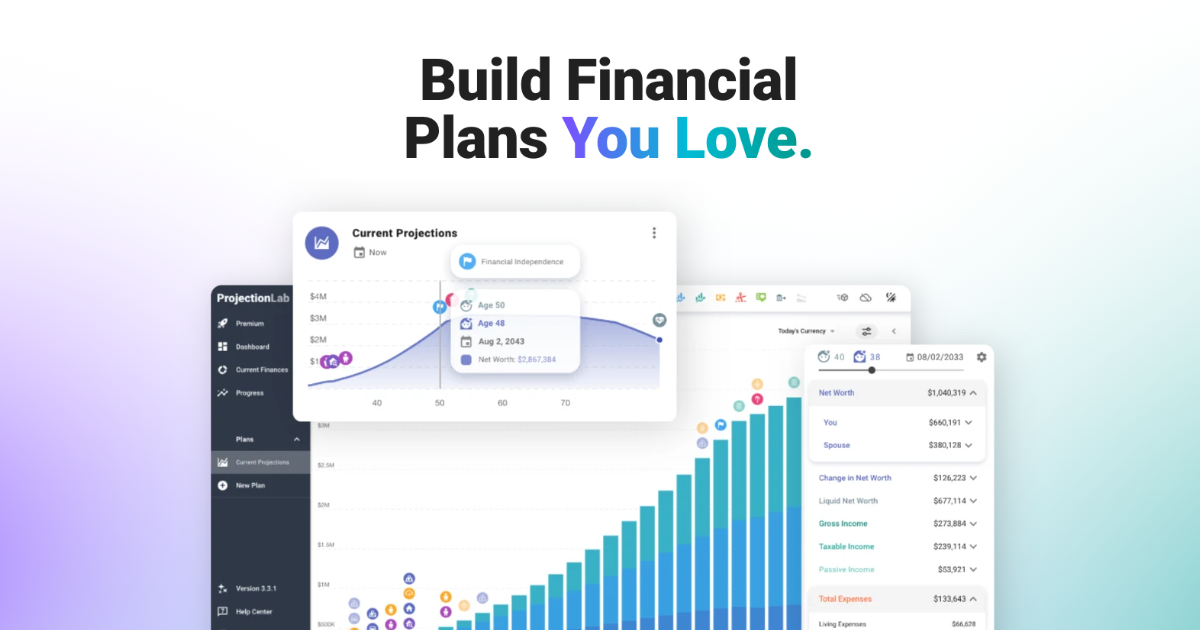
I like the idea of plans but they feel a bit bulky to use and you can't compare them. If you could directly compare plans against each other I think I would find it more useful. Also making them faster to create could be nice. I can change all the defaults in the actual view so why force me to go through the pages? I do like the stacked breakdown of each plan and the behind the scenes calculation of taxes, investing and inflation. [0]: https://gist.github.com/Rafael09ED/61568afa8a2308b53917915ee...
This is a fantastic tool but honestly my favorite part is that I can try what seems like most of the features without ever having to create an account and providing personally identifiable info that will inevitably lead to yet another mailing list for me to ignore. So thank you for having faith in your users!
Comments (255) 80 threads
Earlier commentsFor "Financial Goals", allow me to opt set a fixed number, not just a percentage of income (i.e, if I want to max out my 401k).
When inputting investments, instead of having a field for the sum of the different categories, have line items, so I can add my copy/paste my 401k, IRA, etc into the website without having to add them up myself.
Great work!
I realize that part of the problem is that it's hard for my brain to extrapolate a few months of observations into a decades-long trendline, but I really would love to see a product that helps my brain bridge the gap between my own perception and the big money chart.
That's probably why people serious about their money consult a professional, who has hopefully historical data at hand and in his head, who produces a forecast, each year, that is very tailored to the person, the person's personality, habits, job industry and many other important factors that a financial planer coded with if and else, avg and linear projection etc can't match. Maybe machine learning can get decent results of training properly on very good data sets.
And about most planners showing we will be millionaire in a few years, I'm tempted to say it's for the exact same reason demo data and screenshots for a CRM or analytics system always tend to display over optimist income/sales.
My first 5 years of full time employment with a salary, I was making enough to live comfortably and contribute to a 401K, and finances and investing aren't inherently interesting to me, so I didn't really think too much about the money accumulating in my savings account. The money definitely lost value over those 5 years because of inflation. I finally figured out how to put money into ETFs, and 5 years later that same amount of money has at least doubled in value. A lot of that probably has to do with the economy being crazy, but I suspect I missed out on a lot of compound growth not investing those savings initially. That is to say, my savings over time didn't look like a "PERT" plot until I took concrete steps (and the associated risks) to invest in the market.
Not to say that sitting on money or being slow to invest in higher growth accounts is good or bad. There's risk and everyone has their own personal risk tolerance, and diversification is important. If all you have is $5000, dumping it all into the stock market would seem pretty risky and perhaps foolish. That $5000 sitting in a checking or savings account is losing value over time rather than growing, though.
I suppose that could be another example of it being easier to live frugally when you have money, i.e. buying a $100 pair vs. $20 pair of work boots. On the other hand, many folk with very little savings still seem to find a way to buy luxuries like iphones and vacations. In addition to luck, personal discipline and sacrifice must factor in to some degree when it comes to achieving a financial goal.
I like the idea of plans but they feel a bit bulky to use and you can't compare them. If you could directly compare plans against each other I think I would find it more useful. Also making them faster to create could be nice. I can change all the defaults in the actual view so why force me to go through the pages?
I do like the stacked breakdown of each plan and the behind the scenes calculation of taxes, investing and inflation.
[0]: https://gist.github.com/Rafael09ED/61568afa8a2308b53917915ee...
All comments shown.
Couldn't load more comments. Check your connection and try again.