I've just looked into this, it seems Chrome displays that because of the "tabs" permission:
> "Technically this permission allows observing the history via chrome.tabs.onUpdated, but not read the previously existing history, so the phrasing is not entirely correct, strictly speaking." https://stackoverflow.com/questions/64063754/chrome-extensio... To be clear, the extension doesn't access your browsing history at all. The "tabs" permission is just used to find Wikipedia tabs and enable/disable the new design when using the toggle from the browser popup. The permissions requested (in the manifest.json file) are:
Note that you could also make it a bookmarklet which requires no permissions and only accesses the current tab when the user clicks it. Would be nice for trying out how it looks, given how little it changes I was expecting this would be a little bookmarklet and was a bit disappointed I had to add an extension to my browser for trying the look.
A bookmarklet would have to be clicked every time you open a new wikipedia page. I think it would be more productive to just fix the main permission issue (can view entire browsing history - author says in a comment they'll be fixing it). Chrome also lets you keep the extension inactive - you can easily activate it on-demand from the toolbar. If you do that on a minimal-permission extension, you have the equivalent of a bookmarklet.
FYI for any other extensions that do this, you can use the extension permissions to disallow them from running everywhere, and just give access to the site(s) where you want them to run. This doesn't require the devs to have done anything special — this functionality is built into Chrome. Weirdly, this is only available in Chromium browsers, not Firefox, at least last I checked.
one of the worst things about the current WP GUI is that when you hover over a hyperlinked word with the expectation that your anxious yearning for the definition of that word be fulfilled you're often forced to click through to the actual page, because the popup lacks a concise enough representation of that word, because the definition could not be contained within that small a space, or, the definition of the word succeeds some initial ramblings about the origins of the word, or of its inventors, which does not lead to me understanding the word and makes my WP deep dives less pleasurable.
I believe those texts are specifically set either on Wikidata, or via the template "short description" at the start of the article. Only where those are missing should it fall back to the beginning of the article text.
Certainly NLP could help here. In particular, there are two sub-areas concerned with document summarization and text simplification (e.g. remove relative clauses, split long/complex sentences), respectively, that could be useful in this case.
You may be interested to know that Wikipedia has a page dedicated to such redesigns[1]. Perhaps there are some to draw inspiration from. Regardless, maybe it would be worth contributing to the list.
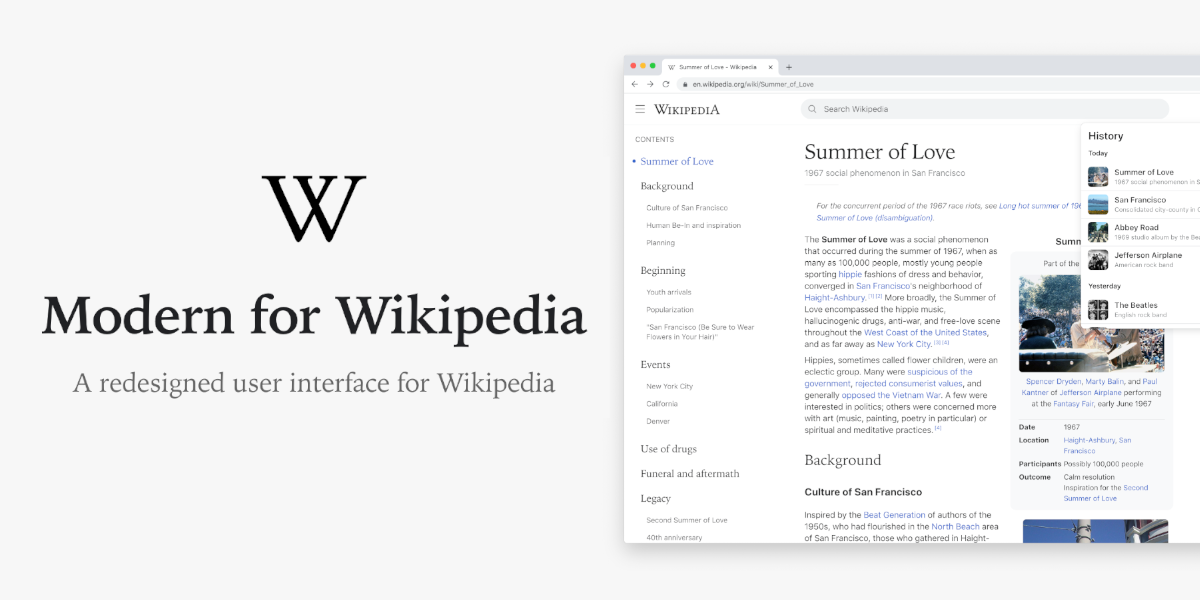
Thanks for that, I did actually come across that page during development when I was searching for redesign concepts. There's a few dead links there, but it seems redesigning Wikipedia is a very popular pursuit for designers as there are tons of designs out there (on dribbble etc). I've tried to incorporate all the best ideas from these into this extension, but I'm open to any suggestions for improvements! I will also try adding this one to the list.
Wikipedia is the one website that still has any value and actually serves the purpose of the web. Your website blocks me because I haven't enabled JS or disabled Tor or whatever, to prove I'm not a bot to fetch your front page which should take less resources than serving a captcha or JS check. Modern indeed.
Comments (409) 120 threads
Earlier comments> "Technically this permission allows observing the history via chrome.tabs.onUpdated, but not read the previously existing history, so the phrasing is not entirely correct, strictly speaking."
I will change that to "activeTab" in the next update which should fix it.https://stackoverflow.com/questions/64063754/chrome-extensio...
To be clear, the extension doesn't access your browsing history at all. The "tabs" permission is just used to find Wikipedia tabs and enable/disable the new design when using the toggle from the browser popup.
The permissions requested (in the manifest.json file) are:
I want WP to solve this with NLP.
[1]: https://en.wikipedia.org/wiki/Wikipedia:Unsolicited_redesign...
All comments shown.
Couldn't load more comments. Check your connection and try again.