One of my favorite engineering tech interview questions is asking an engineer how they think GPS works. You won't believe how many people start with: "Well, your cell phone sends a signal to the satellite......."
Amazing that even engineers don't understand that GPS receivers don't talk to the satellites.
I don't quite understand how such questions help in the hiring process? It reminds me of the famous "why are pothole covers round" question, still not sure what it achieves.
Actually this is a very good question for engineers, as the (wrong) idea that a smartphone regularly sends data to a satellite shows fundamental lack of knowledge in some very basic physical understanding. The basic understanding should be: transmitting/sending = emitting energy (costly if a device runs on batteries), receiving/listening for a signal = almost for free nowadays.
I also like the question because even if you have no idea how GPS actually works, you could quickly come up with the rough idea yourself given that you have a bunch of satellites that can emit arbitrary signals. Lots of room to show creative and analytical thinking here.
I have a hard time imagining engineers in any other field (e.g a structural engineer) would be getting asked questions about GPS as a proxy for general engineering knowhow.
> Actually this is a very good question for engineers
What kind of engineers are you interviewing? > I also like the question because even if you have no idea how GPS actually works, you could quickly come up with the rough idea yourself given that you have a bunch of satellites that can emit arbitrary signals. I find this really doubtful. Someone who doesn’t already understand how GPS works is unlikely to derive it from first principals in a brief interview.
Off the top of my head, I can think of a couple of things it tests for:
* Ability to reflect on and critique their own ideas, using technical common-sense. If someone has never had a reason to research or think too hard about how GPS works, then it might be reasonable to initially assume that it sends a signal to a satellite. But hopefully, when prompted to think about it a bit more, they would realize: "Hey, if that's true, then somehow these satellites that were launched in the 80's and 90's were able to scale up their capacity and handle orders of magnitude more demand, now that everyone has a smartphone in their pocket. Maybe that's not how it works?" * General curiosity and interest in areas outside their field of specialty. This might not be strictly necessary to get a job done, but it probably has some correlation with other measures of technical aptitude that are hard to probe directly.
> General curiosity and interest in areas outside their field of specialty. This might not be strictly necessary to get a job done, but it probably has some correlation with other measures of technical aptitude that are hard to probe directly.
I think this is a bit misguided, since the scope of things outside of a candidate's field of specialty is tremendously large. Picking a random piece of tech within that space and drilling the candidate about it seems rather unfair. A better way to handle this would be to actually ask the candidate about what else interests them outside of their specialty. But hey, maybe that doesn't stroke the interviewer's ego enough (:
You either find out the candidate knows how GPS works or you find out the candidate's willingness to say "I don't know".
It's valuable to know how someone will handle a question they don't know the answer to -- whether they recognize their own ignorance and whether they are willing to admit to it.
There are plenty of ways to get to the bottom of what a candidate knows without resorting to unreasonable questions. What you're really testing for is a candidate's patience for being toyed with.
This is going to come across as harsh, but if that is your favorite interviewing question, and you are not hiring GPS engineers, then it is a ridiculous question to ask and serves no purpose but to "haze" candidates.
I think it depends on the job. If this was for an embedded/firmware engineering position, I'd expect a level of EE knowledge that would at least make the concept of everyone's phone sending data to a satellite be a non-starter.
I think it's more relevant than asking an embedded engineer which sorting algorithm is the fastest.
I think you're unfairly assuming something about how the question was used.
If the intent was to find out if people __knew__ how GPS worked when they didn't need it for the position, sure. However I see two other possibilities: - How does a candidate react when they don't know something? Do they try to bullshit their way through? Do they admit it and ask what you'd like them to do? - Can a candidate, __with guidance__, come to a basic understanding of how GPS works and come up with a reasonable (note: not necessarily correct) suggestion for how to implement it?
I agree with the meta interview concept, but I don't think that applies here because of the OP's last sentence:
>Amazing that even engineers don't understand that GPS receivers don't talk to the satellites. They're amazed at the lack of knowledge, not that a candidate wasn't able to talk it out, or that they bs-ed through it. That tells me the question is asked in bad faith.
I'll firmly disagree. I find logic questions, and how they solve a problem vastly more important than other aspects of the interview.
I'm often looking for someone I can give a problem to and they return with a potential solution. That involves thinking through problems, how they work, how they can't work, etc. Asking someone how they think GPS works, or asking them a question about how they'd try to track down a defect based on what a customer is reporting to me are very important skill sets to have.
I assume the responses are from people who didn't know that and are now offended that they would've flubbed what the interviewer considered common knowledge in their field. I could see someone thinking it's not a relevant question for certain types of positions, but anyone getting defensive about it is a little bit of a red flag. Anyone doing development relying on location services or navigation systems should have a general baseline intuition for how those things work, even if it's only the broadest strokes. If someone feels angry about not knowing this, well congratulations, you now know this and no longer have anything to get defensive about.
You've received some flack for this, but I'm not sure the context. If most of the questions in this round are of this nature, then maybe it is a "why are manhole covers round" thing.
But as a one-off, and if asked in a forgiving way to explore how they think, then I'd consider this question valid. Maybe "Have you ever thought about how GPS works?"
if "yes", then let them explain,
if "no", then make it easy for them to start reasoning about the system and then see how they might design it. Seems to me as fair as asking "have you ever thought about how a double-linked list works?" or "a basic way to ensure database consistency when the DB is replicated at two different physical machines"? It's not like GPS is something esoteric that they are unlikely to have interacted with, odds are they used it to get to the interview location.
I don't understand why you think linked lists and db replication, which I think are both are very appropriate questions for a software engineer (less relevant to FE engs), are as relevant as how GPS works.
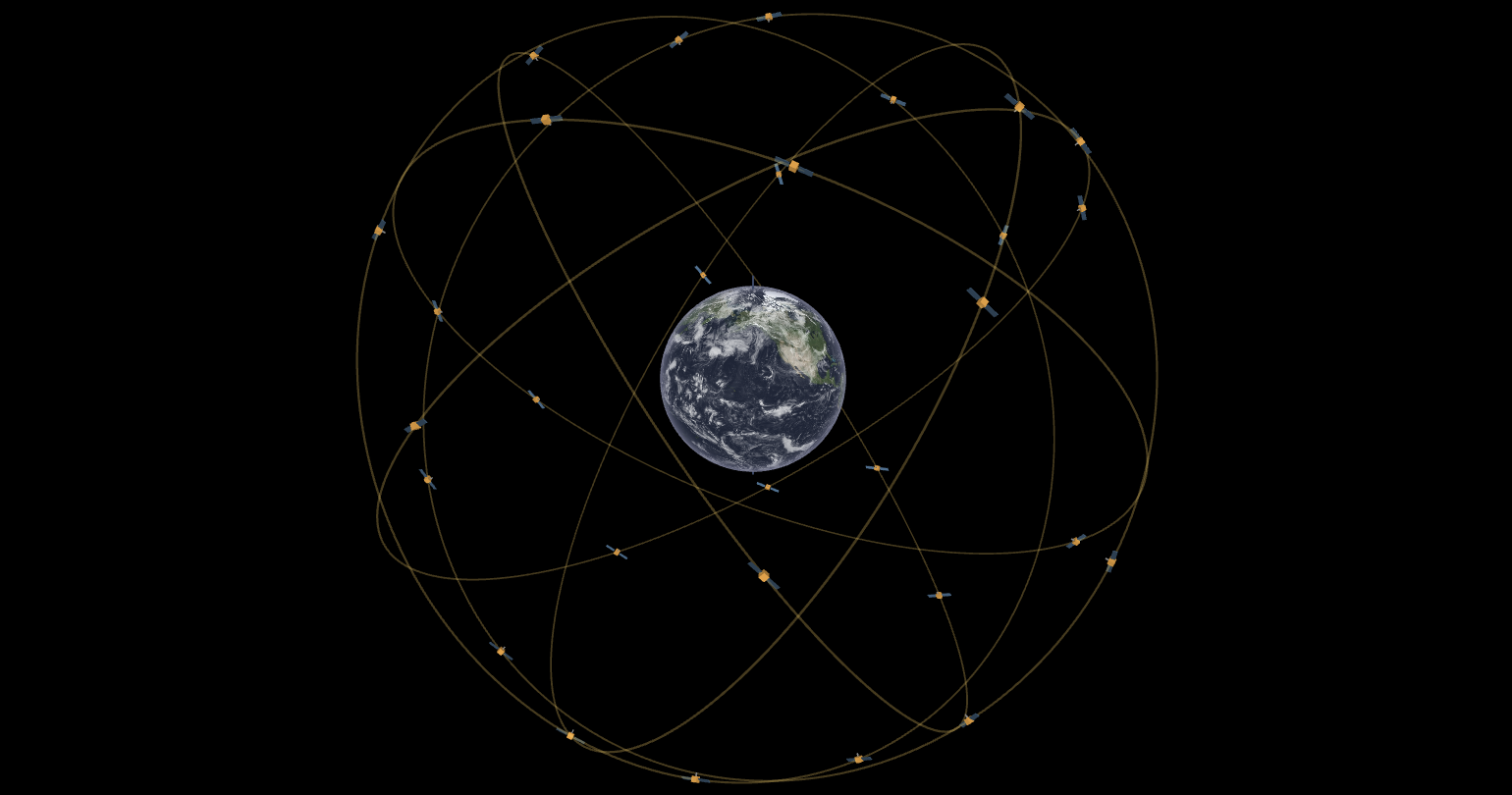
Considering GPS was originally created for military purposes, I find it fascinating that the largest holes are over the north and south poles. The northern polar region is where the US-launched missiles and bombers would travel. Does the lesser orbital coverage in that area not negatively affect GPS precision?
Bombers use a similar inertial guidance system, but with updates from GPS and star trackers as applicable. The reduced precision from GPS doesn't matter too much, as the inertial guidance systems are pretty good now.
A surprising number of ICBMs have used star trackers as well! It's somewhat surprising that ICBMs used star trackers before inertial guidance was sufficiently precise. The idea of an automated, high-precision star tracker is not so surprising today but back in the '60s it was quite an achievement.
I don't believe ICBM's are using GPS. They're programmed like they always have been and follow a very predictable path and don't change course (unlike hypersonic missiles). It's the "smart weapons" that are usually plane/ship dropped/launched that are gps guided as they are smaller munitions that have a much smaller blast radius and need to be more precise to be effective (as opposed to just carpet bombing the whole area). Those are "close" range weapons. You don't need to be very precise with an ICBM to obliterate the target, as it's usually city-sized. A mile off here or there will still destroy the target. Planes can and do still fly without GPS. There also haven't been too many wars involving the poles as basically no one lives there except science teams and no one wants the "land" as you can't do anything economically practical with it. Most of our ICBM's are still ancient Minuteman III's which were manufactured in the 1960's (my dad launched one in 68 out of Minot AFB, ND) and recently updated in 2015 to extend their useful life.
If you're interested in the implementation details of a home made GPS receiver, check out this fantastic writeup: http://www.aholme.co.uk/GPS/Main.htm.
They are operational and very compatible with GPS.
Modern devices have them all, the iPhone 13 for examples combines satellite data from GPS, BeiDou, GLONASS & Galileo. In practice, you get a "super-GPS", with way more satellites (120 vs GPS' 35) and great coverage. Potential accuracy can be in the cm's, it is all about software optimization. https://www.nature.com/articles/srep08328
Comments (285) 59 threads
Earlier commentsAmazing that even engineers don't understand that GPS receivers don't talk to the satellites.
Continue this thread — 6 replies
I also like the question because even if you have no idea how GPS actually works, you could quickly come up with the rough idea yourself given that you have a bunch of satellites that can emit arbitrary signals. Lots of room to show creative and analytical thinking here.
Continue this thread — 4 replies
What kind of engineers are you interviewing?
> I also like the question because even if you have no idea how GPS actually works, you could quickly come up with the rough idea yourself given that you have a bunch of satellites that can emit arbitrary signals.
I find this really doubtful. Someone who doesn’t already understand how GPS works is unlikely to derive it from first principals in a brief interview.
Continue this thread — 4 replies
* Ability to reflect on and critique their own ideas, using technical common-sense. If someone has never had a reason to research or think too hard about how GPS works, then it might be reasonable to initially assume that it sends a signal to a satellite. But hopefully, when prompted to think about it a bit more, they would realize: "Hey, if that's true, then somehow these satellites that were launched in the 80's and 90's were able to scale up their capacity and handle orders of magnitude more demand, now that everyone has a smartphone in their pocket. Maybe that's not how it works?"
* General curiosity and interest in areas outside their field of specialty. This might not be strictly necessary to get a job done, but it probably has some correlation with other measures of technical aptitude that are hard to probe directly.
I think this is a bit misguided, since the scope of things outside of a candidate's field of specialty is tremendously large. Picking a random piece of tech within that space and drilling the candidate about it seems rather unfair.
A better way to handle this would be to actually ask the candidate about what else interests them outside of their specialty. But hey, maybe that doesn't stroke the interviewer's ego enough (:
Continue this thread — 9 replies
It's valuable to know how someone will handle a question they don't know the answer to -- whether they recognize their own ignorance and whether they are willing to admit to it.
Continue this thread — 1 reply
I think it's more relevant than asking an embedded engineer which sorting algorithm is the fastest.
If the intent was to find out if people __knew__ how GPS worked when they didn't need it for the position, sure.
However I see two other possibilities:
- How does a candidate react when they don't know something? Do they try to bullshit their way through? Do they admit it and ask what you'd like them to do?
- Can a candidate, __with guidance__, come to a basic understanding of how GPS works and come up with a reasonable (note: not necessarily correct) suggestion for how to implement it?
>Amazing that even engineers don't understand that GPS receivers don't talk to the satellites.
They're amazed at the lack of knowledge, not that a candidate wasn't able to talk it out, or that they bs-ed through it. That tells me the question is asked in bad faith.
Continue this thread — 4 replies
I'm often looking for someone I can give a problem to and they return with a potential solution. That involves thinking through problems, how they work, how they can't work, etc.
Asking someone how they think GPS works, or asking them a question about how they'd try to track down a defect based on what a customer is reporting to me are very important skill sets to have.
Continue this thread — 1 reply
But as a one-off, and if asked in a forgiving way to explore how they think, then I'd consider this question valid.
Maybe "Have you ever thought about how GPS works?" if "yes", then let them explain, if "no", then make it easy for them to start reasoning about the system and then see how they might design it.
Seems to me as fair as asking "have you ever thought about how a double-linked list works?" or "a basic way to ensure database consistency when the DB is replicated at two different physical machines"?
It's not like GPS is something esoteric that they are unlikely to have interacted with, odds are they used it to get to the interview location.
Continue this thread — 2 replies
Continue this thread — 1 more reply
Continue this thread — 1 more reply
Bombers use a similar inertial guidance system, but with updates from GPS and star trackers as applicable. The reduced precision from GPS doesn't matter too much, as the inertial guidance systems are pretty good now.
Modern devices have them all, the iPhone 13 for examples combines satellite data from GPS, BeiDou, GLONASS & Galileo.
In practice, you get a "super-GPS", with way more satellites (120 vs GPS' 35) and great coverage. Potential accuracy can be in the cm's, it is all about software optimization.
https://www.nature.com/articles/srep08328
All comments shown.
Couldn't load more comments. Check your connection and try again.