Great work! This might be unpopular among the HN crowd, but I think you can monetize this further by bundling this with an advising service.
This idea of FIRE has been spreading beyond techies/Internet nerds and into other highly paid professionals like doctors. [0]. The main difference is that non-programmer professionals generally don't get a thrill out of min/max-ing financial projections. Such people might be willing to pay a few hundred dollars a year for someone to generate this kind of analysis with them and simply execute on it each year. Similar to how people pay for CPAs. My employer actually pays Goldman Sachs to provide a similar service for its employees (no commission, fiduciary advisors) but their tools suck compared to this. [0] For example https://www.whitecoatinvestor.com/, https://www.physicianonfire.com/
To an extent, I was hoping to support use cases like this with the Pro version I rolled out recently. But perhaps I'm currently more out of the loop than you envision, in the sense that I'm not actively pairing people with advisors and it's just a product that advisors can use if they want. What do you imagine a more "bundled" offering might look like?
Personal Capital actively prompt to try to set up a meeting pretty much every time you log in. They're hoping that you'll sign up for some active management stuff, or do they have a robo-investing option (I can't remember.)
At a certain net-worth, they'll start calling you on a regular basis trying to get you to do the same. It's all pretty annoying. Perhaps do that, and after a 6 months of so of calls and prompts, then offer to stop calling / prompting for $10 a month.
> some active management stuff, or do they have a robo-investing option (I can't remember.)
IIRC it's robo-investing. I got a pitch from them, and it was mostly "high expense ratio funds are bad, we put you in low cost funds with expense ratio of < .10% to save you money". "OK... but your expense fee is .90% of funds under management - this puts me at approximately 1%/year in fees." "But we're actively rebalancing 2x per year and we do tax loss harvesting". I was close to giving them a small $ to manage/test with, but backed out.
You’re not too far away. A simple next step is to directly connect me with an advisor who uses ProjectionLab. I bet financial planning is a competitive market and advisors would be willing to use your tool as a unique selling point, or even pay you for the leads you supply.
Another bundling is to help users execute on their projections, similar to how https://www.helloplaybook.com does with tax advantaged investing. More generally, I think there is an opportunity to market the product not as a tool (“ProjectionLab builds the best financial projections”) but as a solution to a problem (“ProjectionLab lets you retire early/plan to pay down your debt/buy a house”). I know you’re doing this as a side project and maybe what I’m suggesting is too startup-y. Best of luck either way, it’s a really great product.
To add, the non tech crowd doesn't really know or have the time to learn about investing. They just need someone to manage their finances. The advisory profession is alive mostly because of this. Instead of acting as a lead gen to advisors, perhaps you could add more value by doing some sort of filtering or match making based on user's data, totally at the discretion of the investor/user. This will be incredibly helpful. You could become some sort of a scaled arbitrage between investors and advisors - a huge gap that exists today.
Sounds like an interesting model. I wonder if it would come with any regulatory hurdles in addition to the technical work plus efforts to make inroads with enough advisors... and then I wonder if there's a way to advertise that kind of optional product offering without immediately turning off the contingent of privacy-focused DIYers that the tool currently resonates with.
the problem is that the type of advisors you are talking about only care about selling products and making commissions, they actually don't care about helping people make the right decisions.
the same goes for CPAs - the moment they see that your tax situation becomes too complicated or a potential liability or they can't make a good profit (read: cookie cutter tax situation which can be handled by fresh grads but can be invoiced at partner rate) they tell you to go elsewhere.
I've heard of fee-only financial advisors. They don't make commissions or skim percentage points off your portfolio, so their incentives should be more directly aligned to yours.
Any data yet on how that model tends to play out over the long-run in the average case? Off the cuff it does sound like incentives could be better aligned though.
I work with a local independent advisor, and while they do make money on commissions they've never advised me to go a direction that doesn't work just to buy a product, and their advice is worth every penny in fees that I pay on the money they manage (which is not most of my retirement dollars, just a small chunk, per their advice to keep it in low-fee funds.) In general I'd say find somebody you trust. Try to work local if you can.
Anyway, my advisor works via a larger "network" company that provides their white-label tools to run monte carlo sims, etc and game out retirement. None of them are this accessible / slick. Definitely something to this.
Any thoughts on the path you might take to approach that? As a solo dev building this as a side project currently, I don't exactly have a huge existing network of connections in the advisory space.
This is great, I took some time to get a fairly in depth plan together. There are two things that stuck out:
1. You've got RSU's (at first it wasn't clear to me where this would be addressed, but I think it made sense once I came across it) but I don't see a dedicated strategy for dealing with ISO/NSO's. That'd be helpful for the tech community especially. 2. I spent the 10-15 minutes working on a plan knowing that I'd need to upgrade to pro for every feature, but it seems like I need to upgrade to save my plan. I ended up not paying because I don't have enough time right now to fully evaluate this, but I might look back later. It would have been great if I could have entered my email and saved my plan without paying, and then had to later pay to access it. This gives you the benefit of getting my email address, and then sending me an email to access my plan so that I've got a second touchpoint to your product when I check my email in the future. Looking forward to using this more in depth in the future!
If you've still got your plan up, happy to give you an extended trial if you want!
But overall I think you're right on both points. I've been wanting to add better support for modeling options for a while; for anyone who'd like to bump priority there, feel free to upvote this item in changemap: https://changemap.co/projectifi/projectifi/task/5735-better-... For #2, I'll do some thinking to gauge level of effort in rigging up a mechanic like that with the current stack. Losing data sucks, and I should take more steps to reduce the chances of that happening to anyone in the onboarding funnel.
I could see allowing only localstorage saving with no option for exporting or importing of data being limiting enough for me personally to have enough reason to upgrade to pro, maybe limit the number of plans you can have (if you haven't already, I haven't tested it) as well as the number of times you can actually save to localstorage.
I liked this enough where I made a model during my lunch break, then remade it when I got home, and then remade it a third time after I had accidentally pressed the "back" button on my mouse talking to someone on Discord, taking me back to the landing page and losing all my data. After that last one I decided to at least get the free trial so I could save, but I had already planned pay for Premium so I wasn't too bothered.
How would you recommend enforcing a limit on number of localStorage saves? If the number was held in localStorage as well, that's easily circumvented, and even if the save number was stored in Firebase and associated with the auth ID for the account, seems to me like people could probably just create a new account as needed and adjust the localStorage content to match, with a few lines of JS.
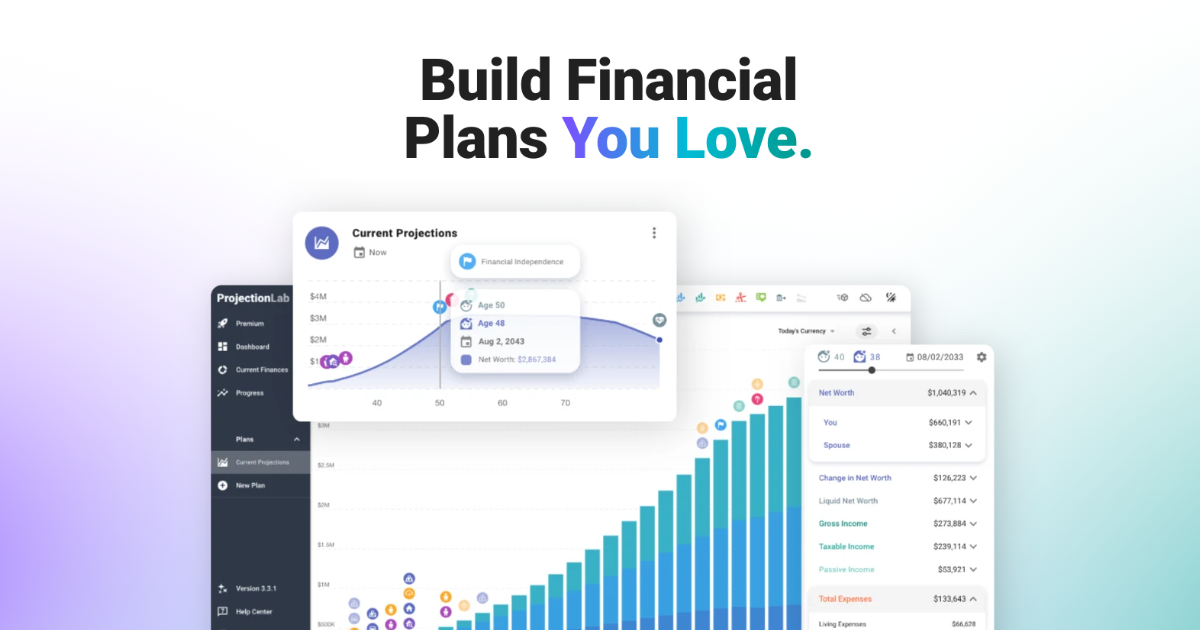
I'm so incredibly impressed with this tool. In addition to the slick interface, it has some killer features and niceties:
- You can add a "dependent expense" (have a kid) at a certain age - You can run Monte Carlo simulations of your portfolio performance - Expenses can be configured to increase linearly, with inflation, up to an amount, or using a custom function that the user can input graphically - Adding a house purchase automatically cancels out your existing rent expense if you indicate that it will be your residence - Easily visualize all of your projected earnings from portfolio growth and losses due to inflation and taxes As an avid YNAB-er, this is heaven.
Thanks a bunch! Mentioned this below, but as a YNAB user, if you find yourself looking for more options on things like cash-flow priorities, you can check out the early access version here where I just added a few for v3.0.1: https://projectifi-201a2--dev-xsmyy9im.web.app
It does seem like there are some pretty wild discrepancies in total comp between countries. If the distributed/remote trend continues progressing, I wonder if we'll see things start to equalize at all in our lifetimes, or if there are other geopolitical / macroeconomic / other factors that are more significant.
It should up to a point. A lot of high paying tech jobs are in regulated industries that sometimes have hard restrictions on who they're allowed to employ. For example, I know someone who works at Oracle Cloud and works on projects for the US DoD. For these projects Oracle is required to employ US citizens, perform background checks, and in some cases ensure those workers have clearance to work with classified information.
I suspect there are other high paying jobs/markets with similar restrictions. It'll be interesting to see how the dust settles over the next few years as geographical location within a country and without impacts the labor market.
I would hope so. I don't think that place of birth, or ability to get a visa should determine salary.
However, personal experience and friendship group makes me think that US tech salaries have only accelerated over the last couple of years. I went looking for some data to back up the idea to tech salaries have accelerated, but https://spectrum.ieee.org/engineer-salary was the best I found, and was less dramatic than I expected.
This is complicated. Taxes in the US are different. For example, a lot of higher earners are concentrated in California and New York, which have fairly high taxes; in New York or San Francisco a single person making $105k would take home about $75k (slightly less in SF, slightly more in NY) or about £3k more. I would suspect (but do not know) that the UK government pension and health-care is at least slightly better than the US version. On top of that, people of a given income level spend more in the US (either because things are actually more expensive, or people in the US are more spendthrift; probably a bit of both), so if you come to spend like a typical American[1] your savings won't necessarily be higher in the US. Bay area rent, in particular is insane (rent alone would be more than the £2k a month you proposed for expenses, though $105k/year in the bay area would be a very low salary for a bay-area tech worker). Now, you can do better. I have a friend who works as a DBA in a very inexpensive part of the country; he makes more than the $105k per year. In fact his yearly salary is higher than what he paid for his house. When remote became normal during COVID a lot of people moved to cheaper parts of the country while keeping their high salaries. Also, everything else being equal, a higher top-line will always provide more opportunities for savings 1: Before you dismiss this completely, there are real social costs to spending less than your peer group. IMO they are worth it, but they should be factored into any planning you do.
> For example, a lot of higher earners are concentrated in California and New York, which have fairly high taxes; in New York or San Francisco a single person making $105k would take home about $75k (slightly less in SF, slightly more in NY) or about £3k more.
That's income taxes; states aren't that different when you actually count "taxes" ie property, sales, income, and whatever else is left over. Texas is theoretically a little worse for the middle class because property taxes are much higher. It's better if you're rich though.
> Texas is theoretically a little worse for the middle class because property taxes are much higher. It's better if you're rich though.
I know they are higher in relative terms, but are they higher in absolute terms? I live in a single-family house in SoCal and pay over $12k/year in property taxes. [edit] absolute <-> relative
Comments (234) 54 threads
This idea of FIRE has been spreading beyond techies/Internet nerds and into other highly paid professionals like doctors. [0]. The main difference is that non-programmer professionals generally don't get a thrill out of min/max-ing financial projections.
Such people might be willing to pay a few hundred dollars a year for someone to generate this kind of analysis with them and simply execute on it each year. Similar to how people pay for CPAs. My employer actually pays Goldman Sachs to provide a similar service for its employees (no commission, fiduciary advisors) but their tools suck compared to this.
[0] For example https://www.whitecoatinvestor.com/, https://www.physicianonfire.com/
At a certain net-worth, they'll start calling you on a regular basis trying to get you to do the same.
It's all pretty annoying. Perhaps do that, and after a 6 months of so of calls and prompts, then offer to stop calling / prompting for $10 a month.
IIRC it's robo-investing. I got a pitch from them, and it was mostly "high expense ratio funds are bad, we put you in low cost funds with expense ratio of < .10% to save you money".
"OK... but your expense fee is .90% of funds under management - this puts me at approximately 1%/year in fees."
"But we're actively rebalancing 2x per year and we do tax loss harvesting".
I was close to giving them a small $ to manage/test with, but backed out.
Continue this thread — 3 replies
Another bundling is to help users execute on their projections, similar to how https://www.helloplaybook.com does with tax advantaged investing.
More generally, I think there is an opportunity to market the product not as a tool (“ProjectionLab builds the best financial projections”) but as a solution to a problem (“ProjectionLab lets you retire early/plan to pay down your debt/buy a house”).
I know you’re doing this as a side project and maybe what I’m suggesting is too startup-y. Best of luck either way, it’s a really great product.
Continue this thread — 4 replies
the same goes for CPAs - the moment they see that your tax situation becomes too complicated or a potential liability or they can't make a good profit (read: cookie cutter tax situation which can be handled by fresh grads but can be invoiced at partner rate) they tell you to go elsewhere.
Anyway, my advisor works via a larger "network" company that provides their white-label tools to run monte carlo sims, etc and game out retirement. None of them are this accessible / slick. Definitely something to this.
1. You've got RSU's (at first it wasn't clear to me where this would be addressed, but I think it made sense once I came across it) but I don't see a dedicated strategy for dealing with ISO/NSO's. That'd be helpful for the tech community especially.
2. I spent the 10-15 minutes working on a plan knowing that I'd need to upgrade to pro for every feature, but it seems like I need to upgrade to save my plan. I ended up not paying because I don't have enough time right now to fully evaluate this, but I might look back later. It would have been great if I could have entered my email and saved my plan without paying, and then had to later pay to access it. This gives you the benefit of getting my email address, and then sending me an email to access my plan so that I've got a second touchpoint to your product when I check my email in the future.
Looking forward to using this more in depth in the future!
But overall I think you're right on both points. I've been wanting to add better support for modeling options for a while; for anyone who'd like to bump priority there, feel free to upvote this item in changemap: https://changemap.co/projectifi/projectifi/task/5735-better-...
For #2, I'll do some thinking to gauge level of effort in rigging up a mechanic like that with the current stack. Losing data sucks, and I should take more steps to reduce the chances of that happening to anyone in the onboarding funnel.
I liked this enough where I made a model during my lunch break, then remade it when I got home, and then remade it a third time after I had accidentally pressed the "back" button on my mouse talking to someone on Discord, taking me back to the landing page and losing all my data.
After that last one I decided to at least get the free trial so I could save, but I had already planned pay for Premium so I wasn't too bothered.
- You can add a "dependent expense" (have a kid) at a certain age
- You can run Monte Carlo simulations of your portfolio performance
- Expenses can be configured to increase linearly, with inflation, up to an amount, or using a custom function that the user can input graphically
- Adding a house purchase automatically cancels out your existing rent expense if you indicate that it will be your residence
- Easily visualize all of your projected earnings from portfolio growth and losses due to inflation and taxes
As an avid YNAB-er, this is heaven.
The top 5% salary in the UK is £81,000 -> after tax is £54,817. £4568 a month. Say you spend £2k a month. That's £2568 for investments per month. Using the calc, it seems you would be able to retire at age 50.
I quickly checked the US salary percentiles and the top 5th percentile of £81,000 in the UK is equal to the top 15th in the US. Thats 3x ceiling you could climb through not to mention taxes in the US are much much better?
Am I crazy?
https://www.gov.uk/government/statistics/percentile-points-f... https://www.thesalarycalculator.co.uk/salary.php https://dqydj.com/average-median-top-individual-income-perce...
I suspect there are other high paying jobs/markets with similar restrictions. It'll be interesting to see how the dust settles over the next few years as geographical location within a country and without impacts the labor market.
However, personal experience and friendship group makes me think that US tech salaries have only accelerated over the last couple of years. I went looking for some data to back up the idea to tech salaries have accelerated, but https://spectrum.ieee.org/engineer-salary was the best I found, and was less dramatic than I expected.
Continue this thread — 1 reply
This is complicated. Taxes in the US are different. For example, a lot of higher earners are concentrated in California and New York, which have fairly high taxes; in New York or San Francisco a single person making $105k would take home about $75k (slightly less in SF, slightly more in NY) or about £3k more. I would suspect (but do not know) that the UK government pension and health-care is at least slightly better than the US version.
On top of that, people of a given income level spend more in the US (either because things are actually more expensive, or people in the US are more spendthrift; probably a bit of both), so if you come to spend like a typical American[1] your savings won't necessarily be higher in the US. Bay area rent, in particular is insane (rent alone would be more than the £2k a month you proposed for expenses, though $105k/year in the bay area would be a very low salary for a bay-area tech worker).
Now, you can do better. I have a friend who works as a DBA in a very inexpensive part of the country; he makes more than the $105k per year. In fact his yearly salary is higher than what he paid for his house. When remote became normal during COVID a lot of people moved to cheaper parts of the country while keeping their high salaries. Also, everything else being equal, a higher top-line will always provide more opportunities for savings
1: Before you dismiss this completely, there are real social costs to spending less than your peer group. IMO they are worth it, but they should be factored into any planning you do.
That's income taxes; states aren't that different when you actually count "taxes" ie property, sales, income, and whatever else is left over.
Texas is theoretically a little worse for the middle class because property taxes are much higher. It's better if you're rich though.
I know they are higher in relative terms, but are they higher in absolute terms? I live in a single-family house in SoCal and pay over $12k/year in property taxes.
[edit] absolute <-> relative
Continue this thread — 5 replies
Source on the all-inclusive assessment? I am familiar with Texas and California and New York. One of these things is not like the others.
All comments shown.
Couldn't load more comments. Check your connection and try again.