The philosophy of technology behind this is fascinating. The need is
the clearest case of non-functional requirements I have ever
seen. When a process owner brazenly does not care about the outcome,
but cares only about forcing people to go through their arbitrary
steps, it is to stamp their seal of authority and control upon the
other.
As Bill Hicks says "Hey, pretend like you're working!" Everything else is post-facto rationalisation. In other words, they'll
dream up anything as a way to explain why you have to conform to
their process, variously invoking "standard practice", "regulation",
"security", with total disregard for the truth. It is the process
with which they identify vicariously, are attached to, and are obliged
to defend. The process owns them. As for the solution. Funny as it is, it's an example of tragic new
realm of digital technology whose purpose is to fake human agency, and
create desired appearance over any actual reality. I'm not just talking about spambots, or automated essay mills for
students to buy their way to a degree one cheat at a time. These are
what Douglas Adams called "Electric Monks". They believe in make-work
bullshit so that real people don't have to. This is the future of AI,
the adversarial workplace, a technological arms race around make-work
wage-slavery which creates no tangible economic value; avatars that
stand in for people remote working so they can sunbathe in the
garden... like that little pecking bird that Homer Simpson gets to run
the nuclear plant by pecking on the Y key. Whoever can afford the best Electric Monks wins the game, because they
will be able to free their attention for real life. edit: italics
Great commentary. I'd add shamelessly that whoever can _build_ the best electric monks dominates the game. The price of developing them will be miniscule.
Really hoping AI ushers us into the resource based economy where humans are freed from rudimentary labor.
> We have a word for it within the domain of philosophy and
literature: Kafkaesque.
I was thinking of something a little different and even considered
specifically excluding Kafka and indeed Weber (I've read a lot of
Franz Kafka but am a Cliffs Notes imposter on Max Weber) from my
comment. In The Trial, or Before the Law, the anxiety lies in not knowing the
mind of a, possibly ambivalent, judging other. In modernity, Weber's
modernity, it is spelled out in intricate, mind numbing detail, in
reams of forms that must be gymnastically navigated. One step further
in the direction I am describing is the officers of Jaroslav Hasek's
Good Soldier Svejk In this incarnation bureaucracy is not an
all-powerful force to be feared, it is a stumbling, stuttering,
inconsistent fool of a thing that can be easily tricked. It brings
tedium not anxiety. I'll wager many hackers relate to that experience
of encountering systems. That is what I mean by the vision of AI versus AI. Two broken retarded
robots sprawling about in the mud while humans gather around in a
circle and laugh. But the last laugh is on us for building them and
getting enchanted by the spectacle.
I've actually never seen the phenomenon through this lens, but I like it!
I think the clearest indicator that this is going on is when you can circumvent the process arbitrarily. Two example memories spring to mind: In a visa office: "fill out form X, you can get one from the table over there" / "There are none left" / "OK never mind give me your passport and I'll stamp it". At my Big Tech employer: "please fill out this document template detailing the update and version history of your service, for an audit" / "really? This looks time consuming and I don't really understand the the reason why you need it" / "OK, never mind then" (Actually, at Big Tech I have found that replying along the lines of "really though?" is a very good first response when confronted with Processes. Sometimes when reporting bugs the template asks you to e.g. gather traces with browser extensions or whatever. I always say "I will do that if you first confirm that it will actually be useful for this bug" and haven't yet received such a confirmation)
But there is something about the aesthetic of such things, it's why the IETF RFC's (example https://www.rfc-editor.org/rfc/rfc8200.html) are made to look like typewritten pages even decades after typewriters stopped being in common usage. I am surprised that they don't "go all the way" with that look and also apply some simulated coffee stains, dog-ears, and stapling artifacts.
No man, it's a deliberate look which sacrifices readability for some kind of retro-aesthetic whether they admit it or not. It's easy enough to reference things by section numbers.
And really, if they cared about being able reference things to the n-th degree, the figures would have been captioned and have their own figure-number instead of just sort-of "in there" like a paragraph (https://www.rfc-editor.org/rfc/rfc8200.html#section-4.4).
A Tulane student got a bunch of funding because he developed a stand-in for folks for zoom meetings. Logs in, records, transcribes, the works. He developed it so he wouldn’t have to attend lectures during Covid. What you’re describing reminds me of this project.
Hey man you were the one with that brilliant write up. I saved your comment to review again later. Incredibly insightful stuff. Already passed it to a few coworkers.
I found this GIMP tutorial several years ago and have used this method ever since. I insert my signature into PDF documents using the stamp tool, unless the software has a more sophisticated method.
OSX's Preview allows you to import your signature by writing in on a white notecard or similar and holding it up the webcam. It then stores a vectorized version which can be added to PDFs.
I did it once with GIMP, and apply it every time with xournal. In my experience people do not really require that the PDF looks printed and scanned, so I never cared about that aspect.
I scanned a signature and set of initials, traced them in Illustrator to neaten them up, colored the ink blue and blurred the lines a little in Photoshop, then saved with transparent backgrounds in a couple of formats. PNG and TIF are the ones I mainly use.
In my ancient version of Acrobat I created rubber stamps from the PNGs. Two clicks to drop them in, a quick resize and adjust the placement, and Bob’s your uncle. Never need a pen again.
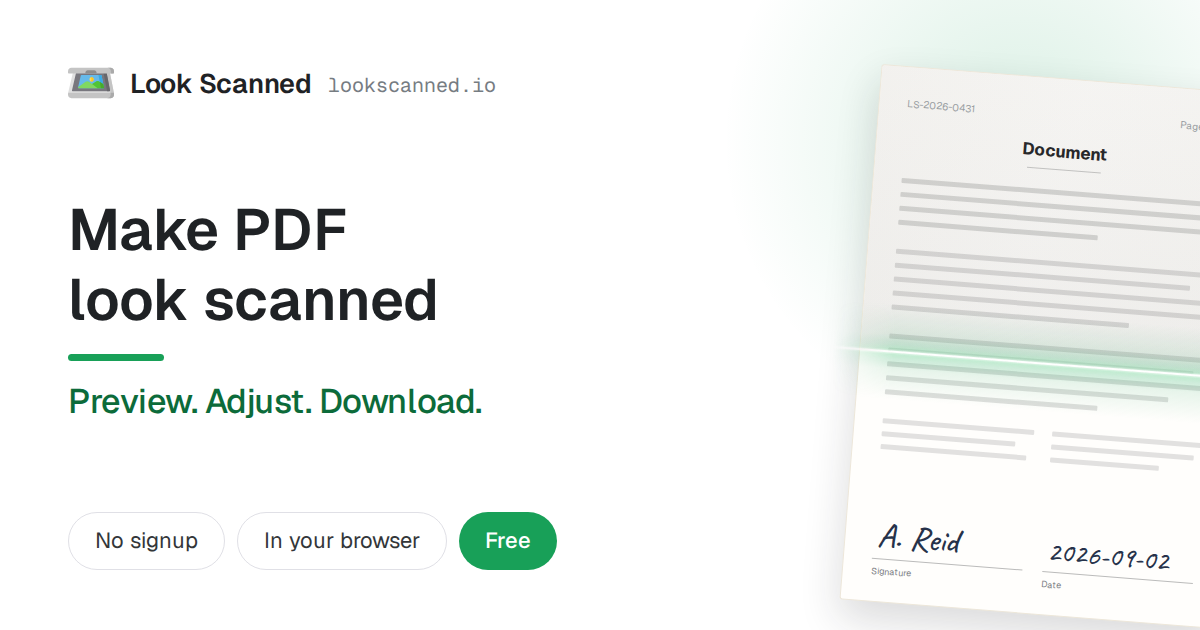
I'll reiterate what I said there: I think there's a legal angle here that should probably be sorted out by lawyers & forensics experts before something like this goes into widespread use or gets marketed at professional scale. The law sometimes requires certain documents to be "in writing" and there is, unfortunately, a legal tradition tied to this that "in writing" means "physically on paper", which lawmakers and bureaucrats unfortunately haven't managed to properly transition into the digital age. However something that is quite a separate matter is the question of whether one needs to actually be in possession of that piece of paper. A scan of an original serves as proof that the original exists. ...and this is usually all that anyone requires for practical intents and purposes. But: You're not supposed to do print/sign/scan, and then just throw away the original or not have an original in the first place. You're kind of supposed to keep it in case you're ever asked by a court to produce it. The document partially loses its forensic value if no original can be produced. Even worse: If a digital forensics expert can prove in court that a piece of digital forensics came from this tool, it may no longer be possible to distinguish a scenario where you used it in good faith because you didn't have a scanner on hand versus a scenario involving fraud where a third party used a scan of your signature plus this tool to create the appearance that you signed and scanned a document that you never did in fact sign. Or it could be alleged that you might have deliberately used this tool instead of signing the document for real to deliberately engineer deniability into this piece of digital forensics based on the previous line of reasoning. Personally, I'd advise anyone to just keep their distance from these sorts of tools. And writing/using the tool as a web service where people upload documents instead of downloading the tool seems like an especially bad idea. Why take the risk of exposing presumably sensitive documents to a third party?
Comments (177) 49 threads
Earlier commentsAs Bill Hicks says "Hey, pretend like you're working!"
Everything else is post-facto rationalisation. In other words, they'll dream up anything as a way to explain why you have to conform to their process, variously invoking "standard practice", "regulation", "security", with total disregard for the truth. It is the process with which they identify vicariously, are attached to, and are obliged to defend. The process owns them.
As for the solution. Funny as it is, it's an example of tragic new realm of digital technology whose purpose is to fake human agency, and create desired appearance over any actual reality.
I'm not just talking about spambots, or automated essay mills for students to buy their way to a degree one cheat at a time. These are what Douglas Adams called "Electric Monks". They believe in make-work bullshit so that real people don't have to. This is the future of AI, the adversarial workplace, a technological arms race around make-work wage-slavery which creates no tangible economic value; avatars that stand in for people remote working so they can sunbathe in the garden... like that little pecking bird that Homer Simpson gets to run the nuclear plant by pecking on the Y key.
Whoever can afford the best Electric Monks wins the game, because they will be able to free their attention for real life.
edit: italics
Really hoping AI ushers us into the resource based economy where humans are freed from rudimentary labor.
I was thinking of something a little different and even considered specifically excluding Kafka and indeed Weber (I've read a lot of Franz Kafka but am a Cliffs Notes imposter on Max Weber) from my comment.
In The Trial, or Before the Law, the anxiety lies in not knowing the mind of a, possibly ambivalent, judging other. In modernity, Weber's modernity, it is spelled out in intricate, mind numbing detail, in reams of forms that must be gymnastically navigated. One step further in the direction I am describing is the officers of Jaroslav Hasek's Good Soldier Svejk In this incarnation bureaucracy is not an all-powerful force to be feared, it is a stumbling, stuttering, inconsistent fool of a thing that can be easily tricked. It brings tedium not anxiety. I'll wager many hackers relate to that experience of encountering systems.
That is what I mean by the vision of AI versus AI. Two broken retarded robots sprawling about in the mud while humans gather around in a circle and laugh. But the last laugh is on us for building them and getting enchanted by the spectacle.
I think the clearest indicator that this is going on is when you can circumvent the process arbitrarily. Two example memories spring to mind:
In a visa office: "fill out form X, you can get one from the table over there" / "There are none left" / "OK never mind give me your passport and I'll stamp it".
At my Big Tech employer: "please fill out this document template detailing the update and version history of your service, for an audit" / "really? This looks time consuming and I don't really understand the the reason why you need it" / "OK, never mind then"
(Actually, at Big Tech I have found that replying along the lines of "really though?" is a very good first response when confronted with Processes. Sometimes when reporting bugs the template asks you to e.g. gather traces with browser extensions or whatever. I always say "I will do that if you first confirm that it will actually be useful for this bug" and haven't yet received such a confirmation)
But there is something about the aesthetic of such things, it's why the IETF RFC's (example https://www.rfc-editor.org/rfc/rfc8200.html) are made to look like typewritten pages even decades after typewriters stopped being in common usage. I am surprised that they don't "go all the way" with that look and also apply some simulated coffee stains, dog-ears, and stapling artifacts.
Form should match the shape of the medium, not fight it.
Continue this thread — 2 replies
And really, if they cared about being able reference things to the n-th degree, the figures would have been captioned and have their own figure-number instead of just sort-of "in there" like a paragraph (https://www.rfc-editor.org/rfc/rfc8200.html#section-4.4).
It’s also called “Buelr,” which really captures the energy of what you’re talking about.
https://finance.yahoo.com/news/ferris-bueller-inspired-produ...
Brilliant. Thanks for that. Exactly the kind of thing I'm thinking of.
https://www.youtube.com/watch?v=efAOsvfi4sU
See my note above re blurring the lines a little in Photoshop.
In my ancient version of Acrobat I created rubber stamps from the PNGs. Two clicks to drop them in, a quick resize and adjust the placement, and Bob’s your uncle. Never need a pen again.
I'll reiterate what I said there: I think there's a legal angle here that should probably be sorted out by lawyers & forensics experts before something like this goes into widespread use or gets marketed at professional scale.
The law sometimes requires certain documents to be "in writing" and there is, unfortunately, a legal tradition tied to this that "in writing" means "physically on paper", which lawmakers and bureaucrats unfortunately haven't managed to properly transition into the digital age.
However something that is quite a separate matter is the question of whether one needs to actually be in possession of that piece of paper. A scan of an original serves as proof that the original exists. ...and this is usually all that anyone requires for practical intents and purposes.
But: You're not supposed to do print/sign/scan, and then just throw away the original or not have an original in the first place. You're kind of supposed to keep it in case you're ever asked by a court to produce it. The document partially loses its forensic value if no original can be produced.
Even worse: If a digital forensics expert can prove in court that a piece of digital forensics came from this tool, it may no longer be possible to distinguish a scenario where you used it in good faith because you didn't have a scanner on hand versus a scenario involving fraud where a third party used a scan of your signature plus this tool to create the appearance that you signed and scanned a document that you never did in fact sign. Or it could be alleged that you might have deliberately used this tool instead of signing the document for real to deliberately engineer deniability into this piece of digital forensics based on the previous line of reasoning.
Personally, I'd advise anyone to just keep their distance from these sorts of tools.
And writing/using the tool as a web service where people upload documents instead of downloading the tool seems like an especially bad idea. Why take the risk of exposing presumably sensitive documents to a third party?
All comments shown.
Couldn't load more comments. Check your connection and try again.