This is random, but a lot of these parts exist because of the way it is constructed.
I wonder how minimal this kind of watch could be if you had a unrealistically accurate 3d printer and the design was essentially optimal (done by machine learning perhaps).
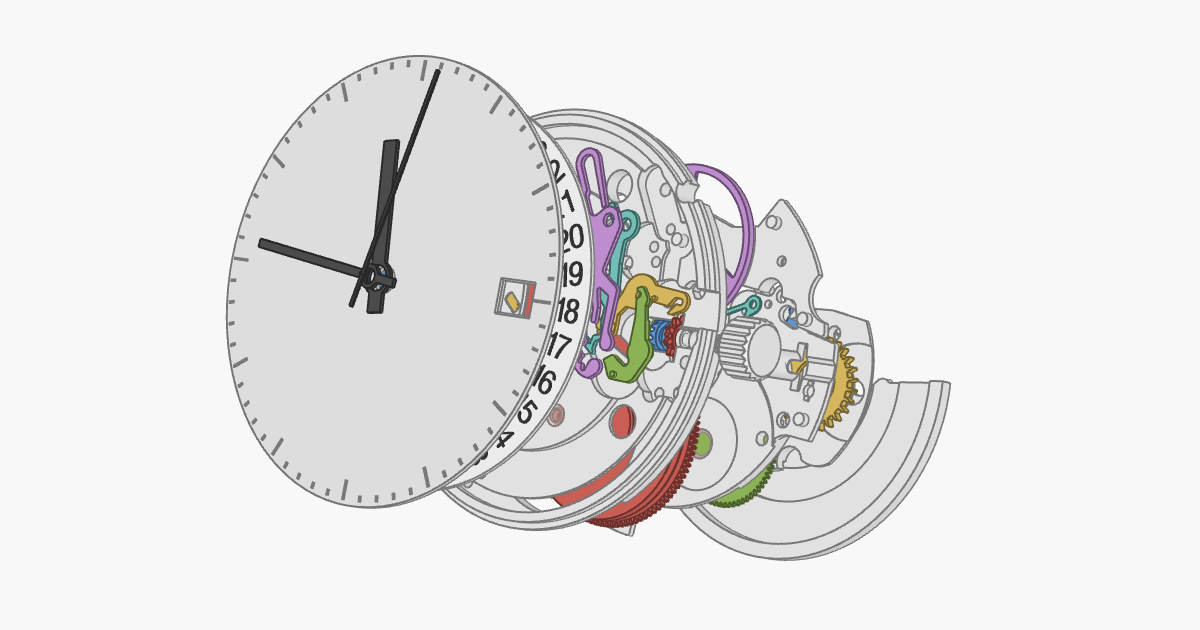
Wow, I didn’t expect I would read all that but the visualization was so great and made it easy to follow, I learned more about mechanical watches than I ever thought I would!
If every subject could have visualization like this I could learn anything!
A few months back I stumbled upon a YouTube video of a watch maker servicing a mechanical watch. This started a mild obsession with watch making and I've been watching these videos ever since. For anyone interested, here's an awesome video [1] of a guy putting together a watch and explaining how all 60 parts of a typical mechanical watch work together (by the way the tools he uses are as cool as the movements themselves). It's surprisingly easy to follow for a noobie.
As usual Bartosz with another extremely high quality post, I have one question, in this bit:
> However, when the driving gear can’t rotate because it’s blocked by the rest of the gear train, the cannon pinion can overpower the friction of that tight fit and rotate on its own. This lets us set time without interfering with the gear train, which could break the delicate parts. How can the cannon pinion (green) both overpower the friction to slide freely and also be attached to the driving gear (blue) when functioning regularly? Does this imply that the driving gear and cannon pinion wear each other out every time you adjust the time?
Comments (413) 108 threads
Earlier commentsI wonder how minimal this kind of watch could be if you had a unrealistically accurate 3d printer and the design was essentially optimal (done by machine learning perhaps).
If every subject could have visualization like this I could learn anything!
[1] https://www.youtube.com/watch?v=hkK6e4tb5Qk
> However, when the driving gear can’t rotate because it’s blocked by the rest of the gear train, the cannon pinion can overpower the friction of that tight fit and rotate on its own. This lets us set time without interfering with the gear train, which could break the delicate parts.
How can the cannon pinion (green) both overpower the friction to slide freely and also be attached to the driving gear (blue) when functioning regularly?
Does this imply that the driving gear and cannon pinion wear each other out every time you adjust the time?
All comments shown.
Couldn't load more comments. Check your connection and try again.