Show HN: I built my own PM tool after trying Trello, Asana, ClickUp, etc. (opens in a new tab)upbase.io
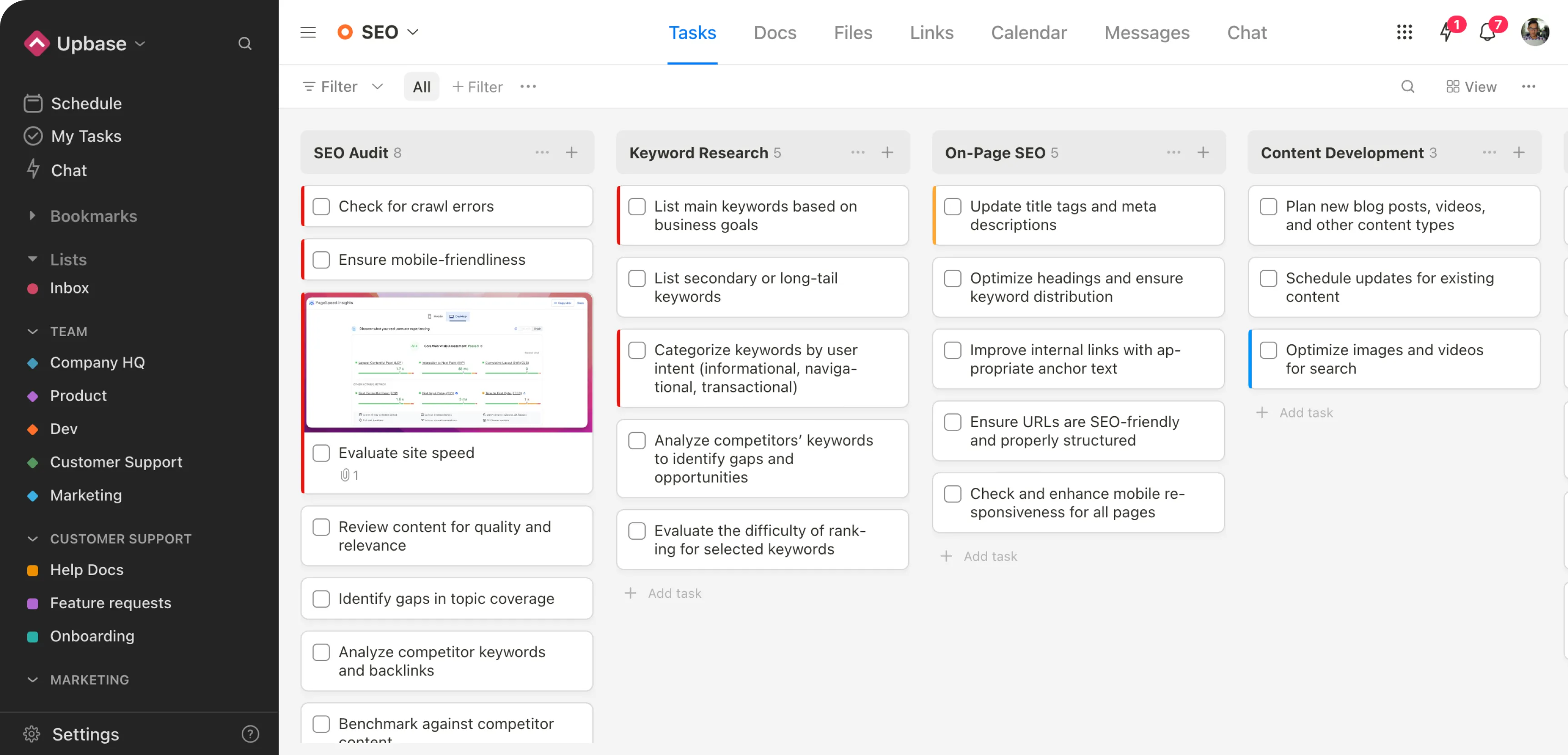
632 pointsOver the past two years, I've been building Upbase, an all-in-one PM tool.
I've tried so many project management tools over the years (Trello, Asana, ClickUp, Teamwork, Wrike, Monday, etc.) but they've all fallen short. Most of them are overly complicated and painful to use. Some others, like Trello, are too limited for my needs.
Most importantly, most of these tools tend to be focused on team collaboration and completely ignore personal productivity.
They are useful for organizing my work, but not great at helping me stay focused to get things done.
That's why I decided to build Upbase.
I try to make it clean and simple, without all the bells and whistles. Apart from team collaboration, I added many personal productivity features, including Weekly/Daily planner, Time blocking, Pomodoro Timer, Daily Journal, etc. so I don't need another to-do list app.
Now I can use Upbase to collaborate with my team AND manage your personal stuff at the same time, without all the bloat.
If these resonate with you, then give Upbase a try. It has a Free Forever plan though.
Let me know if you have any feedback or questions!
Comments (453) 118 threads
Earlier commentsSorry, I've been burned enough times by this now that if your software is not FOSS, I'm not deploying it. Your take is not a good look.
For an open source alternative, check out Focalboard [0]. Note however it is backed by a for-profit company, but the code is open and can be compiled from source (so you can thus remove all telemetry and paid upsell nonsense).
[0] https://github.com/mattermost/focalboard
https://github.com/mattermost/focalboard/issues/1507
I am not sure whether the reasoning is mostly from a concern over IP theft perspective or piracy, but I would consider looking into whether you think you could sustain a self-hosted version in the future.
I think legitimate competitors tend to be unwilling to take the risk reverse engineering things and directly stealing your product. And legitimate businesses also tend not to be willing to take the risk of being audited and getting caught using pirated software, …or, actually, maybe…. story on that later ;-) [1]
And I will probably lose you here, but I would also consider whether a FOSS model could work for you; there are a number of open-source/open-core/semi-opensource services that are seemingly viable commercial products. One example might be GitLab, and another would be Drone CI.
Perhaps consider whether you could survive, and potentially be even more profitable, by doing something like offering the platform as a self-hosted, opensource service, ideally under something like the AGPL, and then require contributors to dual-license their contributions under the AGPL and an incredibly permissive license (e.g., ISC, BSD of some sort, MIT, Unlicense, etc — pick whatever).
This model would allow you guys do opensource the core for the paranoid among us while also preventing any realistic competitors from swooping in and yoinking your hard work for their own financial gain, since they’d likely not be willing to integrate AGPL code into their service.
And by requiring contributions to be dual-licensed under an incredibly permissive license, this’d essentially grant you the same benefits of having contributions sign a properly evil CLA that demands all copyright be transferred to you, etc (e.g., an open-core like GitLab, where you could upsell people on proprietary enterprise features) without the need to drive away potential contributors by being extra evil.
I think this may not even be that awful of an idea, in the sense that:
- A. I think many proper companies that would be big spenders also would rather delegate all the responsibility to you
- B. while I don’t love opencore as opposed to truly fully FOSS, many do seem to be willing to pay
- C. Ultra-broke indie devs, hacker types, etc, many who likely would not pay in the first place, and many of whom may not be willing to use non-FOSS stuff would still be increasing your mindshare, potentially contributing back, etc — free advertising, essentially.
As an example, I cannot count how many times I have heard users of opensource BitWarden praise it everywhere they get a chance, to the point to where I finally caved and decided to give it a try in order to get my parents to stop forgetting their passwords to everything.
And when I did, I actually did not use the FOSS version, despite being the type personally who would have normally; I just didn’t want to add yet another thing I needed to potentially help other people maintain, so it was worth paying.
- D. Lastly, I think it is good PR and branding. Cloud services change all the time. It adds a nice bit of trust knowing that you can only screw up the service so badly before someone decides to just fork.
Don’t take this too harshly, please, because I actually do think the service looks really good, and I do admire and respect the fact such a small team put in the grind to manage to launch it. And I plan to go pay for the lifetime service once I finish up this message.
But that said, man, being truthful, there are a lot of tiny software startups that offer pretty, polished cloud applications, and there are a lot of tiny startups that initially offer “unlimited” plans and “lifetime” subscriptions.
Yet, maybe this is my overly cynical take, but here is what always happens:
- either you simply decide eventually that it’s not worth the money to retain these lifetime users anymore, so you tell tell them that their lifetime service isn’t really lifetime, or you end up taking VC money, because, realistically, it’s hard to say no, and then they make that same decision for you.
- someone uploads 10tb of data to the unlimited service and then my unlimited account is suddenly “unlimited” in the same sense that my unlimited phone is unlimited — I.e. it’s not unlimited; either there ends up being an fair usage policy that makes me wish I’d have just paid for a couple of terabytes directly, or someone decides to add annoying rate-limits to prevent abuse.
In that sense, as I look at the website, I see a lot of red flags. And I just hope they are not as red as they seem.
As I think we both know, lifetime unlimited is not sustainable, so as you’ve said, you guys have chosen this model for the time being in order to avoid VC funding.
If that is the case, then here’s to hoping that you do end up treating all of the early funders right: some people will absolutely upload 2, 3, 5, 10TB worth of content to their unlimited plan.
And yes it may suck paying to keep their stuff stored indefinitely despite no longer receiving money from them (cause it’s a lifetime payment). But I think that is a fair trade-off to avoid the things that do suck about VC funding.
As an example, while I’m aware that being selected for YC brings more than simply cash benefits, when we’re talking about exchanging 10% of the company for $100k, well, dang, I think YC gets a very good deal there when things go well (e.g., Dropbox, etc).
Similarly, if people are gonna dump the cost of a typical annual sub for Dropbox/whatever into your company that may not be around in a couple of years from now, then I would hope you reward them by deciding they are worth the $50-100 a year that it’ll cost to maintain some of them in the future.
(P.s. again, it is perhaps brutal criticism, and maybe it is a little overly cynical and unfair of me, but I don’t mean any harm by it — so pls don’t feel a little bummed out, or I will be a guilty baby)
[1]: except the one time a certain multi-billion dollar electronics company decided to launch their gaming computer brand, and proceeded to try and pirate the Steam OpenID integration for XenForo I was selling $15.00 one-off payment — and had gall to ask for support of all things!!
I would argue this just means that, in this space, one size does not fit all. There are many productivity features, and everyone has a different set of features they want. If you're using a tool that is missing some features you want, you perceive it as limited. If you're using a tool that has a lot of features you don't care about, you perceive it as overly complex.
In short, everyone has their own dreams, preferences, (perceived)needs, and workflows and they are usually unwilling to tweak their own approach and would rather have a tool that fits them. They may be right that their "needs" are truly needs instead of just preferences but either way, you end up with a swarm of nasty little variations that are meaningless for vast swathes of the space. That's why any list of "project management tools" has 100+ entries and is still incomplete.
~10 years back, I realized that most of the people who are open minded enough tweaked their own processes to flip to something like Trello (as I did a few years later). They're still unsatisfied - I wish Trello had intercard dependencies and per-checklist item due dates - but making due.
Happy to offer more info and advice, feel free to ping me.
The problem is enumerating them all and consolidating the language such that it is neither more nor less expressive than necessary.
Then we can truly dump JIRA once and for all.
Intercard dependencies may be covered by a power-up[1].
Per-checklist item due dates were added in the last couple years[2].
1. https://screenful.com/card-dependencies-for-trello
2. https://support.atlassian.com/trello/docs/how-to-use-advance...
If you're looking for broad adoption, I'd focus heavily on your interop and portability story: import and export. If it's easy to try with "bring your own extant content", and mitigated risk of lockin via robust export, the PKM / TFT community will be much more likely to engage. And the community per se is a huge factor in such tools' appeal and viabilty.
Thanks for sharing, good on you for actually shipping, and good luck!
All comments shown.
Couldn't load more comments. Check your connection and try again.