Show HN: I built my own PM tool after trying Trello, Asana, ClickUp, etc. (opens in a new tab)upbase.io
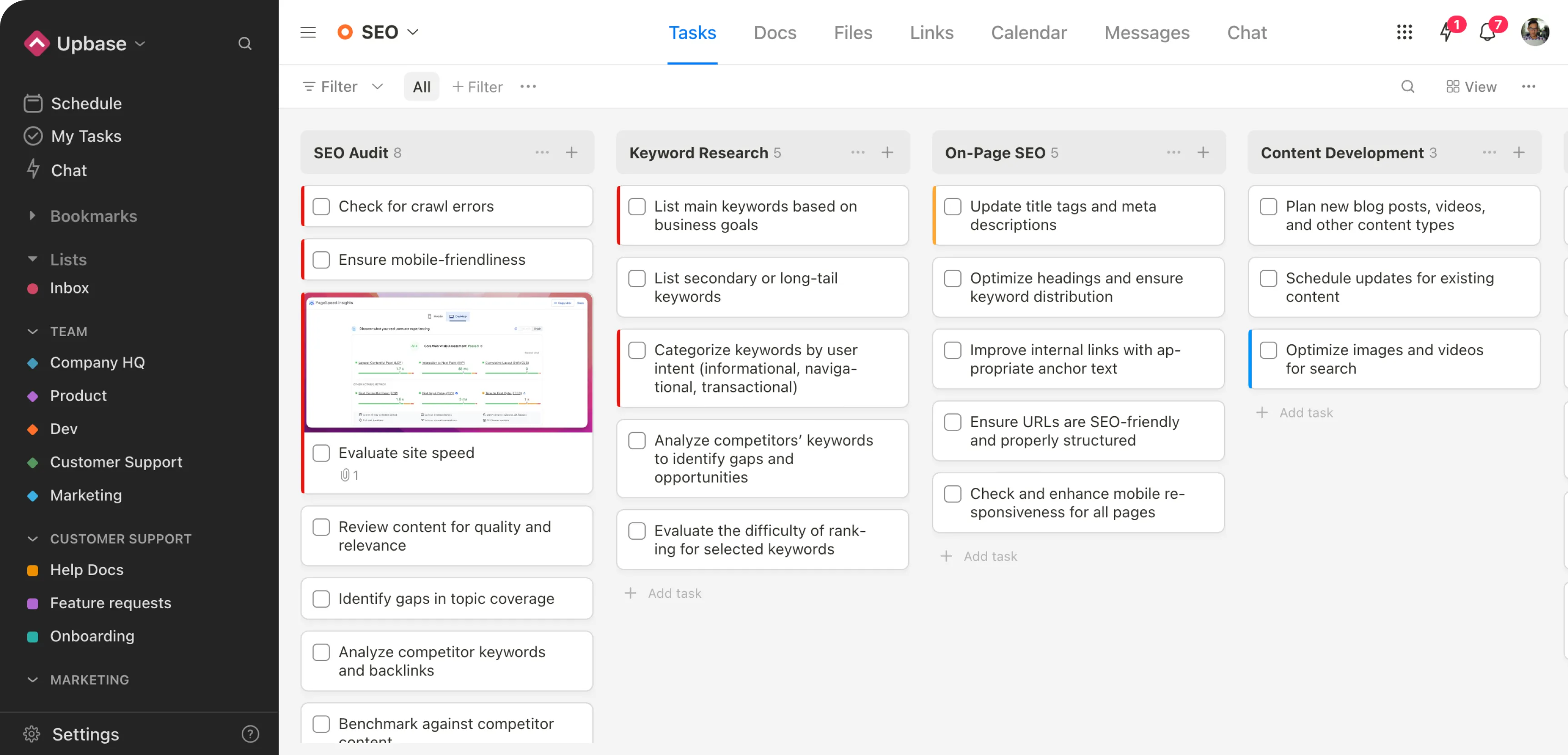
632 pointsOver the past two years, I've been building Upbase, an all-in-one PM tool.
I've tried so many project management tools over the years (Trello, Asana, ClickUp, Teamwork, Wrike, Monday, etc.) but they've all fallen short. Most of them are overly complicated and painful to use. Some others, like Trello, are too limited for my needs.
Most importantly, most of these tools tend to be focused on team collaboration and completely ignore personal productivity.
They are useful for organizing my work, but not great at helping me stay focused to get things done.
That's why I decided to build Upbase.
I try to make it clean and simple, without all the bells and whistles. Apart from team collaboration, I added many personal productivity features, including Weekly/Daily planner, Time blocking, Pomodoro Timer, Daily Journal, etc. so I don't need another to-do list app.
Now I can use Upbase to collaborate with my team AND manage your personal stuff at the same time, without all the bloat.
If these resonate with you, then give Upbase a try. It has a Free Forever plan though.
Let me know if you have any feedback or questions!
Comments (453) 118 threads
Earlier commentsSome restaurants do this pretty well, from small around-the-corner Italian places, to even places like Five Guys where they use their underdog story as a way to build connection. Of course they're not an underdog anymore though.
There are a lot of these Trello/JIRA alternatives. I am sure they are better in one or more dimensions, but I sort of need some kind of evidence breadcrumb to make me believe it is worth the 5-10 hours of time to work out if your product is worth spending another lots of hours transitioning from JIRA to. In some sense then, for people using X already, the price doesn't matter, as long as it is not ridiculously high.
I imagine it is better to target more. Your story says "our team of six people was working on a small content marketing project.". Maybe if you target content marketing teams, you can talk directly to their pain? You might need a landing page per customer profile. Obviously with HN you can only submit one link, so the one for Engineering teams would make sense I guess.
I think start by selling to content marketing teams, as your mouths are full of that dog food already, and it tastes good presumably!
As a side conversation, this project and how you described it made me think about why I have such issues with Jira. Jira is actually fucking useless to me. To the business, it's indispensible because it captures the larger tasks that roll up to a larger business objective. However, for each of those larger tasks I have a series of conversations and cross-functional dependencies that must be negotiated. More basically, my minutiae is much more than the larger tasks can ever describe, and that minutiae is much too noisy for the business to track - which is why we cover it informally in stand ups.
What I need is something offline that tracks my minutiae like stories where the larger tasks (that are currently stories to the business) get tracked like epics on my end.
I say this from the perspective of working at a very large, top-level engineering firm.
Are you saying that what is a story at work, and captured within a single “unit” within Jira (I don’t want to use “task”, because that’s a separate thing in Jira) is more broad, but you benefit from having that story broken down further, and that’s where you would use something like Upbase?
In a contrived example, if my OKR is to reduce the engineer attention in a given support process by 50%, my epic might be to create a framework for automating tasks via Slack. My stories then might be:
- Spike: Investigate Slack API
- Spike: Investigate programattic interfaces of Jenkins
- Build bot framework
- Build pluggable Jenkins module
- Spike: determine deployment patterns for framework + modules
To a business, these are bite-size as the chunks can be, but to me that may involve tracking threads in channels, doing POCs, and doing a lot of reading. All of those things may fall under a single story.
In a laymen's sense, I need a Jira for my Jiras that the business doesn't need to track because those things largely don't matter to the whole.
If a story is your smallest unit of work, does one developer own a story? Or are multiple people working on it? Intuitively it feels like if multiple people are working on a single story then it feels like that should (or at least could) be broken down into subtasks (or checklist items, if you didn’t want to create new tickets) that could be split between developers, and keeping that context and discussion within that ticket, I would think, would be helpful for knowledge sharing and drawing from that discussion to feed into your longer term knowledge base docs.
Just food for thought from someone who tool hops way too frequently with poor short term memory .
Sometimes it's not worth putting everything into a ticketing system.
For large teams with a complex process, I think the problem is the process itself, not the tool.
But let me ask you a question. If I want to get your attention, which one of the following techniques will work best:
1) Write you a snailmail letter 2) Send you an email 3) Send you a text 4) Write it on a yellow post-it note on your refrigerator
The answer is 4. Because it's the most difficult to ignore and leverages our ancient human physiology. It's not an accident that Kent Beck (Author of "Extreme Programming: Embrace Change") used post-it notes stuck to a wall that had every story written on it that mattered to the team within eyesight of every developer.
The problem is that when we get together to put information into a Jira or a Trello or whatever, we're making THE TOOL happy. What matters is the state of the tool, not the state of the system you're working on.
All comments shown.
Couldn't load more comments. Check your connection and try again.