Lurker News
I made a thing!

In 2014, I was holding a stack of iPhones and thought to myself:

    "Hey, if I had each phone display a playing card, I could click a button and they'd shuffle themselves"
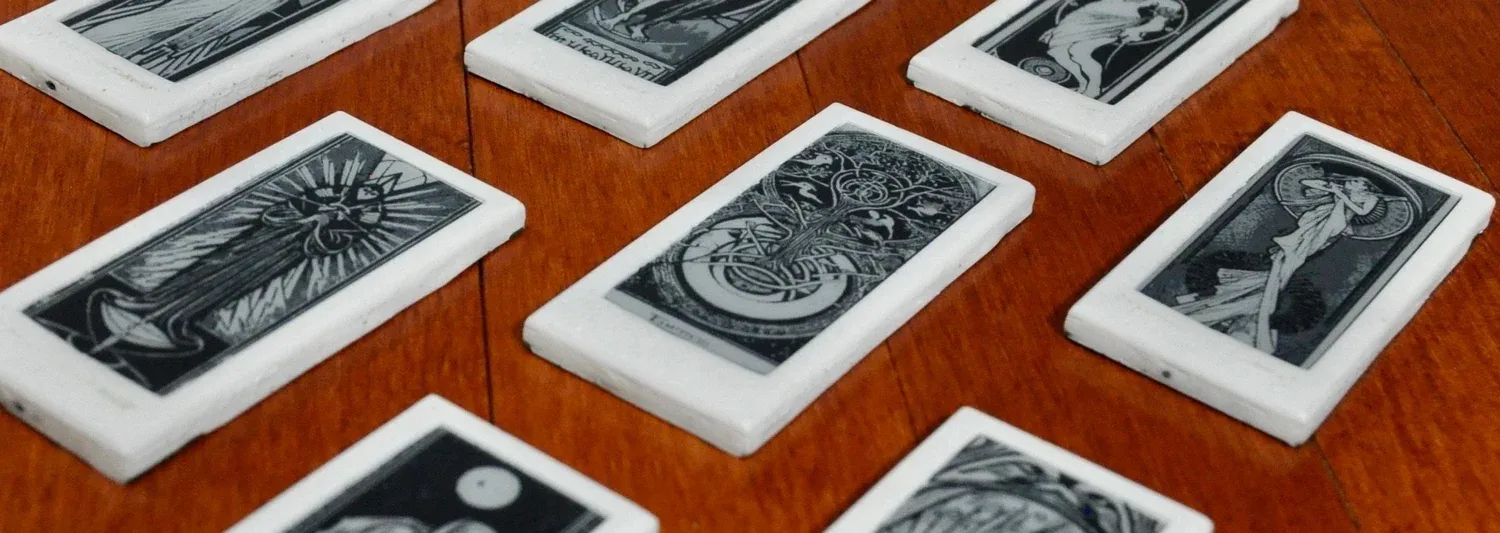
I pared that idea all the way down to this: trading cards made of e-ink displays.

Right now, each card costs me about $20 each, but with only a bit more scale, I think I can get that down to $10.
In doing this project, I learned how to design electronics and circuit boards. I learned Rust and wrote my first driver, I upped my CAD skills, 3D printed, and did my first resin casting. I generated the images on the cards using stable-diffusion.
HN always seems to appreciate new uses for e-ink. Thought I'd share :)
Comments (291) 95 threads

Earlier comments
lightedman1 reply#
Digital Tarot readings would be a possible use for this. You'd need to program the thing to randomly turn cards 180 degrees.
jonahss1 reply#
Yeah! I was going for a Tarot/Occult vibe.

Turning 90 degrees... maybe I could do some magic with magnets.....

lightedman#
I meant more that when you put the 'card' into the slot, at random the image displayed is rotated 180 degrees (like it could be in a real deck of cards) so that the image is upside-down. A simple transform function.
bashmelek1 reply#
This is amazing! I’ve fantasized about doing something similar—-what resources did you use to pick up all of those skills?
jonahss1 reply#
I come from a web dev background, and spent the last 3 years running the cloud and embedded firmware teams for a 3D printer startup. I learned that hardware isn't so hard, once you get past all the mystery. My coworkers gave me tips on which tools to use, and helped me when I got stuck.

The best advice I got was "Read the datasheet"
The biggest step for me was deciding to spend money on experimenting. With a budget, suddenly it was fun to order stuff, buy tools, try things out.
Rust Book was the best for learning Rust.

polishdude201 reply#
I've got the same mindset with a hardware project I worked on. I gave myself more free rein to just buy equipment and tools all in the name of "the project".
jonahss#
I spent about $5000 over two years. Not bad at all, really. A lot of that was registering an LLC and a Fusion360 license.
riatin1 reply#
Amazing project - I love the art on the "cards"! Who was your artist or where did you source it from?
jonahss1 reply#
Ahh... I used Stable Diffusion!
joshvm1 reply#
I think this is one of the most impressive parts to me. I would be comfortable approaching the embedded and mechanical aspects of this project, but I don't have the drawing skills. Being able to generate decent card designs for a demo deck is awesome.
jonahss#
The whole game development community is embracing ai image synthesis, especially for prototyping.
Folcon1 reply#
This is really interesting jonahss, well done for completing it! Have you looked at the physical games and convention spaces?

Things like DnD roleplaying games or Megagames could both use something like this.
I'd personally be interested in both those applications, what kind of wireless communication can they do?

jonahss#
Oh for sure, I'm hoping to inspire the game developer community. I know a lot of things using electronics have been tried in the past and it usually comes out as a gimmick, but I tried to design these to hide their electronic nature, hoping to enter the same spot that dice and counters inhabit.

I was going to post about it on some game dev forums next, any suggestions of where I should post?
They don't do wireless as of now, they have to sit on the plinth to get an update. There are options for how to add some form of wireless connectivity.
I'd be interested in continuing the conversation, I'll send you an email, or email me: jonah@wyldcard.io

Load more comments