I hate to ask this, but have to ... is there any danger of these discoveries being weaponized easily by hostile countries? i.e. does this make unconventional weapons more accessible to countries who otherwise have embargoes on technology and material to make atomic weapons?
https://en.wikipedia.org/wiki/Pure_fusion_weapon That ain't good. Although fusion is clearly the future of energy, we have to get our sh*t together on earth so we don't kill ourselves off or devolve with endless wars. Or give up and use fusion to leave the planet efficiently.
So.. we attack our enemies by building large fusion power plants in their countries, and then blowing them up? Why not just build a traditional nuclear fission power plant and blow that up? It seems that would be a lot cheaper.
> The power densities needed to ignite a fusion reaction still seem attainable only with the aid of a fission explosion, or with large apparatus such as powerful lasers like those at the National Ignition Facility, the Sandia Z-pinch machine, or various magnetic tokamaks. Regardless of any claimed advantages of pure fusion weapons, building those weapons does not appear to be feasible using currently available technologies Nothing about this result from NIF seems to suggest that igniting fusion is any easier than previously suspected.
Your takeaway does not match that article. The article details how "no measurable success was ever achieved" and that the large amount of energy required to start fusion is hugely prohibitive. I don't see how the NIF's success here changes that.
We already have tens of thousands of nuclear weapons spread across the planet, with only two ever actually being aimed at anyone. Lots of problems but the threat of weapons at this scale are a well-feared thing already.
> Fusion bombs (H bombs) have existed for a long time.
and their yield can be made arbitrarily large with designs perfected in the 50s. I don't see this tech contributing to weapons. ...well maybe the lasers i guess but not the fusion at least.
There are much simpler ways to generate fissile material for dirty bombs. This technology doesn't seem to be weaponisable in any other way that I can tell.
I'm not an expert (I'm a physics prof who once took a seminar on nuclear arms control back in college), but what they're trying to do here is much, much harder than making an atomic bomb. If you want nuclear weapons, this work on carefully controlled and contained fusion is close to the opposite of what you'd need to do. (Fusion power is in general much cleaner than fission, at least where lasting radioactivity and waste are concerned.)
Like a fusion reactor can be used as a neutron source to effectively make a breeder reactor.
However, most countries can dig up rocks out of the ground with radioactive isotopes that can act as a neutron source. However, this has legitimate uses as well from research to medical imagining. Also any power generating reactor is gonna want to use those neutrons to make Tritium otherwise it would quickly run out fuel so not something you just want use on something unrelated to running the fusion reactor.
A process which has been finally accomplished at one of the most advanced research facilities in the world after decades of effort, and which requires as an energy input almost as much energy as the process produces, is not easily weaponized, no.
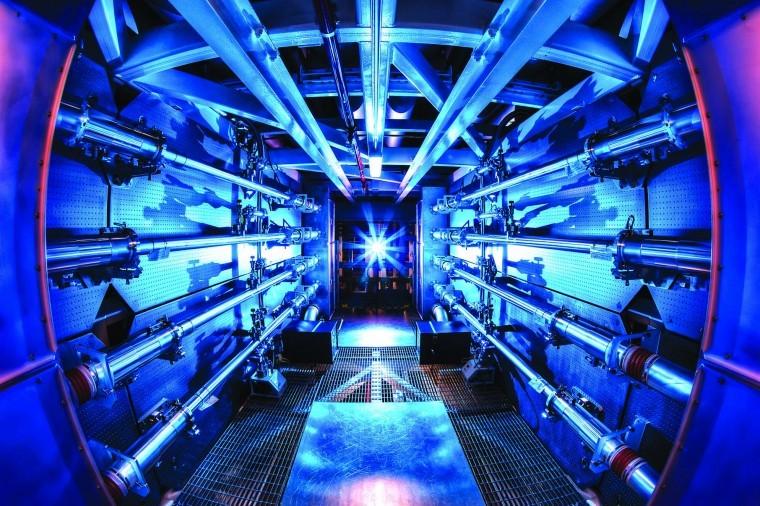
Fusion reactions are hard to start. To use one as a weapon would require you to deliver the fusion fuel together with a source of enough energy to start the fusion reaction off. So the most effective way to do so has historically been to trigger them with a nuclear fission reaction from an atomic bomb - which results in a Hydrogen bomb. In other words, weaponizing fusion generally requires you to already have an extremely powerful weapon. Weaponizing this laser based inertial confinement fusion approach requires you to deliver a facility the size of the Lawrence Livermore lab plus the electricity generating capacity of a significant part of the west coast of America onto your target.
You have to remember that all of the classified details about US hydrogen bomb designs we have were leaked from leaked from Russia after the Soviet Union broke apart. And yet only two countries have managed to become nuclear states since then (Pakistan and North Korea).
It's the engineering that makes nuclear weapons hard to do, not the knowledge.
from my layman understanding I believe fusion reactions are unlike fission reactions in that if they escape the confines of their environment they fizzle out as opposed to runaway like a nuclear explosion.
for some reason, all the news articles are extremely misleading. previous output ratio for this fusion method was something like 70%, now it is 150%. it's a useful improvement, but not a major breakthrough. the whole system still consumes 100x more energy than it produces. 100MJ of energy is needed to power the laser. the laser generates only 2MJ of energy that powers fusion. fusion generates 3MJ of output energy. so all the articles are saying "they put 2MJ energy and got 3MJ energy back". no, they put 102MJ and got 3MJ.
as somebody already explained to you earlier, the NIF uses arcane lasers because their focus is not lasers at the moment, it is fusion. At current tech level we have about 20% laser efficiency (with some types as much as 50%, not sure if they apply). this experiment specifically was about energy positive from a fusion reaction which has never been done except for uncontrolled things like hydrogen bombs. as far as a fusion milestone goes, this is a big deal.
Also, the other thing most commenters are missing here is the remaining problems are incrementally solvable so we should see steady improvements in laser efficiency and pellet optimization going forward. this is even doable with VC money (which we have some now but not significant). in that sense it is a pretty decent development.
Since I absolutely decided to take this in the worst possible way (get the downvotes ready)
What is the timeframe for those lasers to light a bulb somewhere, vs the timeframe of those lasers killing someone on a battlefield ? (As in, how much of is applicable for the military?)
I'm not sure what you're talking about. What is it you think you took in the worst possible way?
The lasers in question are mediocre for battlefield use. The consequences for the military are trivial, unless you're talking about 70 years from now when the US military is using fusion to power some of its military bases, subs or carriers.
I decided to take this "fusion breakthrough" with a massive dose of salt additionned with twice it's weight in pepper and bile.
At least the Nature article had a good ratio of actual information about the experiment, its limitations and prospect, as opposed to massive hyperbole from other commenters already popping the champagne as if the energy crisis was over. This made sound grumpy, which, truth be written, I am. (And, jealous, too, of course. I wouldn't mind a bit of actual success, once in a while.) Or maybe the grunts working on the experiment know better, and are _also_ grinding their teeths at the PR effort ? Maybe _they_ also feel unsatisfied because they still haven't met their own goal ? I suppose nuclear fusion physicists must have imposter syndrome, too ? Who knows.
Comments (1,021) 82 threads
Earlier comments[0] https://astralcodexten.substack.com/p/your-book-review-the-f...
https://en.wikipedia.org/wiki/Pure_fusion_weapon
That ain't good. Although fusion is clearly the future of energy, we have to get our sh*t together on earth so we don't kill ourselves off or devolve with endless wars. Or give up and use fusion to leave the planet efficiently.
> The power densities needed to ignite a fusion reaction still seem attainable only with the aid of a fission explosion, or with large apparatus such as powerful lasers like those at the National Ignition Facility, the Sandia Z-pinch machine, or various magnetic tokamaks. Regardless of any claimed advantages of pure fusion weapons, building those weapons does not appear to be feasible using currently available technologies
Nothing about this result from NIF seems to suggest that igniting fusion is any easier than previously suspected.
Your takeaway does not match that article. The article details how "no measurable success was ever achieved" and that the large amount of energy required to start fusion is hugely prohibitive.
I don't see how the NIF's success here changes that.
Any advance in energy production or propulsion has a weapons counterpart.
and their yield can be made arbitrarily large with designs perfected in the 50s. I don't see this tech contributing to weapons. ...well maybe the lasers i guess but not the fusion at least.
However, most countries can dig up rocks out of the ground with radioactive isotopes that can act as a neutron source. However, this has legitimate uses as well from research to medical imagining. Also any power generating reactor is gonna want to use those neutrons to make Tritium otherwise it would quickly run out fuel so not something you just want use on something unrelated to running the fusion reactor.
Fusion reactions are hard to start. To use one as a weapon would require you to deliver the fusion fuel together with a source of enough energy to start the fusion reaction off. So the most effective way to do so has historically been to trigger them with a nuclear fission reaction from an atomic bomb - which results in a Hydrogen bomb.
In other words, weaponizing fusion generally requires you to already have an extremely powerful weapon.
Weaponizing this laser based inertial confinement fusion approach requires you to deliver a facility the size of the Lawrence Livermore lab plus the electricity generating capacity of a significant part of the west coast of America onto your target.
It's the engineering that makes nuclear weapons hard to do, not the knowledge.
for some reason, all the news articles are extremely misleading.
previous output ratio for this fusion method was something like 70%, now it is 150%. it's a useful improvement, but not a major breakthrough. the whole system still consumes 100x more energy than it produces. 100MJ of energy is needed to power the laser. the laser generates only 2MJ of energy that powers fusion. fusion generates 3MJ of output energy. so all the articles are saying "they put 2MJ energy and got 3MJ energy back". no, they put 102MJ and got 3MJ.
Also, the other thing most commenters are missing here is the remaining problems are incrementally solvable so we should see steady improvements in laser efficiency and pellet optimization going forward. this is even doable with VC money (which we have some now but not significant). in that sense it is a pretty decent development.
What is the timeframe for those lasers to light a bulb somewhere, vs the timeframe of those lasers killing someone on a battlefield ? (As in, how much of is applicable for the military?)
The lasers in question are mediocre for battlefield use. The consequences for the military are trivial, unless you're talking about 70 years from now when the US military is using fusion to power some of its military bases, subs or carriers.
At least the Nature article had a good ratio of actual information about the experiment, its limitations and prospect, as opposed to massive hyperbole from other commenters already popping the champagne as if the energy crisis was over.
This made sound grumpy, which, truth be written, I am.
(And, jealous, too, of course. I wouldn't mind a bit of actual success, once in a while.)
Or maybe the grunts working on the experiment know better, and are _also_ grinding their teeths at the PR effort ? Maybe _they_ also feel unsatisfied because they still haven't met their own goal ? I suppose nuclear fusion physicists must have imposter syndrome, too ? Who knows.
All comments shown.
Couldn't load more comments. Check your connection and try again.