Show HN: OK-Robot: open, modular home robot framework for pick-and-drop anywhere (opens in a new tab)ok-robot.github.io
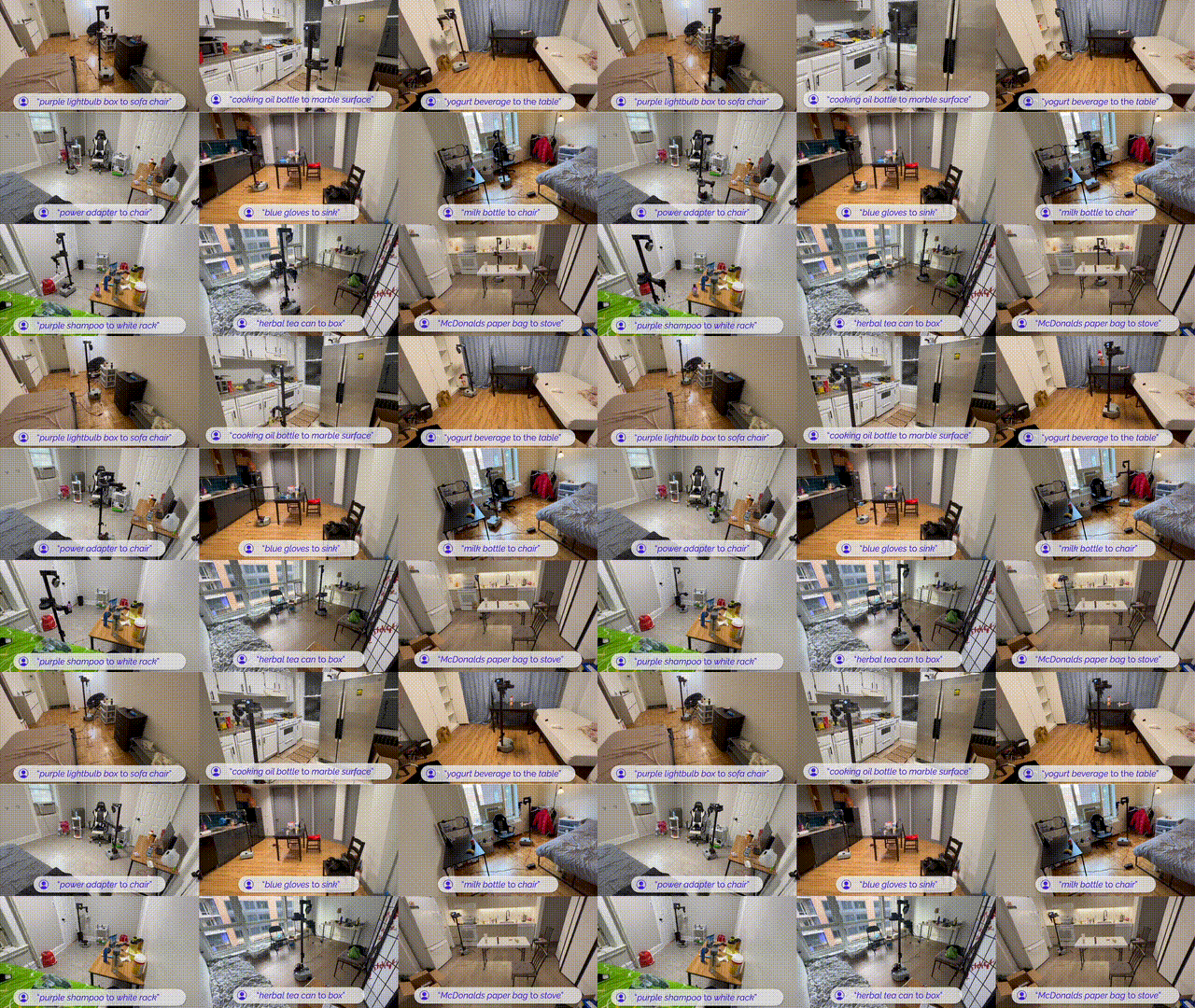
542 pointsWe based everything off of the current best machine learning models, and so things don't quite work perfectly all the time, so we are hoping to build it together with the community! Our code is open: https://github.com/ok-robot/ok-robot and we have a Discord server for discussion and support: https://discord.gg/wzzZJxqKYC If you are curious what works and what doesn't work, take a quick look at https://ok-robot.github.io/#analysis or read our paper for a detailed analysis: https://arxiv.org/abs/2401.12202
P.S.: while the code is open the project unfortunately isn't fully open source since one of our dependencies, AnyGrasp, has a closed-source, educational license. Apologize in advance, but we used it since that was the best grasping model we could have access to!
Would love to hear more thoughts and feedback on this project!
Comments (110) 28 threads
Earlier commentsYou are standing in a kitchen. Ahead of you to your right there is a large refrigerator with the handle on the right side. There is a set of cabinets to your left with a plate sitting on the counter above them.
> get beer
You don't see any beer here.
<< COT: I know that beer is often found in the fridge. I should try opening the refrigerator
> open fridge
Opening the refrigerator reveals 4 cans of beer.
> get beer
taken
Obviously we're still several years from this working, but it's very exciting to consider. Interactive Fiction narrative fed by real sensors plus chain-of-thought blocks as internal monologue.
It would be really cool if the robot could just know where your keys are by attaching some kind of tile-type thing to it. If it already has a scan of your home, theoretically it could show a photo. But I have no idea if it’s possible to pinpoint an object via rfid.
You could take video data and have fuzzy identification of objects moving around, then throw away the video and keep track of the objects, the blue floppy thing (gloves) and the metal shiny deforming things (keys) then have a more constructive dialog about the keys. A voice responding, what do the keys look like? Is there a blue square thing on the key ring? The less identifiable the object the funnier the discussion. What shirt? You have many shirts! Oh, the blue one, you have 4 of those, one in the sink, one behind the bed, one in the laundry basket, one in the closet. Oh the one with stripes! Why didn't you say so, it's behind the bed bro.
It could also ask you if they are suppose to be on the outside in the front door after you close it.
I use this quite a lot actually. Being lazy I take photographs of components and boards and ask it how to wire them to my esp32. It’s able to distinguish the board, chip, etc, as well as the pinouts from a set of photos and tell me what wires to where and anything of note. It’ll often even suggest helpful libraries for the parts. It’s essentially magic.
Labor isn't free. Building custom PCBs and hardware in low quantity isn't cheap. Building, calibrating, and testing robots isn't cheap.
If you need one gas line, you can get a swivel for a normal shop hose reel for $15. If you need two gas lines on the same axis, the part is similar but way lower volume, so you have to go to a specialty supplier and the price is $350.
The business that makes hose reel swivels makes lots of high volume parts, has lots of competition, and needs to charge close to cost to sell them. The business that makes specialty gas swivels for industry that offers multiple gas lines in one swivel, lots of different options, and makes them higher quality needs to charge a lot more to keep their business operational.
Thank you
https://dobb-e.com/
The primary difference is that this is zero-shot (meaning the robot needs 0 (zero!) new data in a new home) but has only two skills (pick and drop); where Dobb-E can have many skills but will need you to give some demonstrations in a new home.
https://hello-robot.com/stretch-embodied-ai
All comments shown.
Couldn't load more comments. Check your connection and try again.