Lurker News
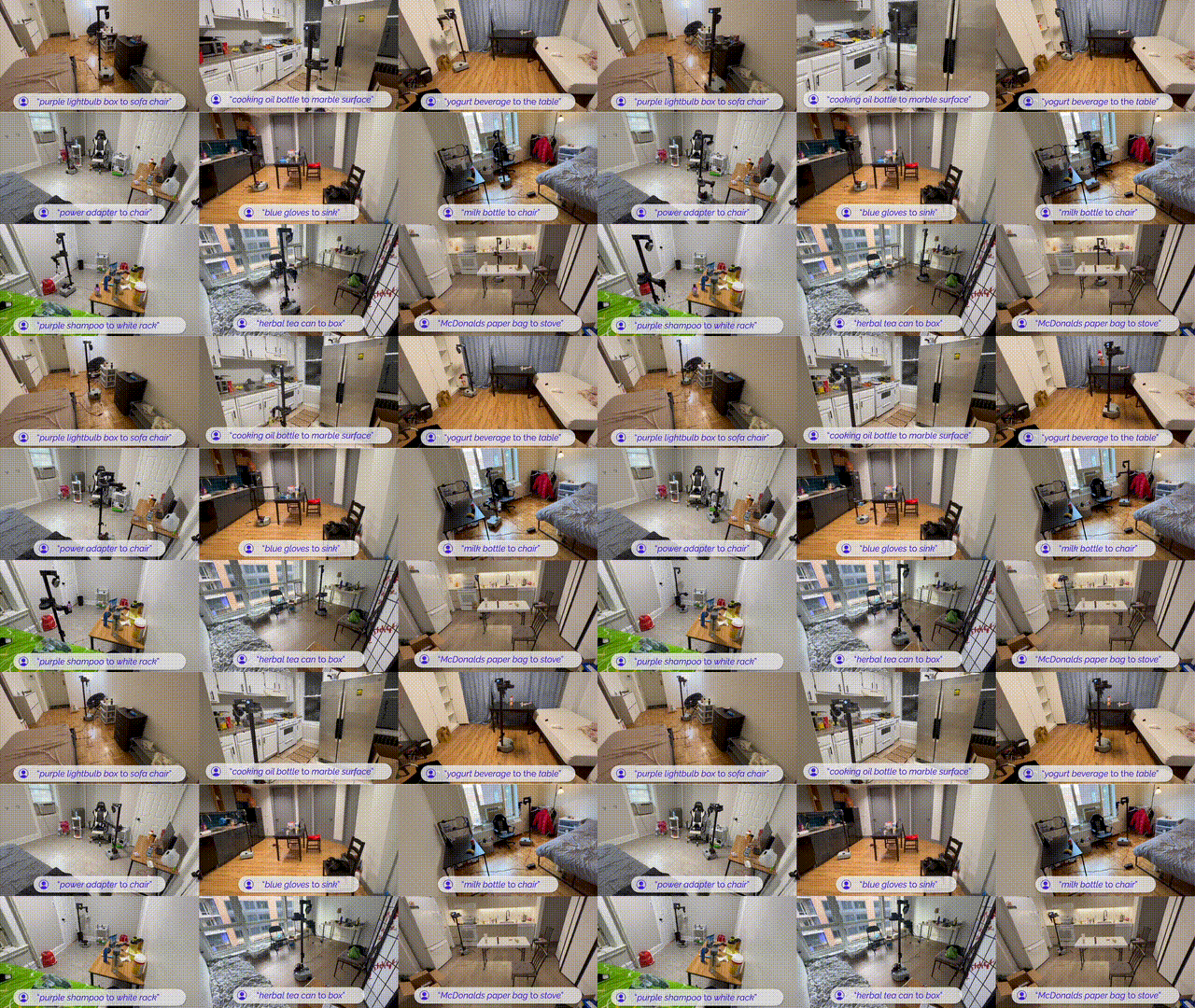
Hi all, excited to share our latest work, OK-Robot, which is an open and modular framework to perform navigation and manipulation with a robot assistant in practically any homes without having to teach the robot anything new! You can simply unbox the target robot, install OK-Robot, give it a "scan" (think a 60 second iPhone video), and start asking the robot to move arbitrary things from A to B. We already tested it out in 10 home environments in New York city, and one environment each in Pittsburgh and Fremont.

We based everything off of the current best machine learning models, and so things don't quite work perfectly all the time, so we are hoping to build it together with the community! Our code is open: https://github.com/ok-robot/ok-robot and we have a Discord server for discussion and support: https://discord.gg/wzzZJxqKYC If you are curious what works and what doesn't work, take a quick look at https://ok-robot.github.io/#analysis or read our paper for a detailed analysis: https://arxiv.org/abs/2401.12202
P.S.: while the code is open the project unfortunately isn't fully open source since one of our dependencies, AnyGrasp, has a closed-source, educational license. Apologize in advance, but we used it since that was the best grasping model we could have access to!
Would love to hear more thoughts and feedback on this project!
Comments (110) 28 threads

Earlier comments
jamesdwilson2 replies#
I'd love to see this be usable as potentially a mower and or vacuum/mop with different swappable components.
bozhark2 replies#
Make it micro.

I want mini robots cleaning dust and debris, silently and out of my way. I don’t want macro bots getting in my way

observationist1 reply#
I agree, micro bots would be best to handle the dirty jobs.
jamesdwilson#
okay, so we all agree a Matryoshka doll like system similar to SD card and microSD card is appropriate then.
mikeegg1#
That's what Zorg though in _Fifth Element_.
happytiger2 replies#
Not to counterpoint, but just for the sake of discussion, i kind of want the opposite but for maybe similar reasons. I want flexible robots that can replace my human labor. I don’t want specialist robots that are obligate specialists.

Laundry, cooking, dishes, sweeping, vacuuming, and other constantly recurring tasks are what I would love to see automated not just a “robot that sweeps” like the market has been trying to sell me.
Ever since I read the second shift book about the unpaid extra 40 hour week women work doing domestic tasks I’ve dreamed of robots replacing that for humanity. It’s a massive cost to people individually and humanity overall, and kind of a silent epidemic.
It’s crazy but freeing up half of humanity from the drudge work of daily chores is one of the most obvious disruptive technology plays. I rarely hear people put the robot revolution in this context, but I very much think we should start doing so.
Here’s a good overview for the uninitiated:
https://www.americanprogress.org/article/unequal-division-la...

sonofhans3 replies#
I applaud — for real — your ideas and feelings here. I’ve had similar thoughts my whole life, growing up reading golden age science fiction.

But I worry very much that tools like this will be used primarily to increase corporate profits and reduce money spent on humans, rather than remove drudgery from people’s lives and allow them to do things more aligned with their goals and natures.
E.g., if we make a cleaning robot, hotels will replace half their staff — what will these people do for a living? Work in an AI sweatshop, categorizing images of child abuse?
Old-school science fiction often proposed that we’d be entering a new age of art and leisure, as robots and AI take over menial tasks. In fact today I think we’re seeing AI and robots — in part — taking jobs from humans, and in order to provide entertainment and economic leverage to richer humans.
It’s making me reevaluate all that old science fiction, as it seemed to require an invisible 90% of the population basically working for the AIs so that the AIs can curate a great life for a stratospherically-wealthy minority.

aidenn0#
> Old-school science fiction often proposed that we’d be entering a new age of art and leisure, as robots and AI take over menial tasks. In fact today I think we’re seeing AI and robots — in part — taking jobs from humans, and in order to provide entertainment and economic leverage to richer humans.

It was also predicted in the mid 20th century that rising productivity would create a shorter work-week; instead we have figured out how to prevent workers from being compensated for higher productivity.
https://www.epi.org/productivity-pay-gap/

KerrAvon1 reply#
I don't think you should reevaluate it in that context. Golden age science fiction assumed what we seem to be now calling AGI and still don't know how to create. What we're now calling artificial intelligence (thanks to OpenAI) is effectively an advanced version of autocomplete with infinite computing power behind it. It's incredibly inefficient, and if we ever build AGI we'll look back at AI like people looking back at the earliest manual typewriters without shift keys or lowercase.

For golden age sci fi theories of human work vs leisure to actually take hold, we need universal basic income, or some other monetary theory that allows us to value other people for being alive rather than solely for being feudal slaves of deranged billionaires.
"Hotel maid" as a job really shouldn't exist when robots can do it better and more consistently (which isn't true yet). At that point, not before, should be considered beneath human dignity. But we definitely need an answer for what happens to the newly undignified human.

Continue this thread — 1 reply

stubish#
The end goal, which I think the vast bulk of humanity wants despite rationalizations to the contrary, is that nobody does anything for a living. People only do things for leisure. Getting from here to there is the problem, which I think is a political and economic problem. People only work in sweatshops when a) they have no choice and b) it is cheaper to hire people than automate. The Star Trek Utopia absolutely requires socialist policies such as social security or UBI or similar to get to the point where wealth and money is meaningless. The alternative is what you see, where more people are pushed out of work by automation, driving down the rate of pay in sweatshops because social security kind of sucks, making more things profitable to run as sweatshops. Automation happens only where it is most profitable, leaving humans working harder for less doing the other jobs, including some of the most menial, degrading and harmful.
yjftsjthsd-h#
I agree that generalist robots would be better, but building them is really hard (which we know, because we've been trying to build them for decades now). So I think piecemeal robots are the happy-enough medium that we can build to start automating away work today (while we hopefully keep working on the general case).
westmeal1 reply#
Is the title a reference to OK computer or is it just something you all came up with?
MahiShafiullah#
The title has multiple meanings, some credits definitely should go to OK computer/radiohead, but also "OK Google" for controlling a home assistant, open-knowledge (OK) models, etc.
ghostly_s#
why are these general purpose robots always so slow? Intuitively we expect machines to be able to do tasks faster than humans, but even the 5x speed video is much slower than a human could do the task.

Load more comments