Show HN: iFixit created a new USB-C, repairable soldering system (opens in a new tab)hackaday.com
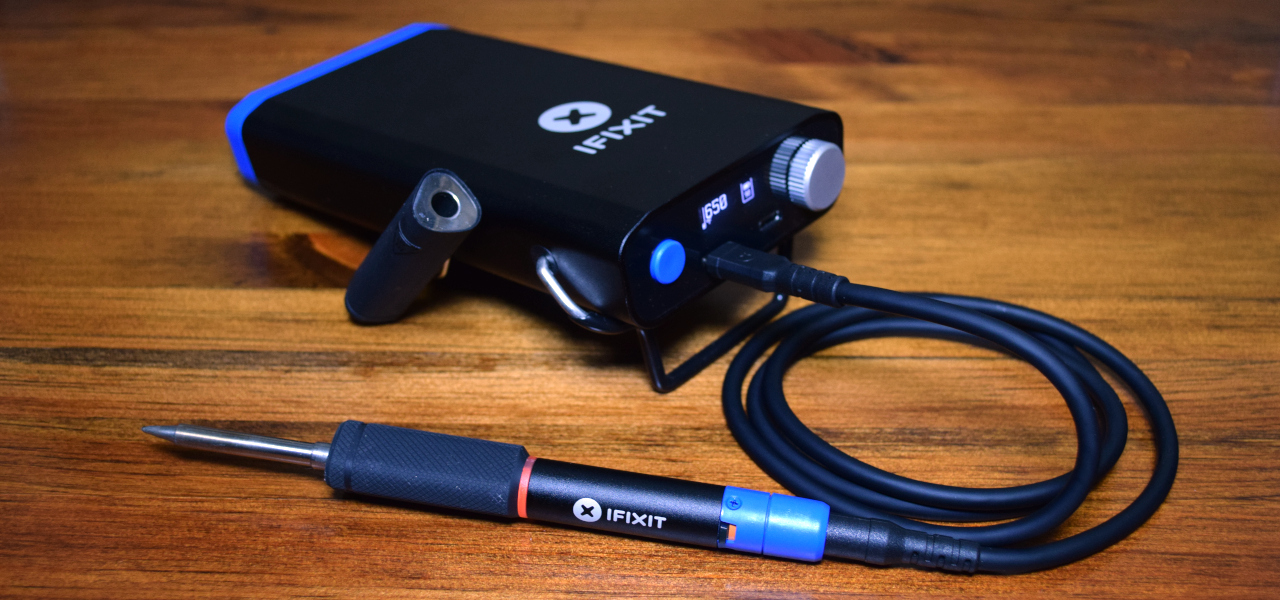
928 pointsIt's a USB-C powered soldering iron and smart battery power hub. Super repairable, of course. Our goal is to make soldering so easy everyone can do it:
https://www.ifixit.com/fixhub
We didn’t want to make just another iron, so we spent years sweating the details and crafting something that met our exacting standards. This is a high-performance iron: it can output 100W of heat, gets to soldering temperature in under 5 seconds, and automatically cools off when you set it down. The accelerometer detects when you pick it up and heats it back up. Keeping the iron at a lower temperature while you’re not soldering shouold prolong the life of the tip.
What’s the difference between this iron and other USB-C irons on the market? Here’s a quick list:
Higher power (our Smart Iron is 100W, competitors max out at 60W over USB-C, 88W over DC Supply)
Heat-resistant storage cap (you just have to try this out, it’s a real game changer in day-to-day use)
Polished user experience
A warranty and a local company to talk to (I can’t find any contact information for Miniware)
Comfier / more natural grip
Shorter soldering tip length
No-tangle, heat-resistant cable
Locking ring on the cable, so it can’t snag and get disconnected (this happens to me all the time on other irons)
More intuitive settings, either on the Power Station or on the computer
We used Web Serial https://caniuse.com/web-serial for the interface, which is only supported in Chromium browsers. The biggest bummer with that is that no mobile browsers support it, yet. Hopefully that changes soon.
Hardware is hard! It's been a journey for us. Happy to answer any questions about how we made it.
Schematics and repair information are online here: https://www.ifixit.com/Device/FixHub_Portable_Soldering_Stat...
Comments (405) 75 threads
Earlier commentsPros:
1. "Portable, sorta"
2. Reasonably high-power
3. Has an accelerometer (as does everything else in its class)
4. "Repairable"
Cons:
1. No Hall effect sensor to detect when iron is placed in holder
2. A walled single-source garden of soldering tips that doesn't even exist yet instead of using commodity COTS parts
3. The fucking temperature control is fucking paywalled behind a proprietary USB power bank. What in the fuck? (And no, it is not possible to create an argument that will persuade me to think that this is an improvement. (Yes, I know that it can be programmed; this changes nothing.))
4. Expensive.
---
I'll just stick with my Pinecil iron. It gets all of these things right. If it breaks (I haven't broken a soldering iron yet in over three decades of trying), I'll fix it or buy another one.
I mean: For the $250 this iFixit product costs (including the paywalled temperature control), I will be able to buy several lifetimes of worth of Pinecil irons.
All of the settings, including the temperature setting, are available in the web interface for free. The settings persist permanently on the iron so you can use it with any USB-C PD power source that you've already got. We worked hard to make sure that the iron works well standalone from the power station. https://www.ifixit.com/fixhub/console
Here I am soldering in the field with my fancy microprocessor-controlled portable soldering iron. I've been using it with 63/37 and doing SMD work, but in front of me now I've got a big wire on a 1/4" TS plug to work on that was put together with lead-free solder and I simply need a higher temperature in order for anything to melt.
I never expected an audio tech in the US to use lead-free solder for anything, ever, but here I am anyway.
So now, I've got choices.
Do I find a computer to plug my soldering iron into so I can reprogram it?
Do I use the $170 temperature control (more than twice the cost of the iron itself) that I left on the bench for safe keeping?
Or do I see this situation in advance, and buy seemingly any other temperature-controlled portable soldering iron instead?
It's got batteries in it. Is it really going to last longer than something that runs on AC with no chips in it?
EDIT: I take the following back. The actual cable is USB-USB. The P2 connector links directly to the heated head, what is perfectly equivalent to "labeled".
But yeah, people that design products, please if you make a non-standard use of a standard connector, label it.
I would absolutely not buy this because that USB-P2 cable will mix with every other thing that thought was a good idea to use an unlabeled USB-P2 cable that only God knows whether they are compatible or not. (Common sense would imply they are, but common sense already flew out of the window long ago when you see a cable like that.)
All comments shown.
Couldn't load more comments. Check your connection and try again.