Show HN: Atlas of Space (opens in a new tab)atlasof.space
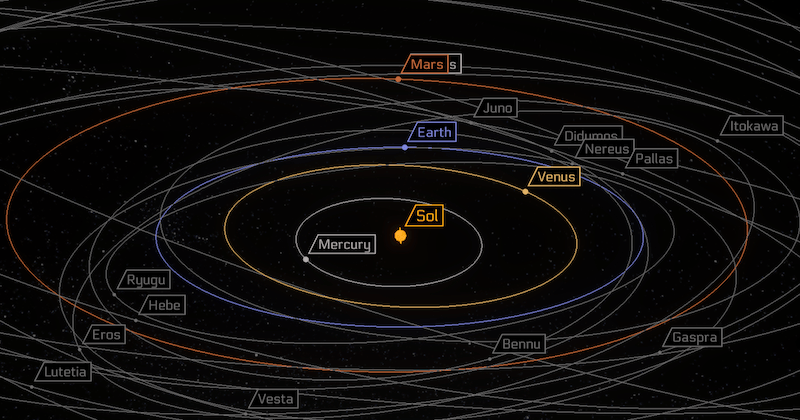
770 pointsHello HN! Sharing a recent side project of mine, the Atlas of Space, that I built out to explore the Solar System.
As a long-time space nerd, I realized recently that I didn't have a good intuition on the scale, speed, and relative orientation of the celestial bodies around us. So over the break I built out a kind of spatial Wikipedia to click around and learn about planets, moons, asteroids, and other bodies orbiting the Sun.
The physics is all simulated in the browser using simple Newtonian mechanics. There's a lot left to do from here, including modeling objects in non-Keplerian orbits and replaying different spacecraft missions.
Hope you have fun clicking around, and curious to hear what I should improve next!
Comments (124) 63 threads
Earlier commentsOne option for the future: orbits of celestial bodies influence each other. Is it enough to see when say, earth and mars get close?
It is true that we don't actually orbit the centre of the Sun, but it is very close.
The problem with Mars getting close is that Mars is quite small and the Earth is a long way away and there are many other planets, some much more massive.
Mercury is actualy lot closer a lot more often (Mercury is the most-often close to all the planets by virtue of it's orbit close to the Sun).
Someone explains it in a bit more detail here: https://www.quora.com/How-do-the-surrounding-planets-influen...
There's a paper suggesting there's some 2.4 million year climate cycle https://www.nature.com/articles/s41467-024-46171-5 but that's too subtle for this visualisation.
I am currently working on a canvas app (not Three.js, though), so I will look through your code, too.
Thank you for doing such an excellent job.
All comments shown.
Couldn't load more comments. Check your connection and try again.