Show HN: Atlas of Space (opens in a new tab)atlasof.space
770 pointsHello HN! Sharing a recent side project of mine, the Atlas of Space, that I built out to explore the Solar System.
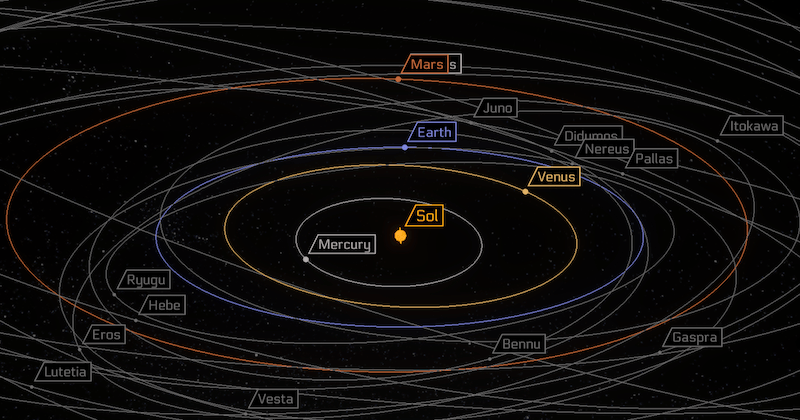
As a long-time space nerd, I realized recently that I didn't have a good intuition on the scale, speed, and relative orientation of the celestial bodies around us. So over the break I built out a kind of spatial Wikipedia to click around and learn about planets, moons, asteroids, and other bodies orbiting the Sun.
The physics is all simulated in the browser using simple Newtonian mechanics. There's a lot left to do from here, including modeling objects in non-Keplerian orbits and replaying different spacecraft missions.
Hope you have fun clicking around, and curious to hear what I should improve next!
Comments (124) 63 threads
Earlier commentsCurious to know, - Is the Source code open source? - If not what is the stack you used to build this.
It's a static React app using Three.js for rendering and a few backend functions deployed on Netlify. It's been a pretty great experience deploying to Netlify, though I didn't expect the attention from HN to go way over my 100GB of free tier bandwidth!
Will take some time to dig in the code, always wanted to try out threejs.
Thank you
All comments shown.
Couldn't load more comments. Check your connection and try again.