Lurker News
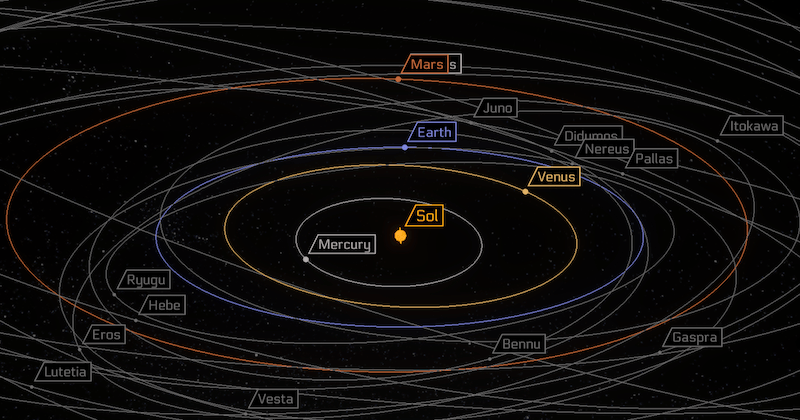
Hello HN! Sharing a recent side project of mine, the Atlas of Space, that I built out to explore the Solar System.

As a long-time space nerd, I realized recently that I didn't have a good intuition on the scale, speed, and relative orientation of the celestial bodies around us. So over the break I built out a kind of spatial Wikipedia to click around and learn about planets, moons, asteroids, and other bodies orbiting the Sun.
The physics is all simulated in the browser using simple Newtonian mechanics. There's a lot left to do from here, including modeling objects in non-Keplerian orbits and replaying different spacecraft missions.
Hope you have fun clicking around, and curious to hear what I should improve next!
Comments (124) 63 threads

Earlier comments
busymom01 reply#
Is there a way to show only spacecrafts? I am having a hard time finding any
philipwhiuk1 reply#
There aren't any - it's just natural stellar bodies.
busymom01 reply#
There's one at least. But you have to click on the toggle visibility button at the bottom of screen, then switch on spacecrafts. Then it will show you at least one - the Tesla Roadster launched in 2018.
pieix1 reply#
Nice find. That's the only one up there currently, mostly because it's in a simple heliocentric orbit (most spacecraft are not). I want to add more but need to figure out how to properly find their current position+velocity to start the physical simulation.

Continue this thread — 1 reply

maxmcd1 reply#
This is so awesome. I've wanted something like this where you could visit all scales of the universe from tiny atoms, to the galaxy, to the broader universe. Does something like that exist in some form?
blakewatson1 reply#
I think https://spaceengine.org/ fills part of your request. I haven't played it but I've watched videos about it and it looks like you can jump anywhere around the observable universe and look at any object you want.
dotancohen1 reply#
This looks terrific. But it's Windows-only.
digging3 replies#
I think it's available on Steam which would mean you could theoretically use it on Linux with Steam's Proton compatibility layer.

Continue this thread — 3 replies

digging#
Super cool! Like a simpler (not in a bad way) Universe Sandbox.

I'm reminded of the astronomical-visualization app I created at the beginning of my career and abandoned. This makes me want to go back to it again!

whearyou#
If anyone here is a fan of strategy games and found this as totally awesome as I did, check out the game Terra Invicta on Steam.

I’m embarrassed to admit how many hours I dumped into it.

Load more comments