Show HN: Strange Attractors (opens in a new tab)blog.shashanktomar.com
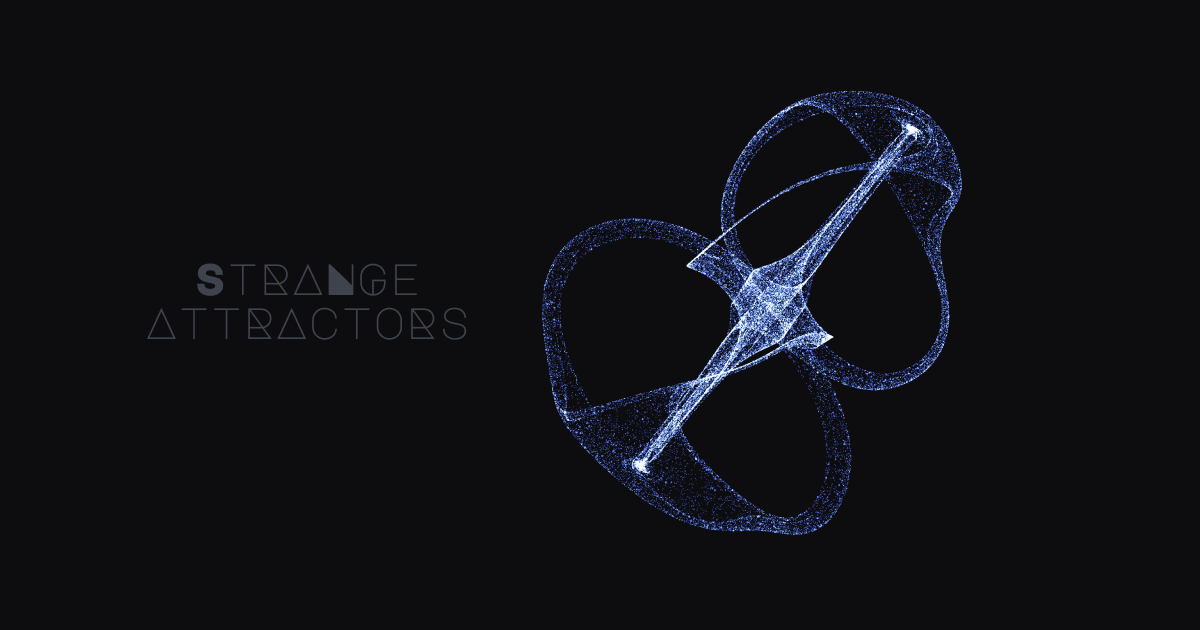
804 pointsI went down the rabbit hole on a side project and ended up building this: Strange Attractors(https://blog.shashanktomar.com/posts/strange-attractors). It’s built with three.js.
Working on it reminded me of the little "maths for fun" exercises I used to do while learning programming in early days. Just trying things out, getting fascinated and geeky, and being surprised by the results. I spent way too much time on this, but it was extreme fun.
My favorite part: someone pointed me to the Simone Attractor on Threads. It is a 2D attractor and I asked GPT to extrapolate it to 3D, not sure if it’s mathematically correct, but it’s the coolest by far. I have left all the params configurable, so give it a try. I called it Simone (Maybe).
If you like math-art experiments, check it out. Would love feedback, especially from folks who know more about the math side.
Comments (78) 49 threads
Earlier commentsThere isn't always "a" correct extension into higher dimensions. There may be many, there may be none, and either way something "close enough" may well be interesting in its own right.
If you'd like something concrete to poke at you can try searching around for people's adventures in trying to make a 3D Mandelbrot. I've seen a couple of good write-ups on those adventures. I don't know if anyone has ever landed on a "correct" solution, it's been years since I last looked, but certainly some very interesting possibilities have been found.
I think this is slightly inaccurate. The butterfly effect is about the evolution of two nearby states in phase space into well-separated states. But the parameter a is not a state. To see the butterfly effect by changing a we would need to let the system settle down, give the parameter a small change, and then change it back. The evolution during the changed time acts as a perturbation on states.
Instead, showing that the attractor changes qualitatively as a function of the parameter is more akin to a phase transition.
All comments shown.
Couldn't load more comments. Check your connection and try again.