Regarding case material for productizing, you could consider a combination of plywood and bent sheet metal, eg like a Moog. Also check out dato.mu for a few examples of kid proof synth enclosures.
That depends on how much effort your spend on finish work. Files and sandpaper works wonders, but that take time. Or you can fold the edges over so that the sharp edges are on the inside (cars do this). The plywood is likely to cover all those sharp edges - plywood is easier to shape than sheet metal so this is a common cheat that can look good if done right.
You can debur it as part of the manufacturing process, and then when it gets powder coating it smooths out even more. But you can just embed the sheet metal edges in a groove on a wooden side.
I'm a 44 year old man and I would love this - for years I've tried to dabble with music with much lack of success - but this looks really fun to play with. Great job.
The problem with music is you can't dabble. You need to dedicate half an hour per day for a few weeks before you reach the point where you are not terrible. You need years of dedicated practice before you can call yourself good. Finding that time is hard. Still making your own music is run and so I encourage you to press through.
Not trying to get good is a liberating step. I never was and never will be good at music, but it’s still fun to play loud punk-ish tunes on a guitar, or twiddle the knobs on a faux-303, none of which requires years of your life.
Go grab a Teenage Engineering Pocket Operator, it's definitely worth a try !
I personally recommend the PO-33 (KO!), it is fun and easy to play with :)
The POs are fun to play with, but from experience I would much rather recommend getting a used mk1 Novation Circuit. For $150 - $200 you have a four track drum machine plus two tracks of a great synth engine, with a built in mixer and simple effects, midi in if you want to use a keyboard, and the thing is still compact and battery powered.
There are also free software synths and DAWs available. GarageBand is the obvious one if you use macOS. I had lots of fun with that and with NanoStudio on iPad. I also own a Pocket Operator, which is fun and very mobile, but a bit pricey.
If you want a synth you can buy that has a similar playing style, you could check out the Modern Sounds Pluto: https://www.modernsounds.co/pluto (the original run is sold out but you can find them on ebay/reverb)
It's two of these 4-note step sequencers with some fun timing randomness. Similar to the OP's synth it uses knobs to set pitches but the knobs are picking notes from a specific key so they always sound good together. It's a lot of fun to play and doesn't require any musical knowledge!
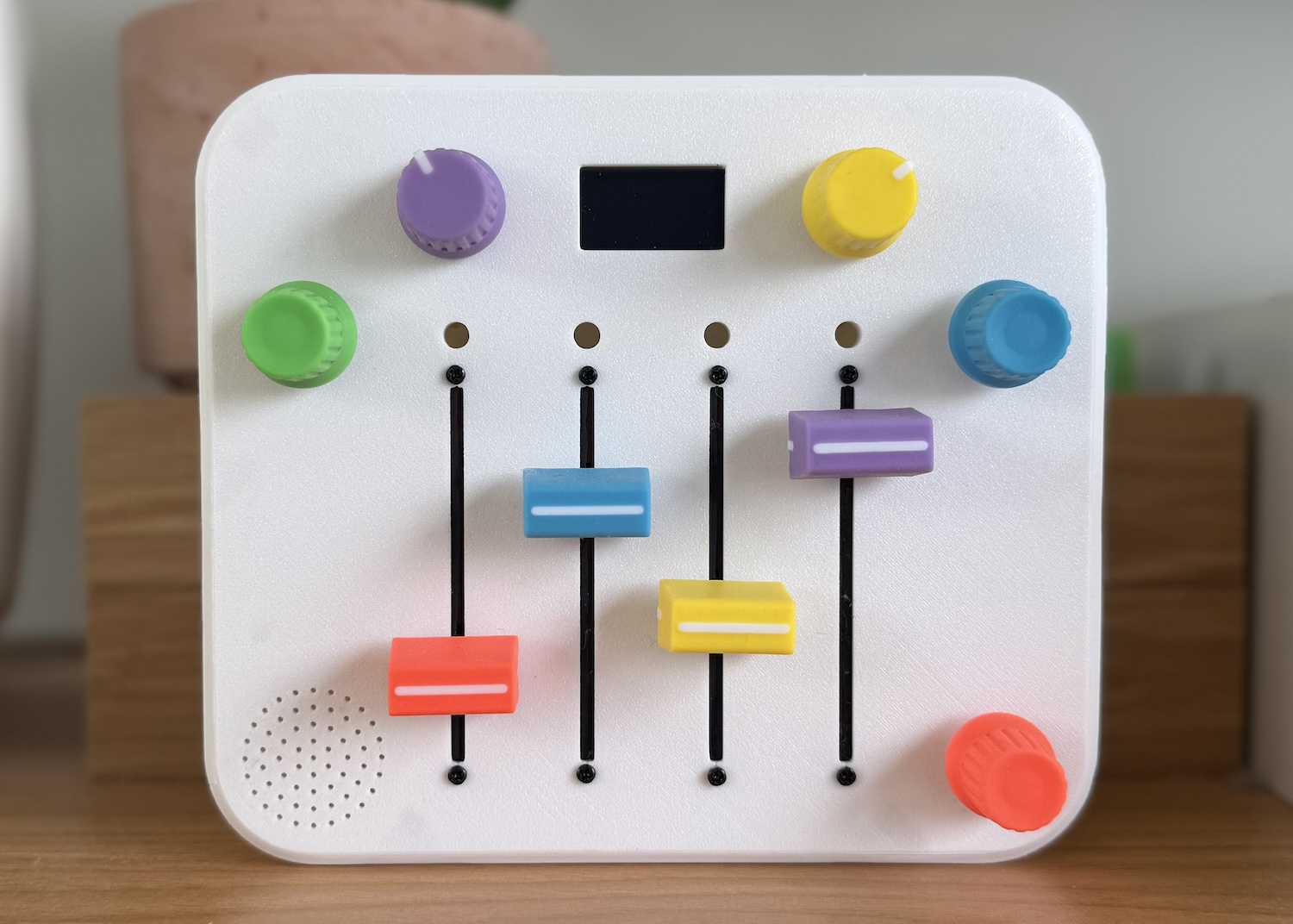
Makes me wonder what the difference, in definition, is between a sequencer and a synthesizer? Is this really a synthesizer, or is it really a sequencer?
A sequencer is always in steps. A synthesizer has a signal generator and can modulate a single step. This toy is both a synthesizer and a sequencer, but since you cannot toggle the 4 steps off, it will always be a sequencer in addition to the synthesizer
The linked project is both. A synth makes sounds, and a sequencer controls the sound over time usually with note on/off data. This sequencer has 4 steps before looping back to the beginning. To simplify, think of a sequencer as the music box drum and the synth as the tines in a music box.
A synthesizer is generally a higher-level ready-to-use product containing any number of oscillators, sequencers, and other circuits and bells and whistles under the hood. A device with an oscillator and a sequencer qualifies as a basic synth.
At a lower levels you find modules like sequencer, oscillator, etc. They are generally not used by themselves: you plug a sequencer into an oscillator to make use of it, just like a standalone oscillator by itself simply makes a continuous noise that gets old quickly. A synth does that connection for you and exposes the controls. (To make things even more fun, the lines between lower-level audio modules are often blurred. For example, the difference between a sequencer and an oscillator can be best summed up as: the former is commonly designed for unipolar control rate signal change where you can specify exact level per step, while the latter is designed for bipolar audio rate signal change between two predetermined extremes—however, as the “designed for” hints, you could configure some sequencers to output a bipolar signal changing so fast it is audible, just like you could run a square wave oscillator so slowly that it becomes a 2-step sequencer.)
Kinda funny but my adult son has taken an interest in guitars and keyboard and that has me working on MIDI routers with AVR-8 and building an ESP32 based synth module.
Comments (209) 82 threads
Earlier commentsIt's two of these 4-note step sequencers with some fun timing randomness. Similar to the OP's synth it uses knobs to set pitches but the knobs are picking notes from a specific key so they always sound good together. It's a lot of fun to play and doesn't require any musical knowledge!
Yes, I'm splitting hairs about semantics.
It is a synthesiser AND it is a step sequencer.
At a lower levels you find modules like sequencer, oscillator, etc. They are generally not used by themselves: you plug a sequencer into an oscillator to make use of it, just like a standalone oscillator by itself simply makes a continuous noise that gets old quickly. A synth does that connection for you and exposes the controls.
(To make things even more fun, the lines between lower-level audio modules are often blurred. For example, the difference between a sequencer and an oscillator can be best summed up as: the former is commonly designed for unipolar control rate signal change where you can specify exact level per step, while the latter is designed for bipolar audio rate signal change between two predetermined extremes—however, as the “designed for” hints, you could configure some sequencers to output a bipolar signal changing so fast it is audible, just like you could run a square wave oscillator so slowly that it becomes a 2-step sequencer.)
All comments shown.
Couldn't load more comments. Check your connection and try again.