Amazing the things we do for our little ones. I built a toddler-friendly keyboard for my son. He's still playing some form of piano 6 years later, no longer with his fists or feet.
Thank you for that closing paragraph in your article. Every time I read something online that tries to bend it into some "profound" lesson, or integrate it into the writer's personal brand, I throw up a little. This is most egregious on LinkedIn, and why I avoid that place unless I have to find a new job or something.
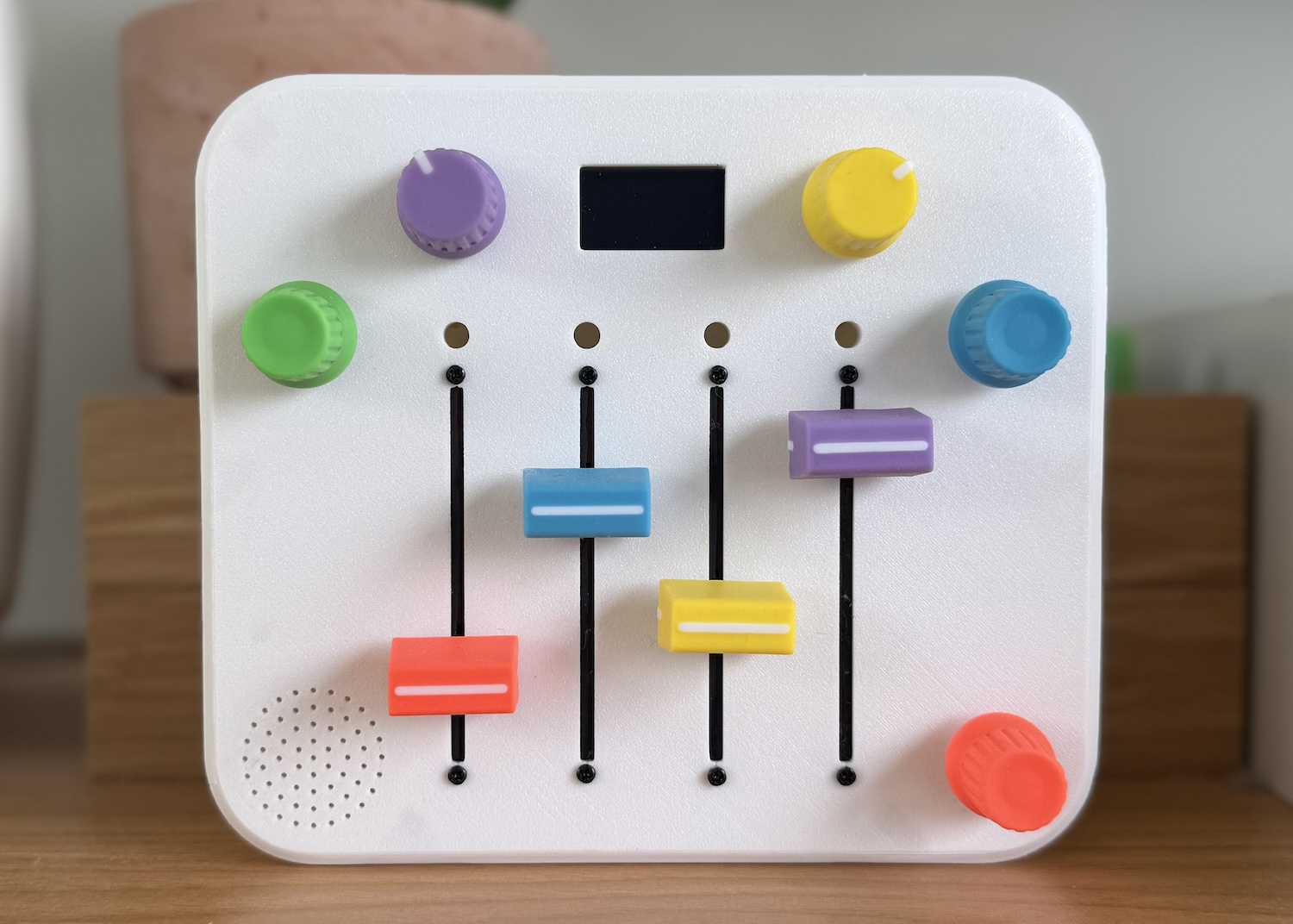
This is phenomenal, but my biggest question is (which is probably a more of a long-term one that comes from genuine curiosity/fascination, not doubt): does she use it/enjoy it? I'm so curious to see what happens over time. Does she learn the functions of these buttons, years before having words for what they're doing? Does she write some music? Does she grow up expecting things with knobs to be this interactive/creative? SO cool!
3-year-olds actually have quite a vocabulary, so they can certainly talk about what the knobs are doing, maybe just not as accurately as adults.
Regarding discovering functionality: The author mentions Montessori stuff, and the philosophy there is unguided discovery, "let them figure out by themselves". Not sure if that's how the author is planning to use this too, though.
It's not kid friendly, but in case anybody's interested I just wrote up how I made a simple "hardware" synth by bodging together a Raspberry Pi Pico 2 and I2S audio module, total cost around £10 on Amazon UK.
The hardware's very cheap and easy. The "default" synthesis is pretty simple but also pretty hackable (in Rust) if you want to customize it. https://github.com/Joeboy/oxynth/
I did some similar playing around with an ESP32 and I2S a few years ago (lockdowns were an odd time). Where I seem to remember getting stuck was how to get the phase to line up, so that each sample looped at a zero-crossing point (which is different for each frequency). For the lazy, what did you do? https://gitlab.com/afandian/melodicornamuse/-/blob/main/melo...
I don't really understand your issue sorry, but my thing basically just writes the audio output to a buffer, and the DMA and PIO "automatically" send that to the I2S output. There's also some messing about with ping ponging between two DMA buffers to avoid gaps between each buffer write audio. I guess things might be quite different on the ESP32.
Edit: Ok I glanced at your code, if I read it right it seems like you're writing sin waves into buffers at "init" time then copying the appropriate buffer at "run" time. Which is not what I'd do, but then I'm used to more luxurious devices. Maybe try using a fast sin approximation rather than the precomputed buffer table? https://bmtechjournal.wordpress.com/2020/05/27/super-fast-qu... might be helpful there.
Thanks! This was just some playing round years ago, so I don't remember much about it. I don't remember if calculating sin() at runtime was too slow, or I wanted to avoid polyphonic O(n) inside the buffer loop, or what. I bet it uses a LUT anyway.
I much prefer your method of just rotating the phase!
were you using single cycle waveforms or longer samples? in the former case, I guess there's not much to it, you just cycle through the waveform (in which case the waveform you choose would usually start and end at a zero crossing by construction, like sines, triangles, etc - or, if it does not, well, that will just create extra harmonics that might or not be desirable).
For the second case, it's more subtle. Most samplers that implement this feature will assume correct loop points (usually, but not necessarily at a zero crossing) are chosen manually by the user. Some of them implement cross-fading at the looping point to make that more forgiving, but that may be CPU/RAM intensive for some devices. If you're referring to small clicks you may get at the start and stop of sample playback, it's fairly common to use very short (ms or less) fade-in/fade-out to avoid that. There's a lot of books out there, but the main one I've read and enjoyed is this one, that happens to be free: https://cs.gmu.edu/~sean/book/synthesis/. it's more of a textbook than a cookbook.
Thanks! Reading the code again, looks like I was filling up buffer of 256 x 16 bit samples.
I think the issue with looping at arbitrary points was word alignment. You need to give it a whole buffer. So you'd have to do some nasty bit-shifting. Per other reply, I think doing it live is probably easisest! Thanks for the recommendation. If I ever get back into this I'll take a look.
Great finish. I was busy designing and soldering the prototype synthesizer during the summer, but I had to put it on hold because my baby was born in September.
I had the same problem back then: injection molding is quite expensive to start. But you could consider a more creative approach: using a PCB directly as the panel, such as a TE's Pocket Operator. Korg also has this solution for some educational products. Alternatively, you could use 3D printing; there are many inexpensive services in China. CNC doesn't have the mold-making issue, but it's more expensive and doesn't seem suitable for children. Another interesting point: after my child was born, I didn't have much time for my sound work. But recently, I was surprised to find that I spend most of my time playing white noise on Glicol (http://glicol.org/) and it works great for my kid. ```
o: noise 42 >> lpf ~mod 1 >> mul ~mod3 ~mod: sin ~mod2 >> mul 200 >> add 1000 ~mod2: sin 0.1 >> mul 0.04 >> add 0.1 ~mod3: sin 0.04 >> mul 0.3 >> add 0.8
``` Good luck with kickstarter!
Comments (209) 82 threads
Earlier commentshttps://blog.afandian.com/2019/09/ux-for-toddlers/
Regarding discovering functionality: The author mentions Montessori stuff, and the philosophy there is unguided discovery, "let them figure out by themselves". Not sure if that's how the author is planning to use this too, though.
The hardware's very cheap and easy. The "default" synthesis is pretty simple but also pretty hackable (in Rust) if you want to customize it.
https://github.com/Joeboy/oxynth/
I did some similar playing around with an ESP32 and I2S a few years ago (lockdowns were an odd time). Where I seem to remember getting stuck was how to get the phase to line up, so that each sample looped at a zero-crossing point (which is different for each frequency).
For the lazy, what did you do?
https://gitlab.com/afandian/melodicornamuse/-/blob/main/melo...
Edit: Ok I glanced at your code, if I read it right it seems like you're writing sin waves into buffers at "init" time then copying the appropriate buffer at "run" time. Which is not what I'd do, but then I'm used to more luxurious devices. Maybe try using a fast sin approximation rather than the precomputed buffer table?
https://bmtechjournal.wordpress.com/2020/05/27/super-fast-qu... might be helpful there.
I much prefer your method of just rotating the phase!
I think the issue with looping at arbitrary points was word alignment. You need to give it a whole buffer. So you'd have to do some nasty bit-shifting.
Per other reply, I think doing it live is probably easisest!
Thanks for the recommendation. If I ever get back into this I'll take a look.
I had the same problem back then: injection molding is quite expensive to start. But you could consider a more creative approach: using a PCB directly as the panel, such as a TE's Pocket Operator. Korg also has this solution for some educational products. Alternatively, you could use 3D printing; there are many inexpensive services in China. CNC doesn't have the mold-making issue, but it's more expensive and doesn't seem suitable for children.
Another interesting point: after my child was born, I didn't have much time for my sound work. But recently, I was surprised to find that I spend most of my time playing white noise on Glicol (http://glicol.org/) and it works great for my kid.
``` o: noise 42 >> lpf ~mod 1 >> mul ~mod3
~mod: sin ~mod2 >> mul 200 >> add 1000
~mod2: sin 0.1 >> mul 0.04 >> add 0.1
~mod3: sin 0.04 >> mul 0.3 >> add 0.8 ```
Good luck with kickstarter!
All comments shown.
Couldn't load more comments. Check your connection and try again.