There goes the XBOX. Microsoft have been letting their consumer products rot for a while now and they're finally going to start feeling the consequences.
The original steam deck was already exactly the product Microsoft should have made. There is now a whole class of similar (but generally more expensive) windows-powered devices. If Microsoft would have made the "XBOX Deck" they could have sold 10 times the numbers Steam Deck did.
But indeed, I'd think Phil Spencer's days are numbered now.
Well, hopefully, future XBoxes are fixed-spec PCs which run Steam AND some xbox frontend, and can switch between them as the user wishes.
There's no reason anymore for the xbox to be a different platform or hardware than PCs. An Xbox that is just a PC with fixed specs (or varying specs with some way to measure what spec you're compliant with) and which can use the Xbox store is probably all that people really want anyway.
Cool but I wish it had a single big APU chip like the consoles and Strix Halo - and unified memory. PCs are long overdue for adopting this change, and the only reason it makes sense to keep the separate is to make graphics cards swappable.
Considering how big GPU silicon is, when you have both integrated and custom, it'd have made sense to integrate them.
> and unified memory. PCs are long overdue for adopting this change
Why? Desktop PCs, especially gaming PCs, have nothing to gain and everything to lose by oversubscribing system memory with GPU workloads. The memory bus typically isn't fast enough anyways, and a modern PCIe x16 can easily handle the bandwidth of a gigantic GPU. The only advantage to unifying everything is latency, which isn't relevant at any framerate under 1000hz. > when you have both integrated and custom, it'd have made sense to integrate them. Sometimes, sometimes not. AMD's mobile packaging technology is not world-class like Apple and Nvidia's is. Valve had the experience with the Steam Deck to make the call if a mobile architecture was the right choice, and they decided against it. Valve doesn't have to make a Mac. This is a gaming device, it's designed accordingly.
All consoles have been using a single integrated chip since the last generation. The memory bandwidth a CPU uses is much less than GPU. Let's say a CPU does 50 GB/s peak while the GPU does 200+
But why is it overdue? It's easy to put the performance profile of a console on an SOC, it's impossible to integrate many desktop GPUs into the same form factor. Pull up a unified benchmark like the OpenCL Geekbench, it makes this obvious. The most powerful SOCs, like the M3 Ultra, pull over 250w to get worse scores than a 4080 laptop dGPU: https://browser.geekbench.com/opencl-benchmarks
How are SOCs going to replace full-fat ATX cards when they can't even beat the thermally-throttled version? The SOC isn't even more energy-efficient, here.
What they're using here is still mostly off the shelf silicon with some tweaks. If they got enough volume, they probably could go for an all integrated APU with unified memory that could keep the GPU fed, but that'd be a very expensive and new thing to develop.
I hope that if this is a success, they'll have the numbers to justify a Strix-Halo like APU with a smaller CPU but keeping the big GPU for the next generation of the device.
I'm thinking they considered this strongly, since that's what they did with the steam deck.
We don't know price yet, but if it's like the deck they'll be trying to keep it as cheap as possible. The deck supposedly was so off-the-shelf that it re-used a design for another AMD customer, leftover elements and all - https://boilingsteam.com/an-in-depth-look-at-the-steam-deck-... Unless Valve took a big risky bet, the Steam deck is going to be again re-using existing hardware and excess hardware. I'm presuming there are leftover unsold Zen 4 and RDNA 3 dies - and nothing competitive that AMD could offer from Valves perspective, at least when they locked the design some months ago.
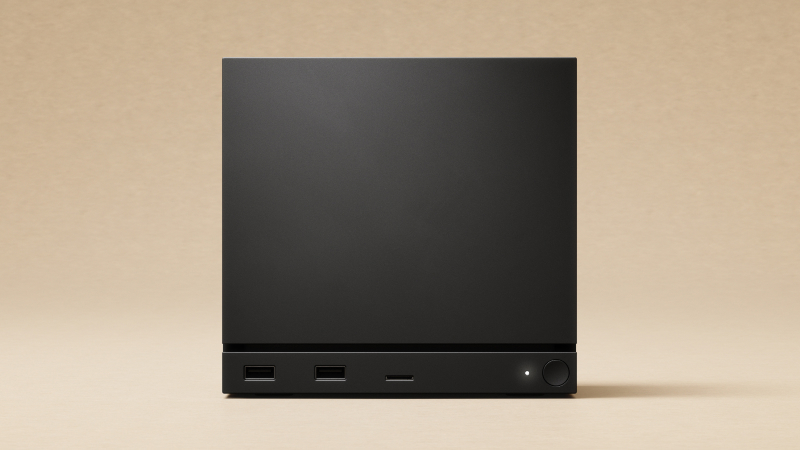
Being able to play PC-ish games without Windows (all on its own) makes this pretty interesting. Looking forward to seeing its real world performance. The fact that it doesn't take up the space of a household appliance is a plus too.
You can do that today with a Steam Deck + a dock. The performance is surprisingly good and most higher end games you buy on Steam will come with pre-configured steam deck settings to downgrade video settings if needed.
I'm going to be buying the box though for the faster AMD chip, as I wasn't able to play some like Resident Evil 2 remake. While the Silent Hill 2 Remake played decent enough.
What exactly do you mean by "pc-ish"? Setting aside steam deck, are you aware that you can already install steam on linux and play many games [0]? Are you aware of Bazzite [1]?
Long time veteran Linux user. I was not able to get anything to run on Steam. It's some sort of display driver issue/conflict, but if it takes me longer than an hour, I'm over it.
This seems to have been targeted especially at someone like me: I don’t like to play on PC, have no interest in building a gaming PC and I only reluctantly buy consoles because of their (kind of) plug-n-play experience.
If this thing can get me a console-like experience and allow me to play my extensive library of games (most of them classic/vintage games you can’t get on modern consoles) hassle-free, then I’m (probably) sold! And on top of that it runs Linux. Awesome, just absolutely fantastic!
This was shared the other day and sounds exactly like what you want. Throw in Steam cloud syncing (although I'm not certain RetroArch supports that) and I imagine it's about as hassle-free as can be. Possibly even more hassle-free than the original consoles - no blowing into cartridges here!
I have a Steam Deck and it’s definitely more janky than for example an Xbox. It’s not bad! But do not expect the same level of polish. Small example, there’s often a need to dial back the graphics quality. Or the text is too small. Or the screen recording is a hassle.
I don't know if it's fair to compare a Deck to a proper full-sized console - especially things like font size being too small, which of course is likely to happen more on a handheld.
I’d be hard pressed to call the Xbox UX “polished” in any way, but I do get what you mean. Though as long as it allows me to play my games with as much ease as the games themselves will allow, then I’m good—I just do not want to be bothered with the “PC” part of this equation.
Comments (1,514) 175 threads
Earlier commentsBut indeed, I'd think Phil Spencer's days are numbered now.
There's no reason anymore for the xbox to be a different platform or hardware than PCs. An Xbox that is just a PC with fixed specs (or varying specs with some way to measure what spec you're compliant with) and which can use the Xbox store is probably all that people really want anyway.
Considering how big GPU silicon is, when you have both integrated and custom, it'd have made sense to integrate them.
Why? Desktop PCs, especially gaming PCs, have nothing to gain and everything to lose by oversubscribing system memory with GPU workloads. The memory bus typically isn't fast enough anyways, and a modern PCIe x16 can easily handle the bandwidth of a gigantic GPU. The only advantage to unifying everything is latency, which isn't relevant at any framerate under 1000hz.
> when you have both integrated and custom, it'd have made sense to integrate them.
Sometimes, sometimes not. AMD's mobile packaging technology is not world-class like Apple and Nvidia's is. Valve had the experience with the Steam Deck to make the call if a mobile architecture was the right choice, and they decided against it.
Valve doesn't have to make a Mac. This is a gaming device, it's designed accordingly.
How are SOCs going to replace full-fat ATX cards when they can't even beat the thermally-throttled version? The SOC isn't even more energy-efficient, here.
I hope that if this is a success, they'll have the numbers to justify a Strix-Halo like APU with a smaller CPU but keeping the big GPU for the next generation of the device.
We don't know price yet, but if it's like the deck they'll be trying to keep it as cheap as possible. The deck supposedly was so off-the-shelf that it re-used a design for another AMD customer, leftover elements and all - https://boilingsteam.com/an-in-depth-look-at-the-steam-deck-...
Unless Valve took a big risky bet, the Steam deck is going to be again re-using existing hardware and excess hardware. I'm presuming there are leftover unsold Zen 4 and RDNA 3 dies - and nothing competitive that AMD could offer from Valves perspective, at least when they locked the design some months ago.
I'm going to be buying the box though for the faster AMD chip, as I wasn't able to play some like Resident Evil 2 remake. While the Silent Hill 2 Remake played decent enough.
0 - https://www.protondb.com/
1 - https://en.wikipedia.org/wiki/Bazzite_(operating_system)
If this thing can get me a console-like experience and allow me to play my extensive library of games (most of them classic/vintage games you can’t get on modern consoles) hassle-free, then I’m (probably) sold!
And on top of that it runs Linux. Awesome, just absolutely fantastic!
https://www.retroarch.com/
https://store.steampowered.com/app/1118310/RetroArch/
It’s just that for the game publishers, the Steam Deck is an afterthought right now. And Xbox is a first class citizen.
Still, it’s pretty great.
Continue this thread — 1 reply
All comments shown.
Couldn't load more comments. Check your connection and try again.