Show HN: I used Claude Code to discover connections between 100 books (opens in a new tab)trails.pieterma.es
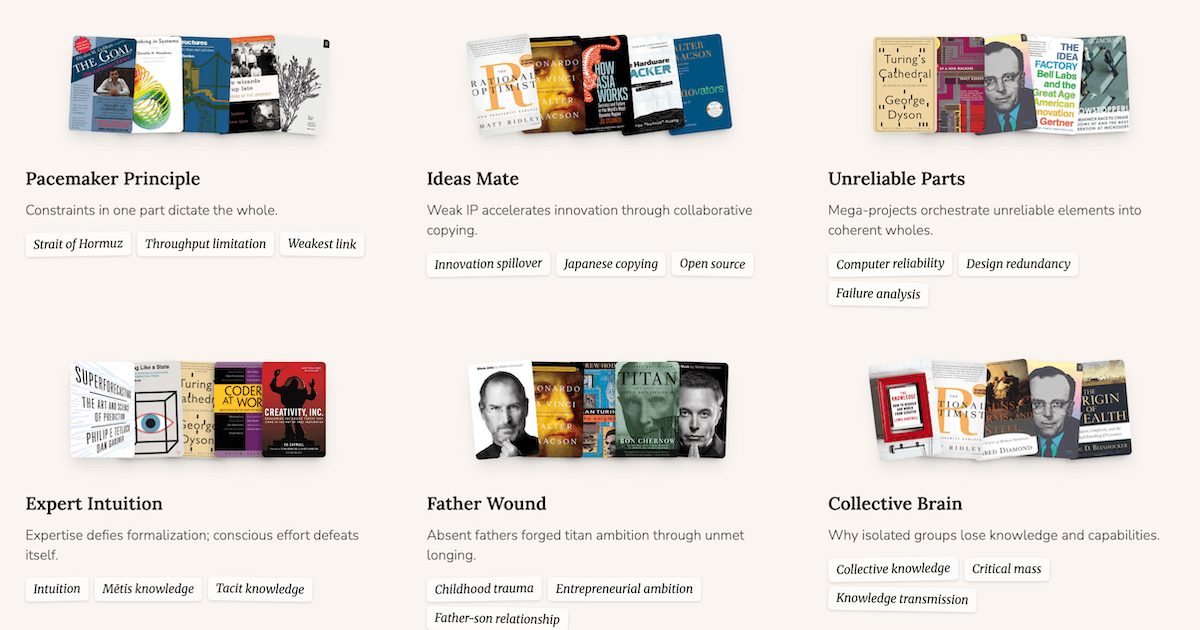
524 pointsI built a system for Claude Code to browse 100 non-fiction books and find interesting connections between them.
I started out with a pipeline in stages, chaining together LLM calls to build up a context of the library.
I was mainly getting back the insight that I was baking into the prompts, and the results weren't particularly surprising.
On a whim, I gave CC access to my debug CLI tools and found that it wiped the floor with that approach.
It gave actually interesting results and required very little orchestration in comparison.
One of my favourite trail of excerpts goes from Jobs’ reality distortion field to Theranos’ fake demos, to Thiel on startup cults, to Hoffer on mass movement charlatans (https://trails.pieterma.es/trail/useful-lies/).
A fun tendency is that Claude kept getting distracted by topics of secrecy, conspiracy, and hidden systems - as if the task itself summoned a Foucault’s Pendulum mindset.
Details:
* The books are picked from HN’s favourites (which I collected before: https://hnbooks.pieterma.es/).
* Chunks are indexed by topic using Gemini Flash Lite. The whole library cost about £10.
* Topics are organised into a tree structure using recursive Leiden partitioning and LLM labels. This gives a high-level sense of the themes.
* There are several ways to browse. The most useful are embedding similarity, topic tree siblings, and topics cooccurring within a chunk window.
* Everything is stored in SQLite and manipulated using a set of CLI tools.
I wrote more about the process here: https://pieterma.es/syntopic-reading-claude/
I’m curious if this way of reading resonates for anyone else - LLM-mediated or not.
Comments (146) 66 threads
Earlier commentsWouldn't it be good if recursive Leiden and cypher was built into an embedded DB?
That's what I'm looking into with mcp-server-ladybug.
Conclusion: you find wisdom in everything if you look for it.
>The Law of Fives states simply that: ALL THINGS HAPPEN IN FIVES, OR ARE DIVISIBLE BY OR ARE MULTIPLES OF FIVE, OR ARE SOMEHOW DIRECTLY OR INDIRECTLY APPROPRIATE TO 5.
>The Law of Fives is never wrong.
>In the Erisian Archives is an old memo from Omar to Mal-2: "I find the Law of Fives to be more and more manifest the harder I look."
All comments shown.
Couldn't load more comments. Check your connection and try again.