Show HN: I used Claude Code to discover connections between 100 books (opens in a new tab)trails.pieterma.es
524 pointsI built a system for Claude Code to browse 100 non-fiction books and find interesting connections between them.
I started out with a pipeline in stages, chaining together LLM calls to build up a context of the library.
I was mainly getting back the insight that I was baking into the prompts, and the results weren't particularly surprising.
On a whim, I gave CC access to my debug CLI tools and found that it wiped the floor with that approach.
It gave actually interesting results and required very little orchestration in comparison.
One of my favourite trail of excerpts goes from Jobs’ reality distortion field to Theranos’ fake demos, to Thiel on startup cults, to Hoffer on mass movement charlatans (https://trails.pieterma.es/trail/useful-lies/).
A fun tendency is that Claude kept getting distracted by topics of secrecy, conspiracy, and hidden systems - as if the task itself summoned a Foucault’s Pendulum mindset.
Details:
* The books are picked from HN’s favourites (which I collected before: https://hnbooks.pieterma.es/).
* Chunks are indexed by topic using Gemini Flash Lite. The whole library cost about £10.
* Topics are organised into a tree structure using recursive Leiden partitioning and LLM labels. This gives a high-level sense of the themes.
* There are several ways to browse. The most useful are embedding similarity, topic tree siblings, and topics cooccurring within a chunk window.
* Everything is stored in SQLite and manipulated using a set of CLI tools.
I wrote more about the process here: https://pieterma.es/syntopic-reading-claude/
I’m curious if this way of reading resonates for anyone else - LLM-mediated or not.
Comments (146) 66 threads
Earlier commentsEdit/update: if you are looking for the phantom thread between texts, believe me that an LLM cannot achieve it. I have interrogated the most advanced models for hours, and they cannot do the task to any sort of satisfactory end that a smoked-out half-asleep college freshman could. The models don't have sufficient capacity...yet.
… realize that it’s nonsense and the LLM is not smart enough to figure out much without a reranker and a ton of technology that tells it what to do with the data.
You can run any vector query against a rag and you are guaranteed a response. With chunks that are unrelated any way.
¹ Oh, that's just LLMs in general? Cool!
Continue this thread — 1 reply
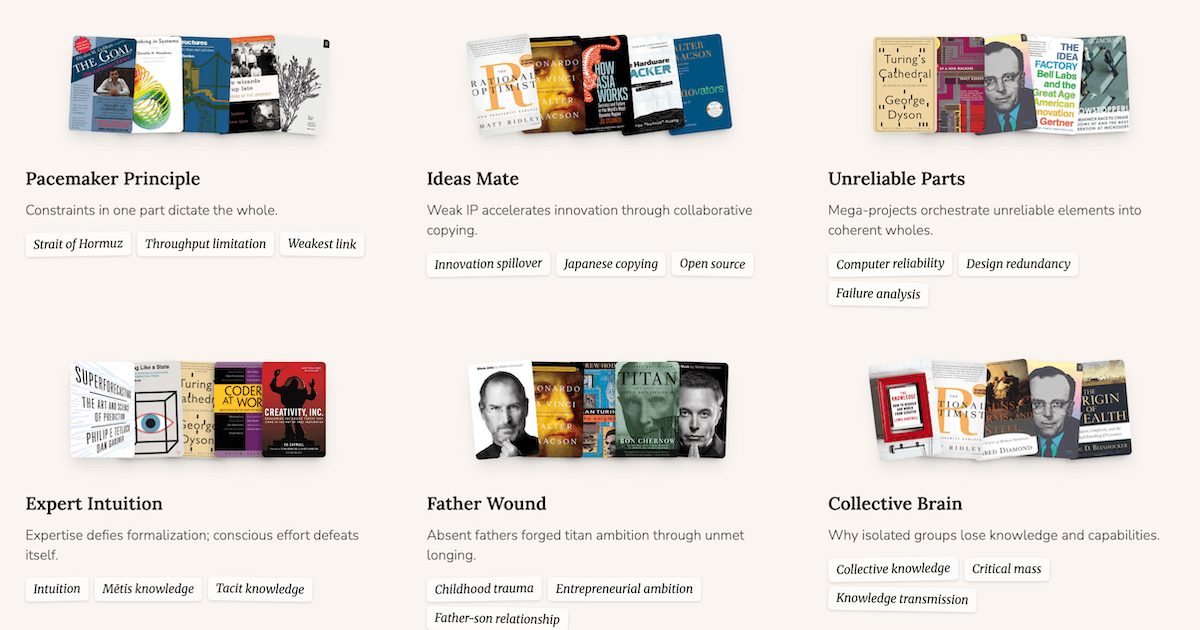
https://trails.pieterma.es/trail/collective-brain/ is great
Continue this thread — 2 replies
Continue this thread — 1 reply
Take for example the OODA loop. How are the connections made here of any use? Seems like the words are semantically related but the concept are not. And even if they are, so what?
I am missing the so what.
Now imagine a human had read all these books. It would have come up with something new, I’m pretty sure about that.
https://trails.pieterma.es/trail/tempo-gradient/
You have an interesting idea here, but looking over the LLM output, it's not clear what these "connections" actually mean, or if they mean anything at all.
Feeding a dataset into an LLM and getting it to output something is rather trivial. How is this particular output insightful or helpful? What specific connections gave you, the author, new insight into these works?
You correctly, and importantly point out that "LLMs are overused to summarise and underused to help us read deeper", but you published the LLM summary without explaining how the LLM helped you read deeper.
this to me sounds off. I read the same 8, to 10 books over and over and with every read discover new things. the idea of more books being more useful stands against the same books on repeat. and while I'm not religious, how about dudes only reading 1 book (the Bible, or Koran), and claiming that they're getting all their wisdom from these for a 1000 years?
If I have a library of 100+ books and they are not enough then the quality of these books are the problem and not the number of books in the library?
A trail that hits that balance well IMO is https://trails.pieterma.es/trail/pacemaker-principle/. I find the system theory topics the most interesting. In this one, I like how it pulled in a section from Kitchen Confidential in between oil trade bottlenecks and software team constraints to illustrate the general principle.
I'm not familiar with he term "Pacemaker Principle" and Google search was unhelpful. What does it mean in this context? What else does this general principle apply to?
I'm perfectly willing to believe that I am missing something here. But reading thought many of the supportive comments, it seems more likely that this is an LLM Rorschach test where we are given random connections and asked to do the mental work of inventing meaning in them.
I love reading. These are great books. I would be excited if this tool actually helps point out connections that have been overlooked. However, it does not seem to do so.
How is that different from having an insight yourself and later doing the work to see if it holds on closer inspection?
Continue this thread — 7 replies
This made me realize that so many influential figures have either absent fathers, or fathers that berated them or didn't give them their full trust/love. I think there's something to the idea that this commonality is more than coincidence. (that's the only topic of the site I've read through yet, and I ignored the highlighted word connections)
But so many of the links just don't make sense, as several comments have pointed out. Are these actually supposed to represent connections between books, or is it just a random visual effect that's suppose to imply they're connected?
I clicked on one category and it has "Us/Them" linked to "fictions" in the next summary. I get that it's supposed to imply some relationship but I can't parse the relationships
All comments shown.
Couldn't load more comments. Check your connection and try again.