Show HN: If you lose your memory, how to regain access to your computer? (opens in a new tab)eljojo.github.io
402 pointsDue to bike-induced concussions, I've been worried for a while about losing my memory and not being able to log back in.
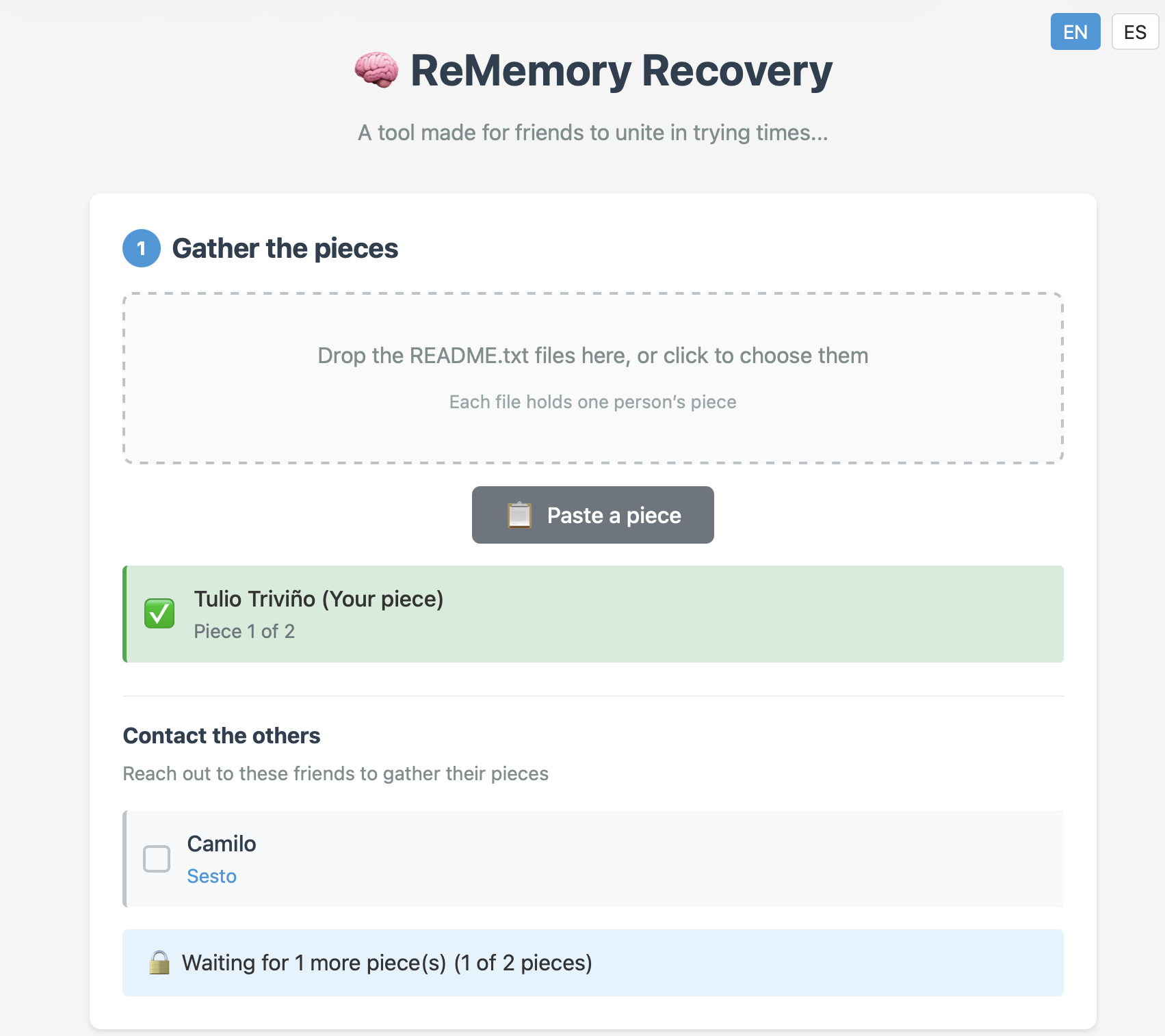
I combined shamir secret sharing (hashicorp vault's implementation) with age-encryption, and packaged it using WASM for a neat in-browser offline UX.
The idea is that if something happens to me, my friends and family would help me get back access to the data that matters most to me. 5 out of 7 friends need to agree for the vault to unlock.
Try out the demo in the website, it runs entirely in your browser!
Comments (233) 69 threads
Earlier commentsHad the same idea years ago (same hashicorp lib too) but lost motivation to polish it to the point I felt confident enough to Show HN. https://github.com/xkortex/passcrux
But given recent events, I want to restart work on it.
My use-case revolved more around preserving a master password e.g. to a password manager. I also wanted to support self-hosted backup, like hiding shares and giving directions to the parts to trusted friends. The shamir sharing part was straightforward but i really want to add forward error-correction to protect against partial data loss.
https://bitwarden.com/help/emergency-access/
Would also cover banking details or whatever else you want to put in there.
While the motivation is similar this basically kills the feature. It requires that your friends not only use but continue to maintain their accounts.
From my understanding of OP's implementation, being completely offline they can basically just keep the key on a USB or file store of any kind.
Personally I think the most robust solution is single key access (a la emergency kit), distributed in one or more secure bank vaults for redundancy (many still do offer these for free or cheaply for small boxes). Put instructions in your (living) will and done.
Similar arguments could be made against this too: trusted contacts need to make sure the USB isn't damaged or lost and that the files haven't been corrupted. At the end of the day, these types of recovery flows require some level of engagement which in itself is an issue since human beings are very flawed.
https://support.apple.com/guide/iphone/share-passwords-iphe6...
https://support.apple.com/guide/icloud/share-files-and-folde...
This is the sort of stuff that terrifies me https://hey.paris/posts/appleid/
All comments shown.
Couldn't load more comments. Check your connection and try again.