Show HN: I built a sub-500ms latency voice agent from scratch (opens in a new tab)ntik.me
570 pointsI built a voice agent from scratch that averages ~400ms end-to-end latency (phone stop → first syllable). That’s with full STT → LLM → TTS in the loop, clean barge-ins, and no precomputed responses.
What moved the needle:
Voice is a turn-taking problem, not a transcription problem. VAD alone fails; you need semantic end-of-turn detection.
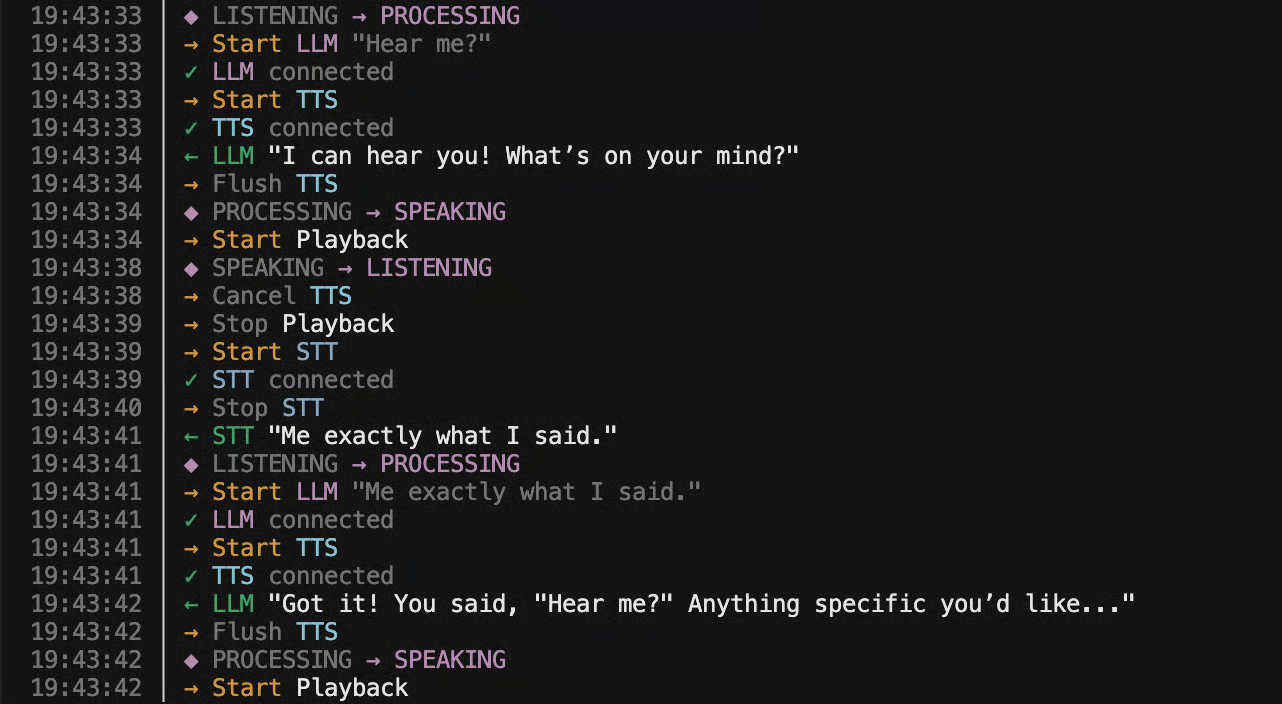
The system reduces to one loop: speaking vs listening. The two transitions - cancel instantly on barge-in, respond instantly on end-of-turn - define the experience.
STT → LLM → TTS must stream. Sequential pipelines are dead on arrival for natural conversation.
TTFT dominates everything. In voice, the first token is the critical path. Groq’s ~80ms TTFT was the single biggest win.
Geography matters more than prompts. Colocate everything or you lose before you start.
GitHub Repo:
https://github.com/NickTikhonov/shuo
Follow whatever I next tinker with: https://x.com/nick_tikhonov
Comments (153) 62 threads
Earlier commentsGroq 8b instant is the fastest llm from my test. I used smallest ai for tts as it has the smallest TTFT
My rasberry pi stack: porcupine for wakeword detection + elevenlabs for STT + groq scout as it supports home automation better + smallest.ai for 70ms ttfb
Call stack: twilio + groq whisper for STT + groq 8b instant + smallest.ai for tts
Alexa skill stack: wrote a alexa skill to contact my stack running on a VPS server
(Raspberry Pi Voice Assistant)
Jarvis uses Porcupine for wake word detection with the built-in "jarvis" keyword. Speech input flows through ElevenLabs Scribe v2 for transcription. The LLM layer uses Groq llama-3.3-70b-versatile as primary with Groq llama-3.1-8b-instant as fallback. Text-to-speech uses Smallest.ai Lightning with Chetan voice. Audio input/output handled by ALSA (arecord/aplay). End-to-end latency is 3.8–7.3 seconds.
(Twilio + VPS)
This setup ingests audio via Twilio Media Streams in μ-law 8kHz format. Silero VAD detects speech for turn boundaries. Groq Whisper handles batch transcription. The LLM stack chains Groq llama-4-scout-17b (primary), Groq llama-3.3-70b-versatile (fallback 1), and Groq llama-3.1-8b-instant (fallback 2) with automatic failover. Text-to-speech uses Smallest.ai Lightning with Pooja voice. Audio is encoded from PCM to μ-law 8kHz before streaming back via Twilio. End-to-end latency is 0.5–1.1 seconds.
───
(Alexa Skill)
Tina receives voice input through Alexa's built-in ASR, followed by Alexa's NLU for intent detection. The LLM is Claude Haiku routed through the OpenClaw gateway. Voice output uses Alexa's native text-to-speech. End-to-end latency is 1.5–2.5 seconds.
All comments shown.
Couldn't load more comments. Check your connection and try again.