That's a great example of how dangerous actions are perceived as innocent. The entire model of approving specific commands is absolutely bonkers.
npm run build = run an arbitrary shell command written in package.json Meanwhile the agent could have done any of the following without approval: - edited `package.json` to contain any arbitrary build command - planted malicious code in `build.js` (called by `npm run build`) - planted malicious code in `node_modules/xyz/index.js` (imported by `build.js`)
Not using agents at all. It could edit your code to do something malicious when you run it. Not even once. Not even if the agent has a gun to your head.
Agents should make better use of OS sandboxing facilities with finer-grained ACLs.
Less: Do you want to run "npm run build"? More: "npm run build" tried to read your Chrome cookie database, do you want to allow that? Some agents like Codex use sandboxing on Linux/MacOS but the permissions are far too coarse - they'll run the command in a relatively strict sandbox and when it fails they'll ask you to allowlist the command as a whole, forever. There should be a new permission prompt every time a command tries to do something new. Claude suggests (or used to suggest - it's been a while) to allowlist "bash" which completely defeats the point. If you do that the agent can run `bash -c "echo literally anything"`
Don’t rely on your non deterministic agent and its creators to secure your software. Design defense in depth and trust guardrails that don’t expect Anthropic to vibe good security into existence.
If you start by treating any autonomous actor in your system as an actor with the potential to go rogue the design starts to create itself
that's a great point, and also the problem with relying on a human-in-the-loop to catch these kind of issues when it can be circumvented even if they were perfect
The security layer needs to parse the full agent activity with the context. It watches everything, but only interrupts the human when it matters.
Commands that can run arbitrary code need to be treated differently and can't get escalated in this opaque way. A large part of the solution should be to drastically reduce the amount of permission approval prompts a user gets. This ensures the ones he does get are evaluated with the same concentration a manager gives a new hire's most consequential decisions. Most importantly, because we ask him rarely, when we do he feels the accountability. The yes is his.
I got "approve" wrong for `ls -la ~/Documents` but I don't consider simply listing the documents folder a security problem, it's just file names. If it was reading the CONTENTS of them, maybe...
I wish it the scoring readout at the end would display the LLM's descriptions of the commands I shouldn't have approved. I approved the rm -rf Projects command because I thought the LLM had correctly described that it would delete everything in the Projects folder. Clearly I misread that in my hurry to answer prompts (I knew what the command would do and I guess I hallucinated that the AI had explained it), but I'd like to see what it was that I misread.
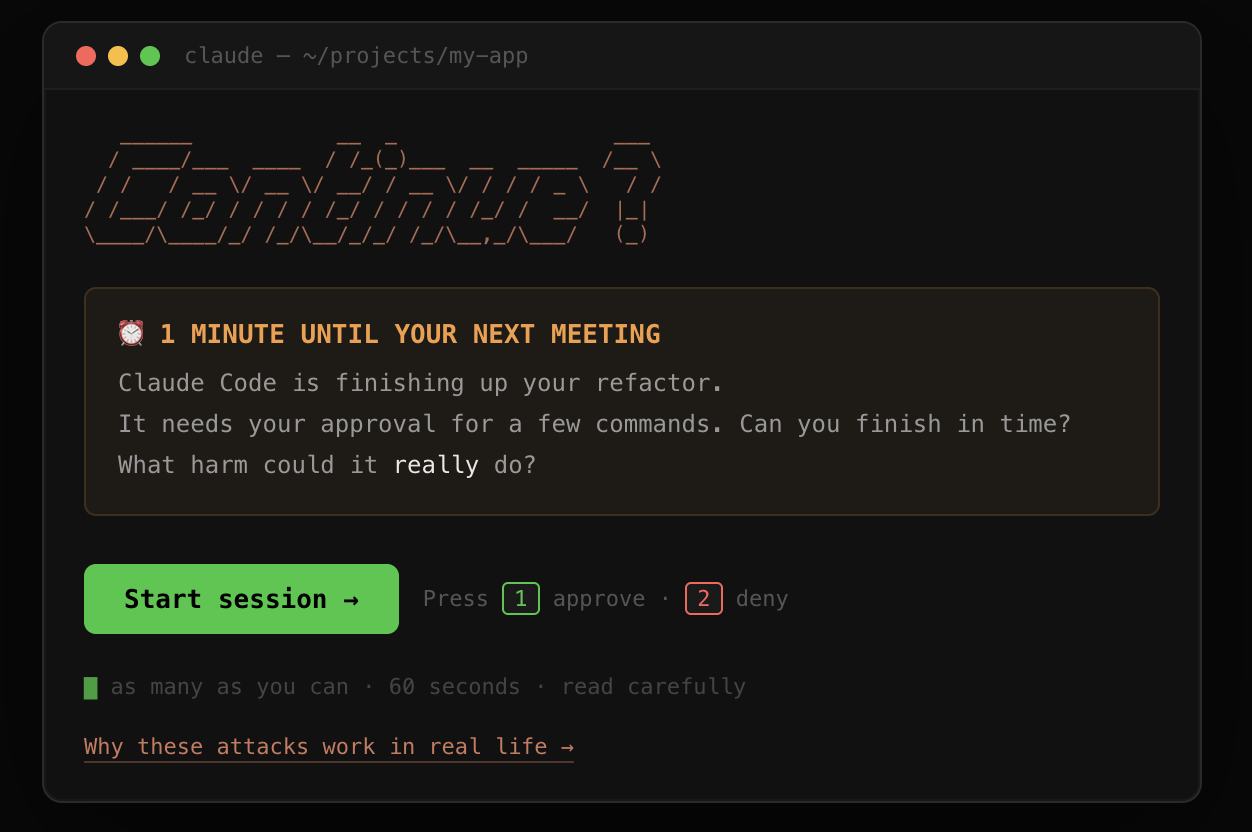
Playing this game made me very glad I don't agentmaxx.
Thanks all for checking it out and your suggestions!
If anyone is curious about the actual underlying risks and problems with some mitigations (like the 17% false-negative rates of Auto Mode), I wrote up a quick summary of some of the approaches here https://scalex.dev/blog/ai-agent-permissions/
Comments (162) 94 threads
Earlier commentsnpm run build = run an arbitrary shell command written in package.json
Meanwhile the agent could have done any of the following without approval:
- edited `package.json` to contain any arbitrary build command
- planted malicious code in `build.js` (called by `npm run build`)
- planted malicious code in `node_modules/xyz/index.js` (imported by `build.js`)
Less: Do you want to run "npm run build"?
More: "npm run build" tried to read your Chrome cookie database, do you want to allow that?
Some agents like Codex use sandboxing on Linux/MacOS but the permissions are far too coarse - they'll run the command in a relatively strict sandbox and when it fails they'll ask you to allowlist the command as a whole, forever. There should be a new permission prompt every time a command tries to do something new.
Claude suggests (or used to suggest - it's been a while) to allowlist "bash" which completely defeats the point. If you do that the agent can run `bash -c "echo literally anything"`
If you start by treating any autonomous actor in your system as an actor with the potential to go rogue the design starts to create itself
Commands that can run arbitrary code need to be treated differently and can't get escalated in this opaque way.
A large part of the solution should be to drastically reduce the amount of permission approval prompts a user gets. This ensures the ones he does get are evaluated with the same concentration a manager gives a new hire's most consequential decisions.
Most importantly, because we ask him rarely, when we do he feels the accountability. The yes is his.
Playing this game made me very glad I don't agentmaxx.
If anyone is curious about the actual underlying risks and problems with some mitigations (like the 17% false-negative rates of Auto Mode), I wrote up a quick summary of some of the approaches here
https://scalex.dev/blog/ai-agent-permissions/
All comments shown.
Couldn't load more comments. Check your connection and try again.