Show HN: I trained a 125M model to autocomplete piano on-device (opens in a new tab)simedw.com
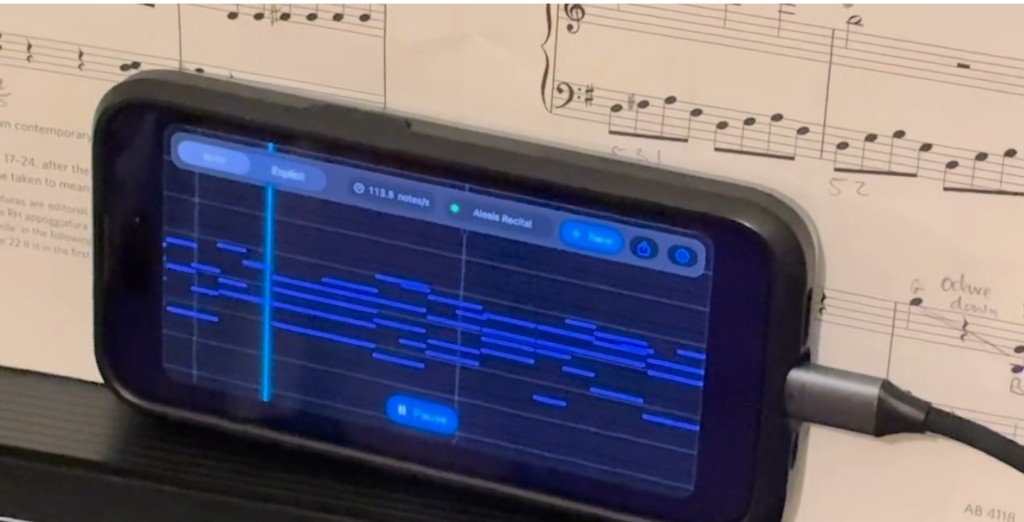
598 pointsI trained a 125M-parameter transformer to autocomplete piano performances in real time (~108 notes/sec on an iPhone 15).
The idea is basically GitHub Copilot or Tabnine, except instead of prompting it with code, you prompt it by playing a few notes on a MIDI piano. The model then continues what you played, entirely on-device.
The app is free if anyone wants to try it. Happy to answer questions about the model, training, Core ML, or the many things that didn't work.
Comments (117) 65 threads
For anyone interested, I’d highly recommend reading Robert Gjerdingen’s article Gebrauchs-Formulas. https://www.researchgate.net/publication/259731561_Gebrauchs...
You can also listen to the transcript of four Russian composers, including Rachmaninoff, playing this pattern recognition and generation game at a dinner party in the late 1800’s: https://youtu.be/PlFPOWuwBHI?is=EKBK7QQkJs4MsTCU
Composers at the time could do this just by looking at sheet music and audiating, without using a piano.
There's a great story around how Beethoven, perhaps one of the strongest improvisers of his day, completely upstaged Steibelt, a contemporary musician and by all accounts a bit of a charlatan. I'll include the entire quote verbatim from "The Lives of the Great Pianists" by Harold Schonberg.
This illustrates the extraordinary degree of audiation, or the cognitive ability to imagine music in the mind in a symbol-linked, systematized way, that used to exist in classical music.
Each composer could read what was just written, audiate how it would sound, audiate a continuation of the phrase, and then transcribe that aural imagination back to sheet music.
After that, the great classical improvisers were probably organists in the 20th century, like Marcel Dupré (1886-1971) and Pierre Cochereau (1924-1984). Cochereau created vast, highly personal, symphonic forms with dazzling orchestral registration.
One think I didn't see mentioned in the post- maybe I missed it- how large was the data? How many samples did you use to pretrain and post-train
> The final dataset contained a few hundred thousand MIDI files, representing roughly 300 million note events.
I see so much in common with this project and the numerous AI-based UX design tools out there. Whether it's music or UI, now that the "generation" portion of the work costs zero, all that remains is taste.
And so much of taste comes from exploring and killing off possibilities that turn out to be dead-ends. I love the idea that models like these will help us find the dead ends faster, or even produce a gem here and there.
P.S. if you want another uncanny version of Fur Elise, listen to Beethoven's own 1822 revision: https://www.youtube.com/watch?v=s24TtiGgb6k. His 1810 version that we all know was simpler and more balanced. But for what it's worth, Beethoven didn't publish either of them.
I am not fond of the extra jazzy notes.
All comments shown.
Couldn't load more comments. Check your connection and try again.