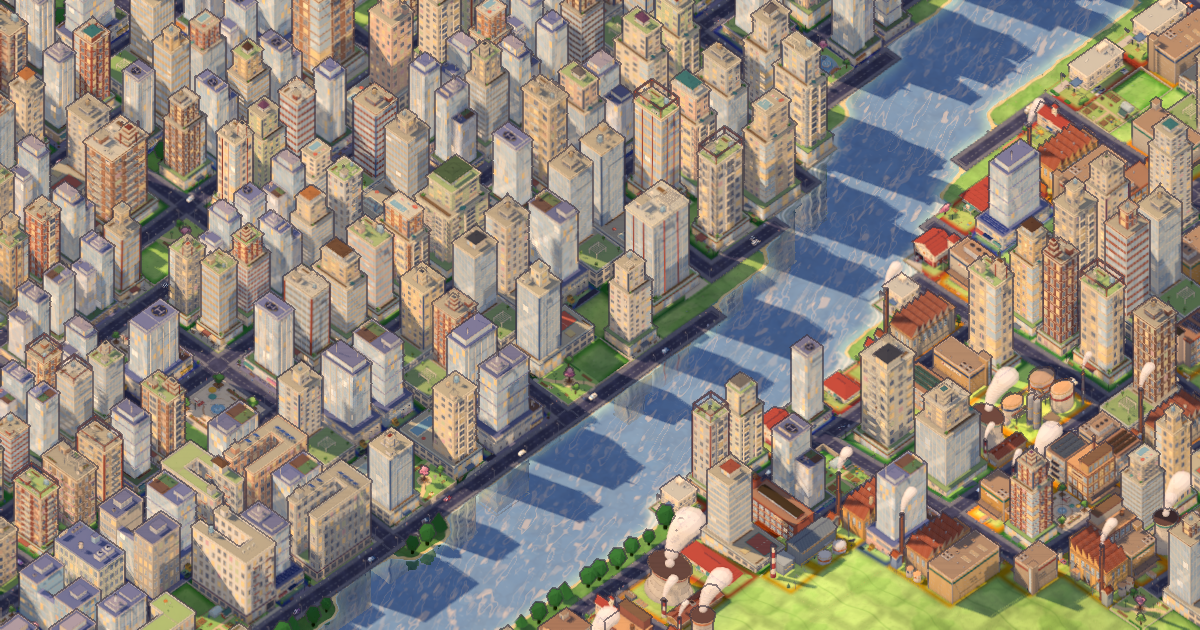
I would actually love a Sim City designed for realistic economic experimentation. A population of 1000’s of professions all acting self-interestedly with their various characteristics, motives, social and economic arrangements.
With a proper SimCity interface and the full complement of fun natural disasters of course!
No, Workers & Resources: Soviet Republic is very much a strong state (aka player) game with basically zero agency from workers as long as they get fed.
Not to say it isn't a great game, it has managed to steal a great deal of my time. With the caveat that its very unpolished and clearly straining under a load bearing amount of duct tape
I suppose this is the result of a hundred years of democracy, aka having to keep everyone happy all the time.
Municipal rules, zoning, community feedback and so on all operate in the space of keeping people happy. No-one wants noise, so we have noise restrictions. Oops, construction is constrained. We all want no traffic, and lots of parking, so low density please, but that creates housing shortages and limits the usefulness of public transport. So a rule is added here, a process there, and everyone is fighting everything all the time. Can't build this because traffic. Can't build that because impact on the neighborhood. But yay, democracy? We can do anything as long as no one is subjectivly harmed. And when nothing at all gets done, we blame politicians for being lazy, incompetent, or corrupt.
> We all want no traffic, and lots of parking, so low density please, but that creates housing shortages and limits the usefulness of public transport.
Sigh. Democracy is going to hang itself with the bike lanes and public transit, isn't it? Density increases and ubiquitous transit result in HIGHER levels of housing shortages. Just ask France.
I'm pretty sure you just said "If you make a place nicer to live, then more people will want to live there, so we should stop making places nicer to live."
Anyway, nobody who has ever been to a major French city believes that they've tried to increase core density. They famously have building height restrictions all over the place. Pretty much the entire city of Paris caps out at 7 stories.
Supply and demand. If you don’t want to increase supply, then you can reduce prices by turning the city into the kind of place that nobody wants to live in.
I repeated the same argument here many times. But the reality is that density creates a vicious cycle of price increases. Higher density provides easier access to talent for companies, so they concentrate in urban cores. This in turn results in the only desirable jobs (and housing) being within the commute distance from the cores. So more people move in, resulting in even greater advantage for companies. Rinse, wash, repeat.
Think about this: EVERY large European city now has a "housing crisis". And nice cities just a couple of hours from them have housing that is essentially free. In Japan it's often _literally_ free. Want an example of a city that doesn't have a housing crisis and is comparable in population to Paris or Berlin? Houston, TX.
>Pretty much the entire city of Paris caps out at 7 stories.
And despite that, Paris is one of the densest cities in the world, and an incredibly pleasant place to live. This should be a good lesson to everyone that "high density" does not have to be synonymous with reams of skyscrapers.
that seems like complete BS claim. What can be asserted without evidence can be dismissed without evidence
increased density and transit increases demand for that area. high demand != shortage. What are you suggesting exactly? low density and car-dependency is the solution to our housing problems?
Just because its heavily regulated doesn't mean it is centrally planned. Housing isn't decided at the federal level. Even city and county commissions that largely decide fate of large, new projects have to abide by state laws or executive orders from governors that sometimes overrule them. And as long as you propose a project that fits zoning rules on the specific parcel you own, you get a permit to build your dream house.
And if one city, county or state says no to your commercial or industrial venture, it's nice that you can shop other states that might love to have you.
Anyone that thinks the US has an insane bureaucracy has never tried to deal with French, German, Chinese, Indonesian, Malaysian, Greek, Italian, or Indian bureaucracy. For those last 6, bribes are a mandatory part of of the process.
Look, at least with the one I had experience of, you knew what you were getting. They would invite you to tea. You grease their palms, and the vast majority of the time, you got what you tacitly agreed to. And you did it after you built, not before. If something went wrong, it was all just haggling on price. Nothing esoteric & labyrinthine with a few warring ideals going up against a hundred petty voices and a handful of corporate interests.
... The french contractors who built the tgv tried working with california in 2011 to build HSR here too. But they backed out, saying the bureacracy was too great and they were going to help Morocco instead. And guess who has high speed rail today? California or Morocco?
It evolves. Laws, rules, regulations accrue but are very rarely re-evaluated to see if they serve their original purpose. It's easier for most lawmakers to leave things alone. Eventually, the state declines or fails under the weight of a century of well-intentioned (maybe) laws that have outlived their usefullness.
Knowing human nature, the best plan for a state that wants to survive is to set a 20 year expiration on laws. Broadly accepted laws would easily be renewed, but obsolete ones would be allowed to die.
Every new generation is convinced that all the cruft of the existing system is useless or obsolete so they create a new system without the cruft based on "first principles" or somesuch bullshit. And then through pain and loss they rediscover why all that cruft was there in the original system in the first place. What seems "obsolete" is many times a bedrock principle of the old system that only seems obsolete now because it is/was so effective that the problem it is intended to address/prevent no longer occurs. Also, legislators review the existing laws all the time. Most "new" laws are just amendments to existing laws.
Well, partly. Cryptocurrencies rediscovered why there are so many regulations. But they also enabled near-instant (hours) cross-border transactions in a way the existing system just can't do because it is too ossified. It also allows people to opt out of regulations they feel are getting in their way too much, which is a good check against over-regulation.
In other words, both the old way and the new way have value. The perfect ideal system is probably a synthesis of both, but in lieu of that, we can have both separately.
That's a matter of political culture and state institutions. Finland is largely governed by rewriting laws. Each government coalition has a few focus areas, where they try to do a major rewrite of all relevant laws and regulations. And then there smaller changes to many other laws. The initial drafts almost always come from career civil servants, and there are processes that try to ensure that all relevant viewpoints have been heard before the proposed changes go to the parliament.
A little too much going on all at once in the beginning. For a complex game like this I think you have to start small and slowly introduce functionality. Why are so many buttons available to me from minute 1? I'm not using them.
I think the overwhelm is kind of the point. If you want a well-balanced video game, where everything is optimized to help you learn the ropes and to get you into a flow state, the classic versions of SimCity provide exactly that. But this game's implementation of a full-fledged city builder is quickly drowned out by the fact that it's shoving resident petitions and requests for variances in your face every 20 seconds. It's an attempt to put the player into the shoes of an actual city planner, mayor, or city councilor that is drowning in interruptions and paperwork.
Give the player a set of AI-powered department heads that manage the day-to-day decisions. The player only gets to write "policy documents" that steer those department, who implement the policies (or not!).
I think that's a charitable read, and I submit that starting slow and ramping up is vital not just from a UX and usability standpoint but to imbibe a sense of panic later on.
The contrast from simple and slow to complex and rapid and the buildup between is what produces the emotion, a cluttered and busy UI is just a cluttered and busy UI. Also : a city planners' job is still fairly serialized and procedural even if it is busy and back-and-fourth; a cluttered UI does little to convey 'busy-ness and conflict'.
Yeah I was excited to try this right up until I looked at the toolbar and inspected a property and got the AI wall of text.
The subject area is great (teach actual civics) but this fails in execution. It could really use a strong pass on UX and learning curve, because right now its a product that everyone is just going to bounce off of. Whether or not the topic is complex is beside the point. The point of this project, as far as I can see it, is get to teach this subject through experience to as many people as possible. Walls of text and tons of controls fundamentally undermine that purpose. Teaching complexity comes by removing everything that isn't absolutely necessary and arranging the complexity in a form that introduces it in compelling bite-sized chunks, so the player is always engaged. To the creator - this is cool, you're certainly barking up the right tree subject-wise. The best thing you can do now is identify the specific learning goals and sequence, and the magic moments you think are possible along the way, and radically simplify the approach. Fork the project and take a different angle on it. I bet there's solid foundations here but if you want to influence you gotta refine.
Thanks - I obviously didn’t get the balance right for everyone, and honestly it’s partly because I started with a maximalist position of “don’t hide the complexity that’s the point”, spent a bunch of time getting those details right…and then quickly realized during playtesting the same thing you and many others pointed out: progressively layering/revealing the depth works better to establish the contrast, while also being significantly easier for players to actually engage with.
Thanks for taking the time to take a look and give thoughtful feedback!
I took some perverse pleasure from the wall of complexity-- as you said, "that's the point". That really came through in my play experience, and I think that adds to it.
Comments (428) 76 threads
Earlier commentsWith a proper SimCity interface and the full complement of fun natural disasters of course!
Songs of Syx is closer but still too micro
I've heard the soviet one is closer to what you're looking for - https://www.sovietrepublic.net
Not to say it isn't a great game, it has managed to steal a great deal of my time. With the caveat that its very unpolished and clearly straining under a load bearing amount of duct tape
Municipal rules, zoning, community feedback and so on all operate in the space of keeping people happy. No-one wants noise, so we have noise restrictions. Oops, construction is constrained. We all want no traffic, and lots of parking, so low density please, but that creates housing shortages and limits the usefulness of public transport.
So a rule is added here, a process there, and everyone is fighting everything all the time. Can't build this because traffic. Can't build that because impact on the neighborhood.
But yay, democracy? We can do anything as long as no one is subjectivly harmed.
And when nothing at all gets done, we blame politicians for being lazy, incompetent, or corrupt.
Sigh. Democracy is going to hang itself with the bike lanes and public transit, isn't it?
Density increases and ubiquitous transit result in HIGHER levels of housing shortages. Just ask France.
Wow, that's a new one
Hell, there are even consulting companies that provide guidance on how to upzone the city to squeeze most taxes out of new density.
Anyway, nobody who has ever been to a major French city believes that they've tried to increase core density. They famously have building height restrictions all over the place. Pretty much the entire city of Paris caps out at 7 stories.
Continue this thread — 1 reply
Think about this: EVERY large European city now has a "housing crisis". And nice cities just a couple of hours from them have housing that is essentially free. In Japan it's often _literally_ free.
Want an example of a city that doesn't have a housing crisis and is comparable in population to Paris or Berlin? Houston, TX.
Continue this thread — 7 replies
And despite that, Paris is one of the densest cities in the world, and an incredibly pleasant place to live. This should be a good lesson to everyone that "high density" does not have to be synonymous with reams of skyscrapers.
Continue this thread — 2 replies
increased density and transit increases demand for that area. high demand != shortage.
What are you suggesting exactly? low density and car-dependency is the solution to our housing problems?
Yes, it just means higher costs.
Continue this thread — 4 replies
Density doesn’t cause housing shortage. A housing shortage creates motivation to increase density.
And if one city, county or state says no to your commercial or industrial venture, it's nice that you can shop other states that might love to have you.
Continue this thread — 1 reply
Morocco's high speed rail line opened in 2018.
Continue this thread — 2 replies
Knowing human nature, the best plan for a state that wants to survive is to set a 20 year expiration on laws. Broadly accepted laws would easily be renewed, but obsolete ones would be allowed to die.
Wait, do we need to pass a law for this?
Continue this thread — 1 reply
Every new generation is convinced that all the cruft of the existing system is useless or obsolete so they create a new system without the cruft based on "first principles" or somesuch bullshit. And then through pain and loss they rediscover why all that cruft was there in the original system in the first place. What seems "obsolete" is many times a bedrock principle of the old system that only seems obsolete now because it is/was so effective that the problem it is intended to address/prevent no longer occurs.
Also, legislators review the existing laws all the time. Most "new" laws are just amendments to existing laws.
In other words, both the old way and the new way have value. The perfect ideal system is probably a synthesis of both, but in lieu of that, we can have both separately.
Continue this thread — 1 more reply
Continue this thread — 34 more replies
Continue this thread — 1 reply
The contrast from simple and slow to complex and rapid and the buildup between is what produces the emotion, a cluttered and busy UI is just a cluttered and busy UI.
Also : a city planners' job is still fairly serialized and procedural even if it is busy and back-and-fourth; a cluttered UI does little to convey 'busy-ness and conflict'.
The subject area is great (teach actual civics) but this fails in execution. It could really use a strong pass on UX and learning curve, because right now its a product that everyone is just going to bounce off of.
Whether or not the topic is complex is beside the point. The point of this project, as far as I can see it, is get to teach this subject through experience to as many people as possible. Walls of text and tons of controls fundamentally undermine that purpose. Teaching complexity comes by removing everything that isn't absolutely necessary and arranging the complexity in a form that introduces it in compelling bite-sized chunks, so the player is always engaged.
To the creator - this is cool, you're certainly barking up the right tree subject-wise. The best thing you can do now is identify the specific learning goals and sequence, and the magic moments you think are possible along the way, and radically simplify the approach. Fork the project and take a different angle on it. I bet there's solid foundations here but if you want to influence you gotta refine.
Thanks for taking the time to take a look and give thoughtful feedback!
I took some perverse pleasure from the wall of complexity-- as you said, "that's the point". That really came through in my play experience, and I think that adds to it.
Continue this thread — 1 more reply
All comments shown.
Couldn't load more comments. Check your connection and try again.