I've had a lot of luck getting LLMs to do interesting things with raw tabulated data. Here's an example, plug this into the model of your choice:
  Here's a puzzle: what is this data from?

  39.0 2582 8.8 24
  39.2 2592 9.6 22
  39.4 2607 5.4 15
  39.6 2619 11.5 30
  39.8 2620 10.8 28
  40.0 2622 5.9 16
  40.2 2642 13.1 28
  40.4 2654 8.8 18
  40.6 2656 3.6 9
  40.8 2665 5.7 12
This is raw data I have laying around that's not from the internet and not part of any training set. It should be able to tell you A LOT about what's going on here, including multiple specific "make and model" type things.
My klaus kot says it's elevation data from a fitness tracker (distance in km, elevation in m, stddev, max-min). It also says there's no way to identify make and model without "seeing the original file" :D
I asked ChatGPT about this a few hours after you posted. It had no meaningful insight into the data on its own, but it found this exact post and referenced the discussion. Which was actually impressive to me because conventional search never worked remotely that well for me.
I think so. I guess the weights could be identical in function, but offset or rotated. I assume a retraining of Astra would yield numerically totally different weights even if functionality was identical.
I dont feel the air of impressivness here. It seems like of course so. Of course theres geometric relationships in the data we dont understand, of course a mathimatical relationship machine found it.
These models are made by a vanishingly small group of people based on how much a frontier lab consumes, of course theres increasing capability in these areas, arent these models having access to much of the same data? didnt chat gpt 4 try to do something like this to chat gpt 2? havent surgical weight edits been done before? What is with this level of astonishment here? Astraturfing? Im not THAT impressed, i applaude the teams progress, but im not in wonderment.
It's not that it's more impressive than solving Millenium Prize problems. It's that if a model can edit its own weights, then it can self-improve without having to undergo training, which means it can self-improve extraordinarily faster.
This is very dangerous because it allows AI capabilities to grow at a much faster rate than humans are able to keep up with.
It will just give the people better understanding. And the extent of the improvement is yet to be seen, it's likely that once you get all the obvious low hanging fruit it would be very hard to improve, the possibility space is just too wide.
What if every model under a ~1B size gets super cracked over the next 2 months? What could swarms of tiny agents 2 ooms larger than what seen so far do?
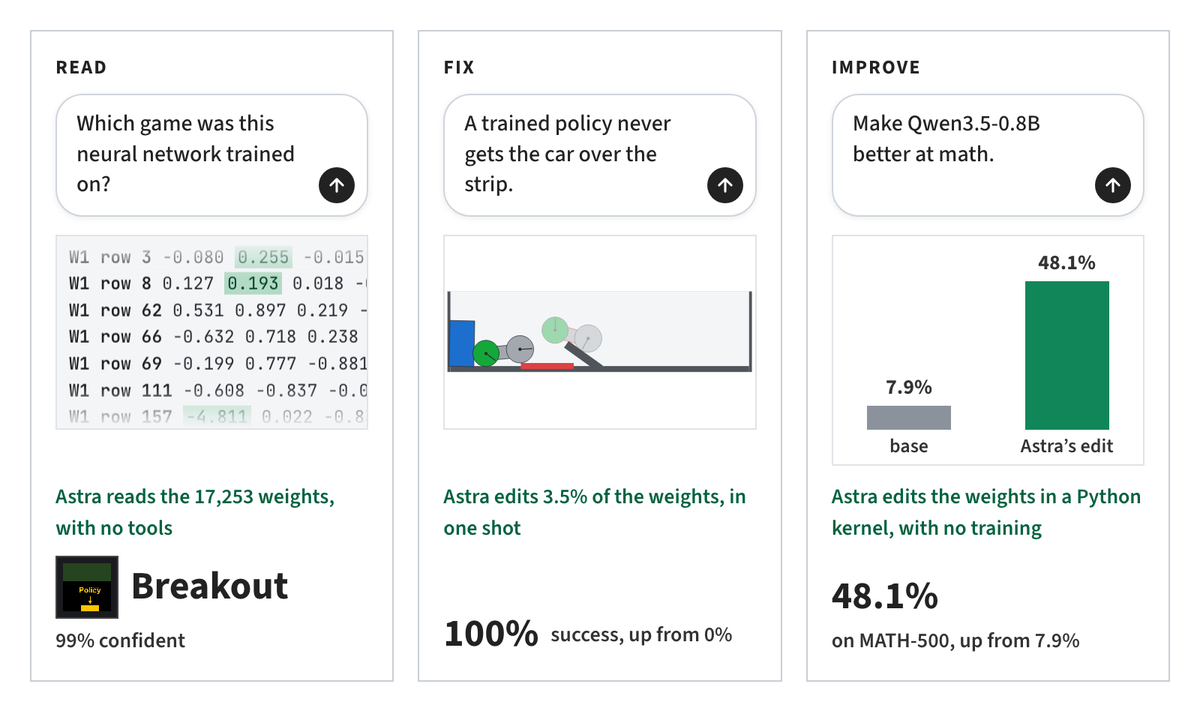
Previously the only way to improve a neural network (short of giving it more data) is to change the size (width, depth, and layers), add stuff like dropout, change the loss function, etc. That amounts to a few dozens of levers to control millions or billions of weights. You're trying to navigate blindly through a latent space with thousands of dimensions and millions of weights to find some optimum point with only a handful of navigation tools. If you can instead have a system reason with all the weights and dimensions directly, you now have millions of levers at your disposal.
It is already the same technique behind abliteration: identifying the direction associated with an observed behavior (refusal, for abliteration) and projecting it out.
Comments (902) 298 threads
Earlier commentsI've had a lot of luck getting LLMs to do interesting things with raw tabulated data.
This is raw data I have laying around that's not from the internet and not part of any training set. It should be able to tell you A LOT about what's going on here, including multiple specific "make and model" type things.Here's an example, plug this into the model of your choice:
FWIW I tested this a couple times on opus and it got it instantly.
So to fix the weights, Astra first has learn a new language of how the numbers that represent weights map to meanings?
These models are made by a vanishingly small group of people based on how much a frontier lab consumes, of course theres increasing capability in these areas, arent these models having access to much of the same data? didnt chat gpt 4 try to do something like this to chat gpt 2? havent surgical weight edits been done before?
What is with this level of astonishment here? Astraturfing? Im not THAT impressed, i applaude the teams progress, but im not in wonderment.
This is very dangerous because it allows AI capabilities to grow at a much faster rate than humans are able to keep up with.
All comments shown.
Couldn't load more comments. Check your connection and try again.