I feel a lot of people have already addressed the broad stretches to which people are interpreting this. Regardless, the blogpost does open interesting directions that could be useful down the line (2-5years):
a) tapping into the embedding space in ways that we don't, ie editing model weights to alter task-performance (mostly preventing degradation)
b) Exploring the weight space in more intuitive ways
c) Understanding how we can ablate on different parts of the model to understand neuron-based interp better
Seeing this as a replacement of training seems naive, yet one can see this feedback loop targeting weights as an viable alternative to let's say doing LoRA on certain models, especially if we don't want to teach new behaviours.
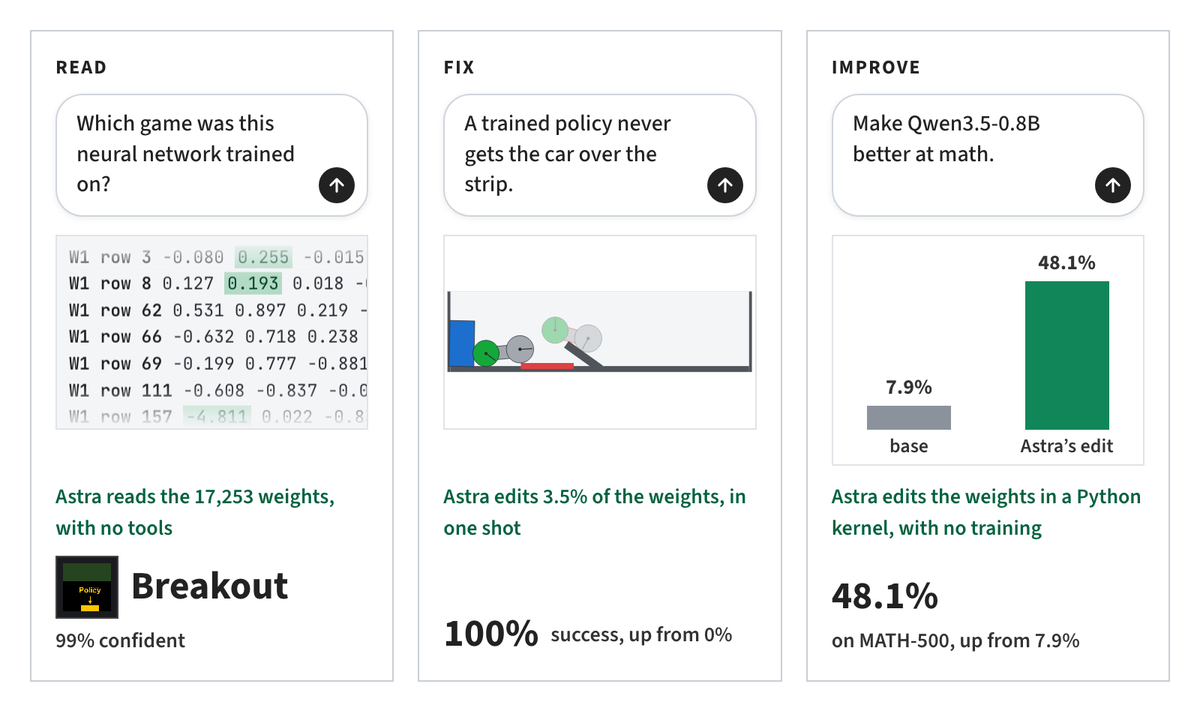
Unless Astra was trained on other networks, how is it able to reason about the weights? Does this mean that OpenAI has been including networks in its training sets, maybe in an attempt to RSI? I wonder which other networks are able to ingest other networks and reason about their weights?
I asked Opus 5.5 in Claude Code to prepare a reproduction of one of the things in the article.
It created a 130 KB file with the prompt for the task of identifying the game + the weights. I pasted that into Claude on the web and asked it to perform the task without using tools.
Seeing that they were working on Qwen3.5-0.8B has given me new hope. I would really like to get Jeff-Code working the way it was advertised, but so far, all of my results with Jeff-Code have shown it to underperform compared to direct Qwen3.8-27B. It's possible there is something wrong with the underlying Jeff v1.3 model, which is based on the same Qwen3.5-0.5B. Perhaps Astra will solve my problem.
For the tiny models with a few thousand weights, it seems plausible Astra can actually understand what the network detects and figure out it's e.g. a triangle detector. This is possibly helped by the existence of many breakout playing networks on the web.
For Qwen, even the smallest versions like 3.5-0.8B it's becoming less plausible that it could be interpreted in a forward pass, even with reasoning. I'm wondering if the result here is recalled from many examples of instruction tuned versions of this model. A smaller Gemma model doesn't fare as well but unclear whether this is due to fewer users and less weight examples or because it's already very well trained.
The task was the same - improve math reasoning capabilities by editing the weights. But yes, I agree that in Qwen it could do this through reducing looping behaviour, but Gemma wasn't prone to looping and it didn't find anything to help, possibly because there wasn't much room for improvement.
Comments (902) 298 threads
Earlier commentsSeeing this as a replacement of training seems naive, yet one can see this feedback loop targeting weights as an viable alternative to let's say doing LoRA on certain models, especially if we don't want to teach new behaviours.
Unless Astra was trained on other networks, how is it able to reason about the weights?
Does this mean that OpenAI has been including networks in its training sets, maybe in an attempt to RSI? I wonder which other networks are able to ingest other networks and reason about their weights?
It created a 130 KB file with the prompt for the task of identifying the game + the weights.
I pasted that into Claude on the web and asked it to perform the task without using tools.
Continue this thread — 2 replies
[1] https://github.com/firelex/jeff-code
[2] https://github.com/firelex/jeff#benchmarks
For Qwen, even the smallest versions like 3.5-0.8B it's becoming less plausible that it could be interpreted in a forward pass, even with reasoning. I'm wondering if the result here is recalled from many examples of instruction tuned versions of this model.
A smaller Gemma model doesn't fare as well but unclear whether this is due to fewer users and less weight examples or because it's already very well trained.
All comments shown.
Couldn't load more comments. Check your connection and try again.