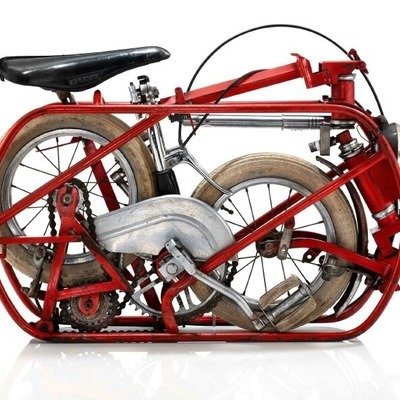
I'm curious if anyone else shares my fairly strong aversion to folding bikes ?
They've always struck me as 1) being 'too clever by half' i.e. yes, being very inventive in their design while also 2) still compromising the rideability of the bicycle (because the foldable design must introduce design compromises) I want a bicycle to be optimally designed for riding purpose only
It’s not that I “dislike” them, but I probably wouldn’t consider buying a small folding bicycle myself.
While they can be incredibly useful depending on where you live, I ended up getting rid of mine because, in the end, I had to make compromises regarding how to use them, their durability, and the availability of replacement parts. That said, I have no intention of dismissing the passion people have for simple modes of transportation, and I actually enjoy watching them.
Brompton bikes ride really well though. They are not particularly compromised on the road.
I’ve done long event rides on mine, 150 milers, and been able to keep up with friends on road bikes. On the Dunwich Dynamo you see a whole fleet of Bromptons because it’s so much easier to get to the start by train. (I’ve also ridden that on carbon road bikes for comparison).
It depends a lot on the design. I wouldn't speak for Brompton but I hear they ride really well, my choice was on the BD-1 [0] like folding style.
The folding part is baked in the suspension and the main frame is fully rigid with no articulation, no folding. Only the stem gets a visible and dedicated folding mechanism. It still rides like a small wheel bicycle, and that's a part I actually like. The suspensions and customizability are pretty great, at no point I felt the design was compromised. [0] https://www.birdybicycle.com/en-jp
I ride my Dahon to and from training twice a week, which is about 16 km from home, which takes me a bit over 3/4ths of an hour; and if the weather's really dire I can fold it up and take it on the bus. I can also take it on the train when I need to cover larger distances (although the Belgian rail network has some massive holes in coverage which is very annoying, especially when travelling between Flanders and Wallonia).
No they are the worst. They only make sense if you need to bring a bike along on a boat or something like that. Anyone that commute with them just chose a subpar ride for no worthwhile upside.
In London, folding bikes serve two primary purposes for me. When I commute, I have a long distance from my house to the train station, then an awkward change of train to underground and a few changes on the underground to my office.
- A folding bike solves this and cuts a lot of time off my commute, from house to station, from far end of station to the office, and it can be taken on the train during peak times, unlike normal bikes. - I could in theory use a normal bike, but then I'd have to lock it up somewhere outside in London, and it is almost certainly going to be stolen. Apart from these issues, yes, I would absolutely prefer to use a non-folding bike.
From a design perspective this (and the other products mentioned in comments here) are really cool.
For an infrastructure perspective, I wonder if the better solution for most people is a municipal bike system, where you can have a real, full-sized bike, instead of having to schlep a small one around with you (that probably has compromises made to accommodate the form factor).
100% yes. I don’t get why cities aren’t aggressively building bike lanes and shared bike infrastructure everywhere. Its much cheaper than building new highways, is healthier and promotes commerce and community.
Because America? Germany has been aggressively pushing pro-cyclist infrastructure for years, sometimes even outside Germany. If you are a cyclist you can consider yourself the king of the road.
The typical use case will be a commuter riding the bike from a train station to home, where there may be no bike share kiosk nearby. And as someone who has ridden shared municipal bikes in many cities, they're often in bad condition and uncomfortable to ride.
Train-assisted walking (or tram, bus, metro, L-train, BRT-assisted) is most useful to most people, if you design for bikes then you get bike-dependent cities and tons of non-space taken up by bike parking (which Amsterdam is surely dealing with). Bikes are perhaps good for cities that were made sprawling for cars, for fun and exercise, or for some people's journeys within a wider city that isn't bike-dependent.
Why not just use an electric unicycle instead? Oh yes, it's banned in a lot of countries for purely bureaucratic reasons, such as legally requiring 2 wheels or a handlebar.
Comments (165) 27 threads
Earlier commentsThey've always struck me as 1) being 'too clever by half' i.e. yes, being very inventive in their design while also 2) still compromising the rideability of the bicycle (because the foldable design must introduce design compromises)
I want a bicycle to be optimally designed for riding purpose only
While they can be incredibly useful depending on where you live, I ended up getting rid of mine because, in the end, I had to make compromises regarding how to use them, their durability, and the availability of replacement parts.
That said, I have no intention of dismissing the passion people have for simple modes of transportation, and I actually enjoy watching them.
I’ve done long event rides on mine, 150 milers, and been able to keep up with friends on road bikes.
On the Dunwich Dynamo you see a whole fleet of Bromptons because it’s so much easier to get to the start by train. (I’ve also ridden that on carbon road bikes for comparison).
The folding part is baked in the suspension and the main frame is fully rigid with no articulation, no folding. Only the stem gets a visible and dedicated folding mechanism.
It still rides like a small wheel bicycle, and that's a part I actually like. The suspensions and customizability are pretty great, at no point I felt the design was compromised.
[0] https://www.birdybicycle.com/en-jp
- A folding bike solves this and cuts a lot of time off my commute, from house to station, from far end of station to the office, and it can be taken on the train during peak times, unlike normal bikes.
- I could in theory use a normal bike, but then I'd have to lock it up somewhere outside in London, and it is almost certainly going to be stolen.
Apart from these issues, yes, I would absolutely prefer to use a non-folding bike.
For an infrastructure perspective, I wonder if the better solution for most people is a municipal bike system, where you can have a real, full-sized bike, instead of having to schlep a small one around with you (that probably has compromises made to accommodate the form factor).
Train-assisted walking (or tram, bus, metro, L-train, BRT-assisted) is most useful to most people, if you design for bikes then you get bike-dependent cities and tons of non-space taken up by bike parking (which Amsterdam is surely dealing with). Bikes are perhaps good for cities that were made sprawling for cars, for fun and exercise, or for some people's journeys within a wider city that isn't bike-dependent.
All comments shown.
Couldn't load more comments. Check your connection and try again.