The problem with things like stalwart, mox, maddy, etc is that they do everything in one piece. If you like the way that piece works, it’s okay. If you don’t, the ability to substitute and/or customize functionalities is limited to nonexistent.
If you’re managing mail for more than a handful of inboxes, that is no good. Classic inbox handling evolved modularly (smtp, spamfilter, imap, webmail…) for a reason.
Customization doesn't require having a separate components. Modularity also doesn't necessarily depend on having a builtin functionality, plugins could exist.
> modularly ... for a reason but not necessarily the one reason you mentioned, maybe they simply got stuck with a worse design
All I know is that today, if I don’t like part of what opensmtpd is doing with my messages, I can write my own plug-in to change it. Meanwhile, some of these all-in-one packages (like mox) don’t even support milters. Maddy is mbox-or-bust. Need maildir instead? Too bad. Spam filtration alone is more art than science. Someone who thinks of that as just another checkbox to tick instead of a project unto itself clearly doesn’t know much about running a big boy mail server.
> some of these all-in-one packages don’t even support milters.
So others do support milters? How can you make a generalized criticism that's not generally applicable? > I can write my own plug-in to change it. Have you actually done it? How hard would it be compared to writing your own patch for the all-in-one?
I've run mailservers both using postfix+dovecot+friends on debian, simple-nixos-mailserver on nixos, mailcow and am currently using mox.
- More options is good - Standards compliance is needed for compatibility - Many old software components are written in memory unsafe languages like C - Users like simple tools, unified software packages like mox and stalwart provide that - Software evolves and you can shape many projects by contributing
I prefer modular time-tested components in C to amateur re-creations of ms exchange in go/rust. There is nothing wrong with C. We have valgrind. We have pledge/unveil. And if I want to be extra-paranoid, we have filc.
It's probably a fine solution if you're broke. Low budget orgs deserve email, too.
90% or whatever of orgs switched from local ms exchange for clear reasons - managing a commodity is drudgery and political, you want insulation from us hosting companies, cyber ops are better on hosted and threats are rampant, etc.
I see. So you would rather host with the company that was fully compromised by Russia and China 4-5 years ago ? Didn't they also release a notification last weekend admitting someone broke into a whole bunch of tenants ?
What's it feel to pay for top service and get this instead ?
>So you would rather host with the company that was fully compromised by Russia and China 4-5 years ago ?
Fighting nation states is beyond what all but a few corps could do. It's just not a threat model to lose sleep over. Are the services you use nation-state proof? :/ >Didn't they also release a notification last weekend admitting someone broke into a whole bunch of tenants ? The Entra Connect health service one leaked "unauthorized read-only access to tenant-level metadata, including administrator email addresses, tenant IDs, domain names and synchronization status". In other words, a Tuesday at $WORK. Unfortunately. Nonetheless, we persisted.
If MS is not one of those corps that can fight nation states then who is ? When their _hosted_ suite powers 50-60% of the economy, what do you think will happen if it ever comes to blows between the US and Russia / China ? Russia / China persisted for 2 years inside MS undetected. You really think that what, MS cleaned all machines and restored from last known clean backups ? And yes, I fully believe a decentralized Internet, especially e-mail , is a lot harder for nation states to compromise when it's hosted on 1000000 different providers, rather than 1.
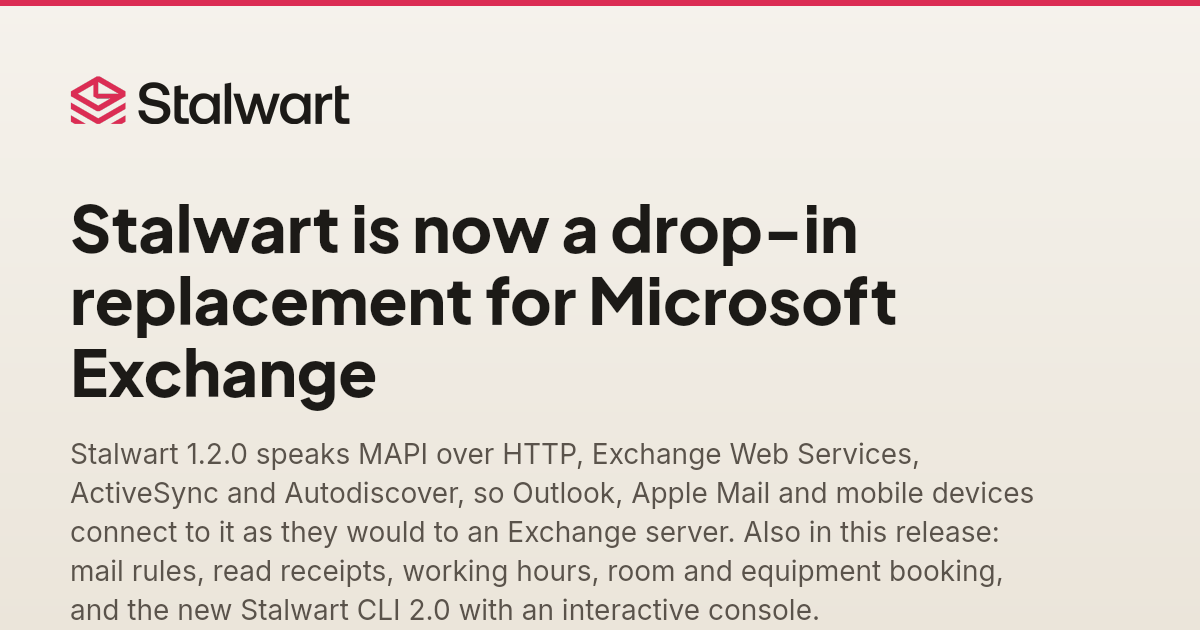
Okay, will this effectively nullify the reliance we have on Microsoft's cloud servers? Will this mean that we won't lose mail for two weeks because of microsoft?
I get your point. But personally, I hated every minute of the 12 months I had to use Teams, and wished everything had gone back to email. I mean, just the input lag drove me mad.
Comments (348) 60 threads
Earlier commentsIf you’re managing mail for more than a handful of inboxes, that is no good. Classic inbox handling evolved modularly (smtp, spamfilter, imap, webmail…) for a reason.
> modularly ... for a reason
but not necessarily the one reason you mentioned, maybe they simply got stuck with a worse design
All I know is that today, if I don’t like part of what opensmtpd is doing with my messages, I can write my own plug-in to change it. Meanwhile, some of these all-in-one packages (like mox) don’t even support milters. Maddy is mbox-or-bust. Need maildir instead? Too bad.
Spam filtration alone is more art than science. Someone who thinks of that as just another checkbox to tick instead of a project unto itself clearly doesn’t know much about running a big boy mail server.
So others do support milters? How can you make a generalized criticism that's not generally applicable?
> I can write my own plug-in to change it.
Have you actually done it? How hard would it be compared to writing your own patch for the all-in-one?
Continue this thread — 1 reply
- More options is good
- Standards compliance is needed for compatibility
- Many old software components are written in memory unsafe languages like C
- Users like simple tools, unified software packages like mox and stalwart provide that
- Software evolves and you can shape many projects by contributing
90% or whatever of orgs switched from local ms exchange for clear reasons - managing a commodity is drudgery and political, you want insulation from us hosting companies, cyber ops are better on hosted and threats are rampant, etc.
What's it feel to pay for top service and get this instead ?
Fighting nation states is beyond what all but a few corps could do. It's just not a threat model to lose sleep over. Are the services you use nation-state proof? :/
>Didn't they also release a notification last weekend admitting someone broke into a whole bunch of tenants ?
The Entra Connect health service one leaked "unauthorized read-only access to tenant-level metadata, including administrator email addresses, tenant IDs, domain names and synchronization status". In other words, a Tuesday at $WORK. Unfortunately. Nonetheless, we persisted.
If MS is not one of those corps that can fight nation states then who is ? When their _hosted_ suite powers 50-60% of the economy, what do you think will happen if it ever comes to blows between the US and Russia / China ?
Russia / China persisted for 2 years inside MS undetected. You really think that what, MS cleaned all machines and restored from last known clean backups ?
And yes, I fully believe a decentralized Internet, especially e-mail , is a lot harder for nation states to compromise when it's hosted on 1000000 different providers, rather than 1.
All comments shown.
Couldn't load more comments. Check your connection and try again.