Am I the only one who loves Venice, but wouldn't want to live (more than a couple of days) in it?! The same applies to buildings - so many of them I love, but never considered for a living!
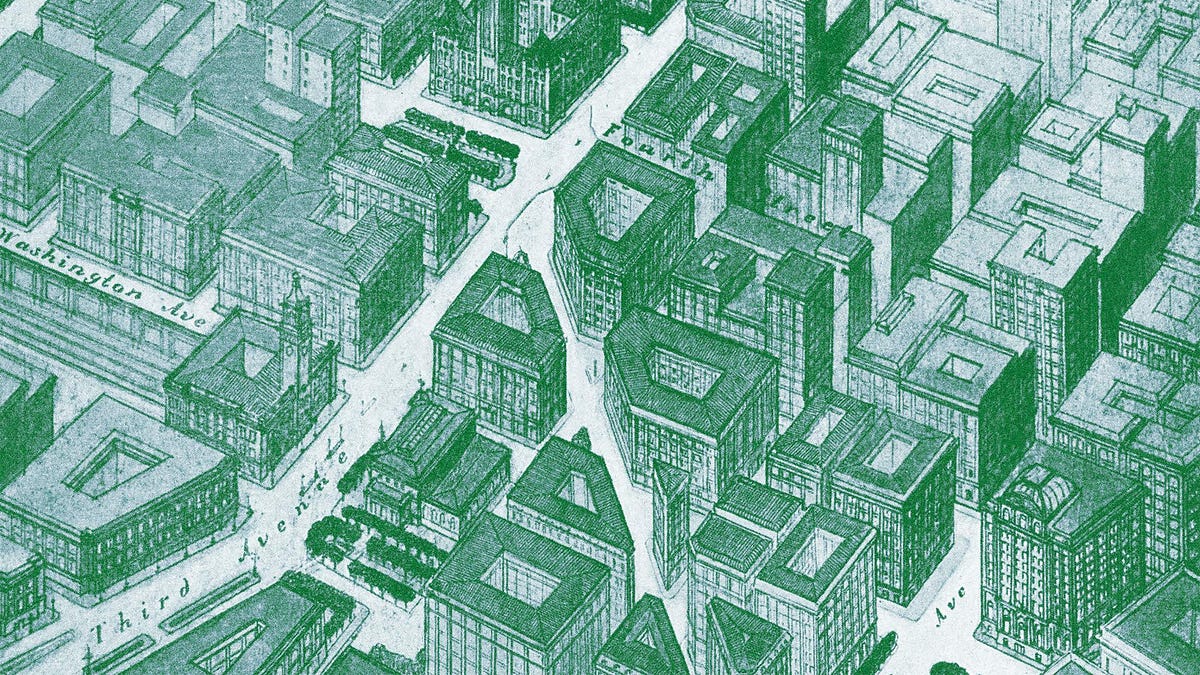
I don't know Camillo Sitte's ideas beyond what I read in the referenced article, but maybe he - for the same reason - did not characterize his work as striving for "lovable" cities. Have a look yourself: https://ia601500.us.archive.org/3/items/in.ernet.dli.2015.21...
After everyone and their sidewalk-pissing dog moves to the lovable cities, they first become vibrant instead of lovable, and after that they're just average.
In the city where I live, Ostrava, which is a rust belt city with a certain, uh, reputation, there is a very valuable small neighborhood designed by Camillo Sitte, and it is located right next to the main railway station.
If one could coordinate a move of a decent chunk of the recent AI money to a location outside of the SF Bay Area, the US could potentially build a "lovable city".
E.g. if Anthropic & OpenAI coordinated to open an outpost in rural Colorado (East of the Denver Airport is wide open spaces with airport, city and mountain access nearby - just sayin'!), it could be conceivable that, with proper housing policy, a decent, dense metro area might be spun up.
That is historically true, not for the recreation water provides, but that you can't get enough food to a city to feed everybody unless there is water based transportation. Whatever is pulling a wagon of food will eat all the food in the wagon.
In these modern days trucks and railroads can bring enough enough food so water is no longer required.
Someone is already trying this outside of SF near Vacaville called "California Forever". And on a smaller scale there's Culdesac in Arizona. Both of these places suffer from being too sterile, imo.
Going back to the original article, there are smaller details the author left out like good public transit, public seating, and sheltered pedestrian walkways or trees for shade. Loitering is desirable.
All comments shown.
Couldn't load more comments. Check your connection and try again.
Comments (86) 8 threads
Earlier commentsI don't know Camillo Sitte's ideas beyond what I read in the referenced article, but maybe he - for the same reason - did not characterize his work as striving for "lovable" cities. Have a look yourself:
https://ia601500.us.archive.org/3/items/in.ernet.dli.2015.21...
https://youtu.be/K5H1nEP2wXA
Run this through a translator: https://www.kudyznudy.cz/aktivity/mestska-pamatkova-zona-ost...
or walk Google Maps around here:
https://maps.app.goo.gl/x7pohbWYXE7C1fuTA
Ironically, this used to be a ghetto until recently, with the buildings neglected for decades. Now it is a gentrifying place, but not yet fully gentrified; e.g. there are still several pawn shops there.
E.g. if Anthropic & OpenAI coordinated to open an outpost in rural Colorado (East of the Denver Airport is wide open spaces with airport, city and mountain access nearby - just sayin'!), it could be conceivable that, with proper housing policy, a decent, dense metro area might be spun up.
My pet theory is that a nice city needs ample open water (lake, sea, rivers,...) nearby and that's not the case there as far as I can see.
In these modern days trucks and railroads can bring enough enough food so water is no longer required.
Continue this thread — 1 reply
Going back to the original article, there are smaller details the author left out like good public transit, public seating, and sheltered pedestrian walkways or trees for shade. Loitering is desirable.
All comments shown.
Couldn't load more comments. Check your connection and try again.