a friend was working for a very large automotive manufacturer. He was working in the "audio control". In the "audio control" responsible for meassuring if each of the poduced cars doors had the >correct sound< when opening/closing the door and how it sounds if you pick/release the door handle. He explained that car manufacturers investing huge money to get >that specific brand touch< when you are experiencing the >audio performance< of a car: They found out that some sounds/frequency spectrums are perceived as of higher/better quality than others, thus designers even have attention on how it sounds if your put your bunch of keys with the car key attached onto a wood table etc.
I wonder what such a service might be called outside of that industry. Like if consultants were brought in to help product designers who don't need someone with this skillset around everyday, what would they say is the name of what they offer? "Audio control" seems a bit overloaded.
>what would they say is the name of what they offer?
Id say classic engineering offices/companies are sourced; there are tons of smaller engineering shops, specialized in whatever niche; e.g. I know a company supporting online subscription services in finding "the optimal price" for their subscriptions for different customer bucktes.
So I would bet therefore that companies doing such things already exist.
This is a field I'm in, and generally go by "automotive sound design" or "automotive audio engineering" depending how much the particular client wants me to design a little click sound vs engineer their $1 car horn hardware to be meatier...
I assume VW Group doesn't have such a department because every Audi door handle I've used on the B9 generation onwards sounds like I'm breaking a cheap plastic toy in half.
20 years ago I used to drive a Renault Symbol (back then it was the cheapest offer from them), and one friend told me how cheap the doors sounded, and I agreed.
However, they were also the strongest doors ever, surviving all the abuse by a lot of mindless university students.
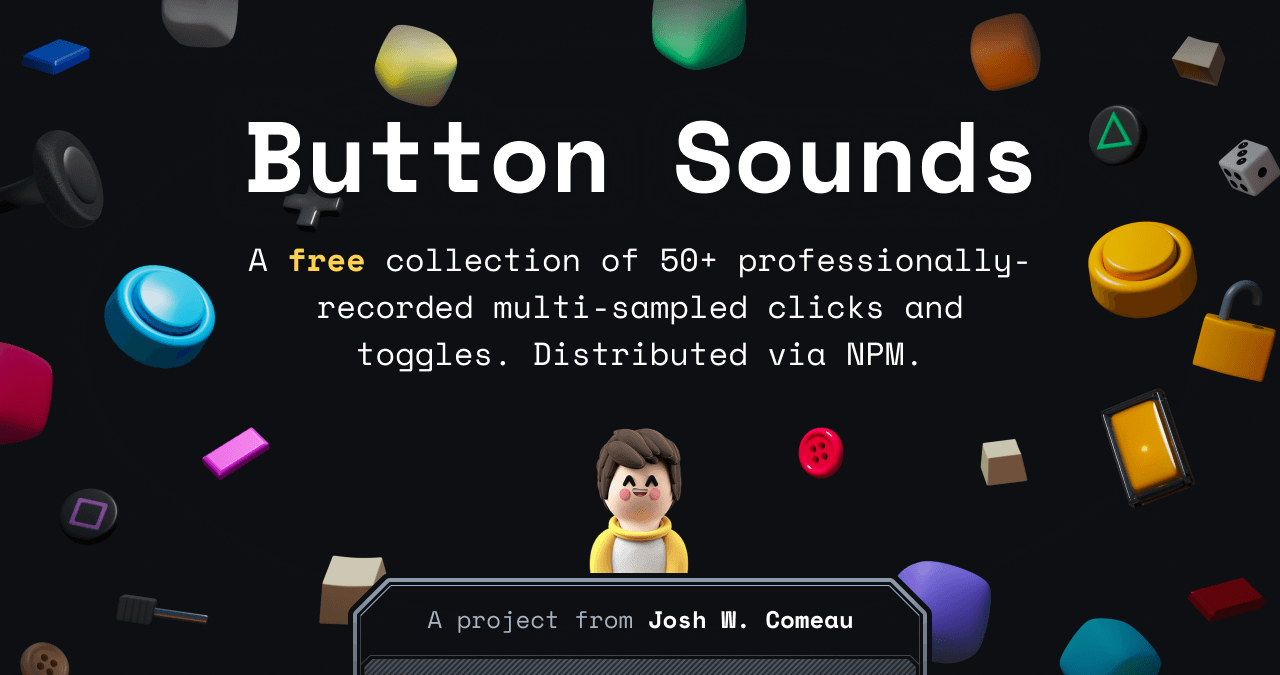
> Frustratingly, browsers can decide to block a website from playing any sound. iOS Safari seems particularly strict about this. So, if you’re not hearing a click sound when tapping the big red button, please check out this website on a desktop computer.
While I understand this behavior from Apple in a user-first perspective and do find audio on mobile web to be annoying in most cases, an easy way to allow audio to play on an iPhone that isn't "use a desktop" seems to be flipping the hardware switch to turn off silent mode. I'm not proud to admit it took 5 minutes of poking and a Google/Gemini search to figure that out...
The general rule is that audio in a tab on ios is banned until a user initiated event (eg a play button) plays audio. After that, audio works.
After a lot of trial and error, I've taken to putting a button on any page I make that uses audio with the label "Click here to unmute". Have it play a silent audio clip when it's pressed. After that, audio works. The UI on this page should work fine on ios if the big red play button simply plays audio directly via webaudio. Who knows how it's actually coded though. It looks like an LLM's work. Probably a mess.
> I've taken to putting a button on any page I make that uses audio with the label "Click here to unmute". Have it play a silent audio clip when it's pressed. After that, audio works.
So anyone who wants to defy the reason for this limitation simply needs to lead the visitor to click something that doesn't reload the page? Instead of "unmute," maybe a throbbing "next" arrow or any innocuous link such as a menu item... I wonder if some set of navigation-like things, such as doing a history.pushState() to change the address bar, cancels what this trick would otherwise achieve.
untill you get stuck in some CORS permissions nightmare like try to click through a link or expose iFrames etc this is as much W3C as it is Apple also big blocker for immersive web (webxr) permissioning just gets in the way
This is really cool. I have a suggestion, though: the samples within a button seem to have several modification types including a pitch shifter. For example, "DOWN4" under the "Multi-sampled sounds" heading sounds nearly a semitone lower than the other DOWN variants. I suggest eliminating all pitch shifting (or at least confining your use to a few cents), leaving only timbre variation. Go nuts creating variation through EQ, distortion, formant shifting, reflections/delay/reverb, etc. but keep the pitch locked. Why? Because the pitch of everything in this world is based on its resonant frequency, which is based on the size of whatever can vibrate, and in the case of a button it's resonating based on the size of the button. Many aspects of the sound would change based on things like how quickly the button is pushed or how much dampening the finger pushing it imparts, but the fundamental pitch is not one of them.
When playing a violin, if you move up the fingerboard, the pitch of the string increases. But if instead of playing the string you knock on the body as if knocking on someone's front door, the main pitch of that knocking never changes. The sympathetic vibrations of the strings will have frequencies that vary as the finger position varies, and the brightness and RT60 of the reverberation through the wood will vary from knock to knock, but the fundamental frequency generally excited by the knock only changes if the violin's volumetric size changes, and it never will. Maybe a drum is a better example than a violin, since it's "unpitched" and yet still gets tuned to have some fundamental frequency. Only the noisy stuff varies from hit to hit, and the fundamental frequency does not (until you re-tune, or from temperature/humidity changing).
Comments (51) 34 threads
a friend was working for a very large automotive manufacturer. He was working in the "audio control".
In the "audio control" responsible for meassuring if each of the poduced cars doors had the >correct sound< when opening/closing the door and how it sounds if you pick/release the door handle.
He explained that car manufacturers investing huge money to get >that specific brand touch< when you are experiencing the >audio performance< of a car: They found out that some sounds/frequency spectrums are perceived as of higher/better quality than others, thus designers even have attention on how it sounds if your put your bunch of keys with the car key attached onto a wood table etc.
Id say classic engineering offices/companies are sourced; there are tons of smaller engineering shops, specialized in whatever niche; e.g. I know a company supporting online subscription services in finding "the optimal price" for their subscriptions for different customer bucktes. So I would bet therefore that companies doing such things already exist.
However, they were also the strongest doors ever, surviving all the abuse by a lot of mindless university students.
While I understand this behavior from Apple in a user-first perspective and do find audio on mobile web to be annoying in most cases, an easy way to allow audio to play on an iPhone that isn't "use a desktop" seems to be flipping the hardware switch to turn off silent mode.
I'm not proud to admit it took 5 minutes of poking and a Google/Gemini search to figure that out...
RE: your solution - For iPhones with action buttons, can disable silent mode in control center.
I would find it frustrating if my phone was set to silent and it played button noises on a website.
After a lot of trial and error, I've taken to putting a button on any page I make that uses audio with the label "Click here to unmute". Have it play a silent audio clip when it's pressed. After that, audio works.
The UI on this page should work fine on ios if the big red play button simply plays audio directly via webaudio. Who knows how it's actually coded though. It looks like an LLM's work. Probably a mess.
Also, here's the author's AI policy: https://www.joshwcomeau.com/ai-policy/
They're also a somewhat active user here.
So anyone who wants to defy the reason for this limitation simply needs to lead the visitor to click something that doesn't reload the page? Instead of "unmute," maybe a throbbing "next" arrow or any innocuous link such as a menu item...
I wonder if some set of navigation-like things, such as doing a history.pushState() to change the address bar, cancels what this trick would otherwise achieve.
untill you get stuck in some CORS permissions nightmare like try to click through a link or expose iFrames etc this is as much W3C as it is Apple also big blocker for immersive web (webxr) permissioning just gets in the way
When playing a violin, if you move up the fingerboard, the pitch of the string increases. But if instead of playing the string you knock on the body as if knocking on someone's front door, the main pitch of that knocking never changes. The sympathetic vibrations of the strings will have frequencies that vary as the finger position varies, and the brightness and RT60 of the reverberation through the wood will vary from knock to knock, but the fundamental frequency generally excited by the knock only changes if the violin's volumetric size changes, and it never will.
Maybe a drum is a better example than a violin, since it's "unpitched" and yet still gets tuned to have some fundamental frequency. Only the noisy stuff varies from hit to hit, and the fundamental frequency does not (until you re-tune, or from temperature/humidity changing).
All comments shown.
Couldn't load more comments. Check your connection and try again.