While I think this project and the data are interesting, one thing that becomes problematic is that you actually DO have to invest time in whatever courses you register for at most colleges and universities (or at least the ones that I've seen).
Generally, if you aren't making adequate progress in a course, you can be dropped by the instructor mid-semester/quarter or placed on academic probation, both of which can cause you to fall below the minimum number of credits needed to be eligible for healthcare coverage. So while you may save some money on health insurance, you lose a potentially large amount of time due to having to keep up with coursework to maintain eligibility. That being said, this may not be a problem if they are courses you are actually interested in and can dedicate time to completing.
This works out best if you're taking classes that are relevant to you so that you're getting value from the time spent as well. Otherwise your goal should be to find the easiest most phone-in-able class possible.
Funny, I was thinking that the opportunity to spend time in classes sounds like a win. I’d love to brush up on discrete math and take a bowling credit for the next five months.
True that, but in many cases, if you just need to stay enrolled and don't have the stress of needing a good grade or to juggle a full load, it could be just eating into your TV couch potato time, be way more interesting and rewarding, and be a win as well. Depends on how much you have to take to get the insurance, though.
Back in undergrad there were 1 credit hour online classes that you could bust out entirely in probably 2 hours total of focused work. Small price to pay imo.
While I am not one to subscribe to the "Europe does everything better"-style thinking of U.S. progressives, the reality is, in this particular field, there is absolutely no way to defend the U.S. system.
How much do you pay per month for health insurance where you live? (Or if you don't know, how much does your country spend per capita on healthcare?)
My wife and I pay way less than $500/month, but her employer pays some of it so I'm not sure what the total cost is. When I was looking for it on my state's healthcare exchange it was also considerably cheaper than $500/month, but then since I was unemployed at the time, it ended up being free. Healthcare in the US is a real problem that needs to be resolved, but it's not a simple situation.
> How much do you pay per month for health insurance where you live? (Or if you don't know, how much does your country spend per capita on healthcare?)
The cost per capita in the US is apparently 85% than in Sweden [0] while the gdp per capita in the US is only around 27% more than in Sweden [1]. I'm not sure how current/accurate those numbers are, but they do fit in with everything I've read over the years. > Healthcare in the US is a real problem that needs to be resolved, but it's not a simple situation. I don't really understand this sentiment. There are so many other systems to look to for comparison. If you mean that powerful entrenched interests that would stand to make less money and they are hard to fight, then sure that's hard, but it's not like we don't know better systems. They are everywhere if we choose to look. I think the main problem is that too many Americans seem incapable of recognizing that the system there really is worse than many high-tax socialist countries. They don't really have any reason to believe this, but they know this deeply in their heart. It only hurts the US and plays into the hands of the aforementioned entrenched interests (which to be fair certainly work hard to propagate the lies that Americans later believe). By the way, I'm both an American and Swedish citizen. I was born in Sweden, lived most of my life in the US, and am now back in Sweden. I definitely identify more as American than a Swede. In my experiences of the US and Swedish systems I'd take the Swedish one (i.e. the cheapest setup without any of the possible extra insurance which can be purchased extra here) over the US system any day of the week. I think the Americans who have knee-jerk reactions against "socialized medicine" are either totally ignorant or deluded. It's sad. Such self-defeating attitudes weaken American as a nation. [0] https://www.businessinsider.com/personal-finance/cost-of-hea...
[1] https://en.wikipedia.org/wiki/List_of_countries_by_GDP_%28no...
The US government spends around as much or more on healthcare per capita as any country with socialized healthcare. Every penny that you pay and your employer pays on your behalf is due to graft/rentseeking.
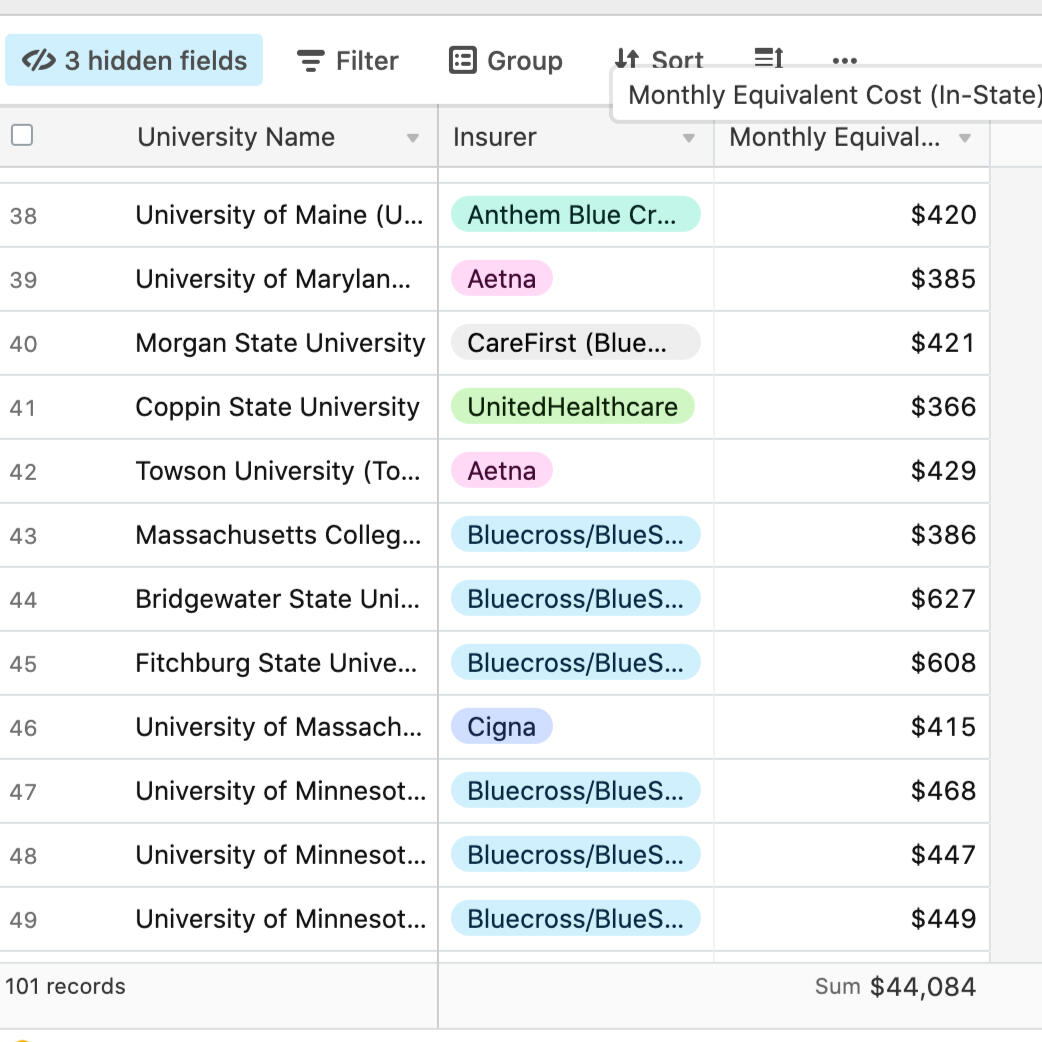
The data here may not be totally accurate, but the sentiment is right. For my local school it's showing the marginal cost of the first credit hour, but the average cost per credit hour is substantially lower once you get to the minimum number of credit hours to qualify for insurance. After correcting for that mistake it cut the monthly cost for tuition+insurance for my local school in half. In addition, some schools offer insurance for spouses and children as well, which usually drives the cost per person down even further. For our situation, the total cost of tuition (9 credit hours per semester) plus insurance (2 people) is about $870 per month. A comparable ACA-compliant insurance plan would be about $1,000 per month.
Even with a "gold level" insurance plan we ended up spending around $4,000 for an accident that occurred on campus that required an ambulance to the University hospital (1 mile away) and about 4 hours in the emergency room to get stitches and confirm that a head injury was not a concussion. It's hard to visualize how much money has been legally stolen from the American people over the last few decades due to the giant scam that is the health insurance industry. The combined salaries of every single doctor in America could be paid for with 8% of what we spend on healthcare every year. If you add in the salaries of nurses, pharmacists, drug researchers, etc. it's probably under 25% of what we pay. Unfortunately there are literally millions of middlemen and unnecessary administrators who soak up a very large percentage of healthcare spending without really doing anything. Canada and Australia spend less than half as much per capita as we do on healthcare despite having similar levels of GDP per capita and better average life expectancies. If the US could save 50% on healthcare we could probably solve climate change single-handedly. This is not even an exaggeration, it's an illustration of just how much we spend on healthcare.
Getting foreign car insurance is pretty common, which gets you nothing when you try to make a claim in the US. For healthcare it goes down to 30$ (that I've found, I assume it's more like 50 per employee with their business healthplan), again with the vast majority of claims being rejected - eg Apria Healthcare. You might need to learn to speak some Tagalog.
I wonder how many of those schools would kick you out for never showing up and failing all your courses every quarter.
Maybe you could filter this list for those schools. Or perhaps you could subcontract our your schooling online and just pay people to do the minimum required to get a passing grade. :-)
Comments (283) 29 threads
Earlier commentsGenerally, if you aren't making adequate progress in a course, you can be dropped by the instructor mid-semester/quarter or placed on academic probation, both of which can cause you to fall below the minimum number of credits needed to be eligible for healthcare coverage.
So while you may save some money on health insurance, you lose a potentially large amount of time due to having to keep up with coursework to maintain eligibility.
That being said, this may not be a problem if they are courses you are actually interested in and can dedicate time to completing.
This works out best if you're taking classes that are relevant to you so that you're getting value from the time spent as well.
Otherwise your goal should be to find the easiest most phone-in-able class possible.
Thanks, COVID!
My wife and I pay way less than $500/month, but her employer pays some of it so I'm not sure what the total cost is. When I was looking for it on my state's healthcare exchange it was also considerably cheaper than $500/month, but then since I was unemployed at the time, it ended up being free.
Healthcare in the US is a real problem that needs to be resolved, but it's not a simple situation.
The cost per capita in the US is apparently 85% than in Sweden [0] while the gdp per capita in the US is only around 27% more than in Sweden [1]. I'm not sure how current/accurate those numbers are, but they do fit in with everything I've read over the years.
> Healthcare in the US is a real problem that needs to be resolved, but it's not a simple situation.
I don't really understand this sentiment. There are so many other systems to look to for comparison. If you mean that powerful entrenched interests that would stand to make less money and they are hard to fight, then sure that's hard, but it's not like we don't know better systems. They are everywhere if we choose to look. I think the main problem is that too many Americans seem incapable of recognizing that the system there really is worse than many high-tax socialist countries. They don't really have any reason to believe this, but they know this deeply in their heart. It only hurts the US and plays into the hands of the aforementioned entrenched interests (which to be fair certainly work hard to propagate the lies that Americans later believe).
By the way, I'm both an American and Swedish citizen. I was born in Sweden, lived most of my life in the US, and am now back in Sweden. I definitely identify more as American than a Swede. In my experiences of the US and Swedish systems I'd take the Swedish one (i.e. the cheapest setup without any of the possible extra insurance which can be purchased extra here) over the US system any day of the week. I think the Americans who have knee-jerk reactions against "socialized medicine" are either totally ignorant or deluded. It's sad. Such self-defeating attitudes weaken American as a nation.
[0] https://www.businessinsider.com/personal-finance/cost-of-hea... [1] https://en.wikipedia.org/wiki/List_of_countries_by_GDP_%28no...
Even with a "gold level" insurance plan we ended up spending around $4,000 for an accident that occurred on campus that required an ambulance to the University hospital (1 mile away) and about 4 hours in the emergency room to get stitches and confirm that a head injury was not a concussion. It's hard to visualize how much money has been legally stolen from the American people over the last few decades due to the giant scam that is the health insurance industry. The combined salaries of every single doctor in America could be paid for with 8% of what we spend on healthcare every year. If you add in the salaries of nurses, pharmacists, drug researchers, etc. it's probably under 25% of what we pay. Unfortunately there are literally millions of middlemen and unnecessary administrators who soak up a very large percentage of healthcare spending without really doing anything.
Canada and Australia spend less than half as much per capita as we do on healthcare despite having similar levels of GDP per capita and better average life expectancies. If the US could save 50% on healthcare we could probably solve climate change single-handedly. This is not even an exaggeration, it's an illustration of just how much we spend on healthcare.
https://cougarhealth.wsu.edu/studentinsurance/insurance-cove...
https://inside.ewu.edu/bewell/optional-medical-insurance/
This spreadsheet is inaccurate, at best. Also, what kind of insurance matters. I can get you 50$ a month insurance that wont cover anything. Without context, this spreadsheet is a big list of rumours for you go look up and be disappointed.
(The argument being that there's got to be some kind of fraudulence-meets-loophole sort of thing going on for this to work at all.)
Maybe you could filter this list for those schools.
Or perhaps you could subcontract our your schooling online and just pay people to do the minimum required to get a passing grade. :-)
In the policy they require in-person classes.
How that's going to work this year with online-only classes is an open question.
All comments shown.
Couldn't load more comments. Check your connection and try again.