Before my father qualified for Medicare he figured out this hack.
He has a severe chronic condition. Health insurance for him as a self employed person at the time was $4k/month Tuition at the local public college at the time came with a senior discount for folks in his age group and insurance for $10k/year. He loved the classes and saved a bundle on health insurance. He needed a life flight and weeks of hospitalization related to his chronic illness. The insurance had him covered. I think it was a non-trivial payout for the insurance company. The following year the insurance company changed the terms with the university to charge more if you didn’t live on campus. My father went to a different school with a different insurer after that. He’s finally on Medicare. We shouldn’t tie healthcare coverage to employment in our country. It’s stupidly expensive.
Tying health insurance to your employer is incredibly dumb. It means insurarers compete for your employers business, not yours, which influences their incentives. It means if you don't like your insurance company, your only option is to change jobs. It disincitives people from being self employed, because then health insurance is prohibitively expensive.
Let's say HR really does care about employees interests. It could be that they chose an insurance program that is best for 90% of employees, but is a terrible choice for you. HR is unlikely to change anything because of a few outliers.
Think about the state of the software rolled out for HR. i.e. speed, UX, cross platform support.
I think from that alone you can safely conclude that HR departments don’t or can’t deliver things that employees need. Employees are not the customers of HR departments and they won’t or can’t fix your health insurance.
No, it works exactly as it was designed. Health insurance keep s costing more, cover less and not care about helping people in the time of need. That is not an accident. It is a result of concentrated effort of lawyers, lobbyists, salesmen, etc... - a whole system that maximizes profits and market share at all costs, and not the quality, breadth and affordability of healthcare. It is like that by design. So the results are logical - we pay more and get less. And will continue paying more and getting even less. There will be a point in future when this approach will "meet its maker", the hope is that will happen sooner rather than later.
It's an efficient market. It's efficient at collecting money from customers who little or no choice, and at not providing those customers with a service - because providing a service costs money, which takes a cut out of profits.
This is what markets do. They amplify political and financial inequality. Anyone who thinks that competition will somehow magically fix this isn't paying attention to how markets actually work.
As is not allowing interstate competition, and not requiring pricing to be published, and not paying rebates for seeking out less expensive treatments.
I'm my own employer, and the exchange choices are shitty beyond belief. I pay $15K/yr for a family of 3 (that's excluding the considerable deductibles), and I'm not even sure to what extent I will be covered if I e.g. break a leg. The premiums go up every year like clockwork, and will likely go _way_ up this year, due to C19. I'm thinking of just finding a clinic somewhere abroad if shit really hits the fan, and going without insurance in the US at all, covering my yearly physical out of pocket. It boggles the mind that politicians are proposing to sink trillions more into the bottomless money pit that is the US "healthcare" system.
I was paying about $1.5k / mo for a terrible plan for just a family of two in NC under ACA. The public risk pool is completely terrible and large corporate employers’ risk pools are separated from the general public and self employed.
More and more employers are now self insured. Making your employer your negotiate with healthcare providers directly for care. They might also us a TPA (third party administrator).
Thing is, your boss may know way more about your health than you’d expect. The entire system is broken.
In my experience, when I was unemployed, an ACA plan doesn't cost $4K or even $800. I'm not sure even COBRA was that expensive.
Perhaps your anecdote is from before the ACA, but is it really productive to still be complaining about the way things were? Maybe spend more time making sure we vote for people who will keep it going.
I have had an ACA plan during two separate periods of time over the last decade and it was on the order of $400/month, with no consideration of pre-existing conditions. I've also had the opportunity for COBRA, which was too expensive, but still under $800.
Depends on the state and plan. For me COBRA was $2000/mo. When employed I paid like $20/mo and my employer paid $1980/mo. When I left I paid the entire amount.
The plan you had was $2,000 (wow, that's really a lot though) and your employer was willing to pay $1,980 (again, that's a lot compared to employers I worked for) in addition to your salary.
Has the ACA caused prices to go down? I'm getting mixed messages about who has actually benefited, with "only insurers and people who were covered by the Medicare expansion actually benefited" being the impression that I get.
Whether prices have gone down may be of importance to society, but on a personal level, being able to pay is more germane. Before the ACA, when I was unemployed and not in school, I just wasn't insured. At this point though, that's kind of a long time ago.
Also, I think you may be confusing Medicare and Medicaid. I've never been covered under either.
I find it sad, yet interesting, how many things/institutions/processes have built up in a way that you would never actively choose as an option.
As in, if given the choice between building the current system and some alternative, there is no way you'd say, "for sure, build again what we have now, it's great". Yet that's what we kind of do every year implicitly by continuing through inertia. Healthcare, financial/banking, transportation, rocket launches, etc. I guess that's how a country gets old and slow -- too many legacy things that have to be supported or can't be changed without disruption to people's established habits or ways that they've come to rely on. (or make a profit from) And it's not until some outside actor shows you it's possible that you're shocked into knowing that it can be done differently. Or forced to do it differently out of necessity now.
I am currently in government. I would say that most processes are not really designed at all. They are the sum of a lot of other decisions kludged together.
We are currently putting together a software system for managing parking contracts and in doing so are excruciatingly copying how those contracts are currently handled (often to an absurd level). Nobody thinks the current process makes sense, but here we are baking it into a mega project.
Eh, one of the larger challenges is figuring out who is responsible for certain things. We genuinely are not sure who is responsible for various elements of projects.
I do R&D for government. A significant portion of what my group develops is required to conform to or to mimic business processes that emerged, practically accidentally, 50+ years ago. Nobody dares innovate, perhaps for two reasons: professional risk, and institutional preservation (departments, unions, etc.). :-/
>The extreme detour of the recurrent laryngeal nerves, about 4.6 metres (15 ft) in the case of giraffes,[26]:74–75 is cited as evidence of evolution, as opposed to Intelligent Design. The nerve's route would have been direct in the fish-like ancestors of modern tetrapods, traveling from the brain, past the heart, to the gills (as it does in modern fish). Over the course of evolution, as the neck extended and the heart became lower in the body, the laryngeal nerve was caught on the wrong side of the heart. Natural selection gradually lengthened the nerve by tiny increments to accommodate, resulting in the circuitous route now observed
While everything you say is true, my experience in software with the Big Rewrite suggests that continuing through inertia, while by no means always the right choice, is also not always the worst choice. Big projects can end up going very badly, and the devil you know is sometimes the lesser evil.
Although, in the case of healthcare pricing in the U.S., maybe not.
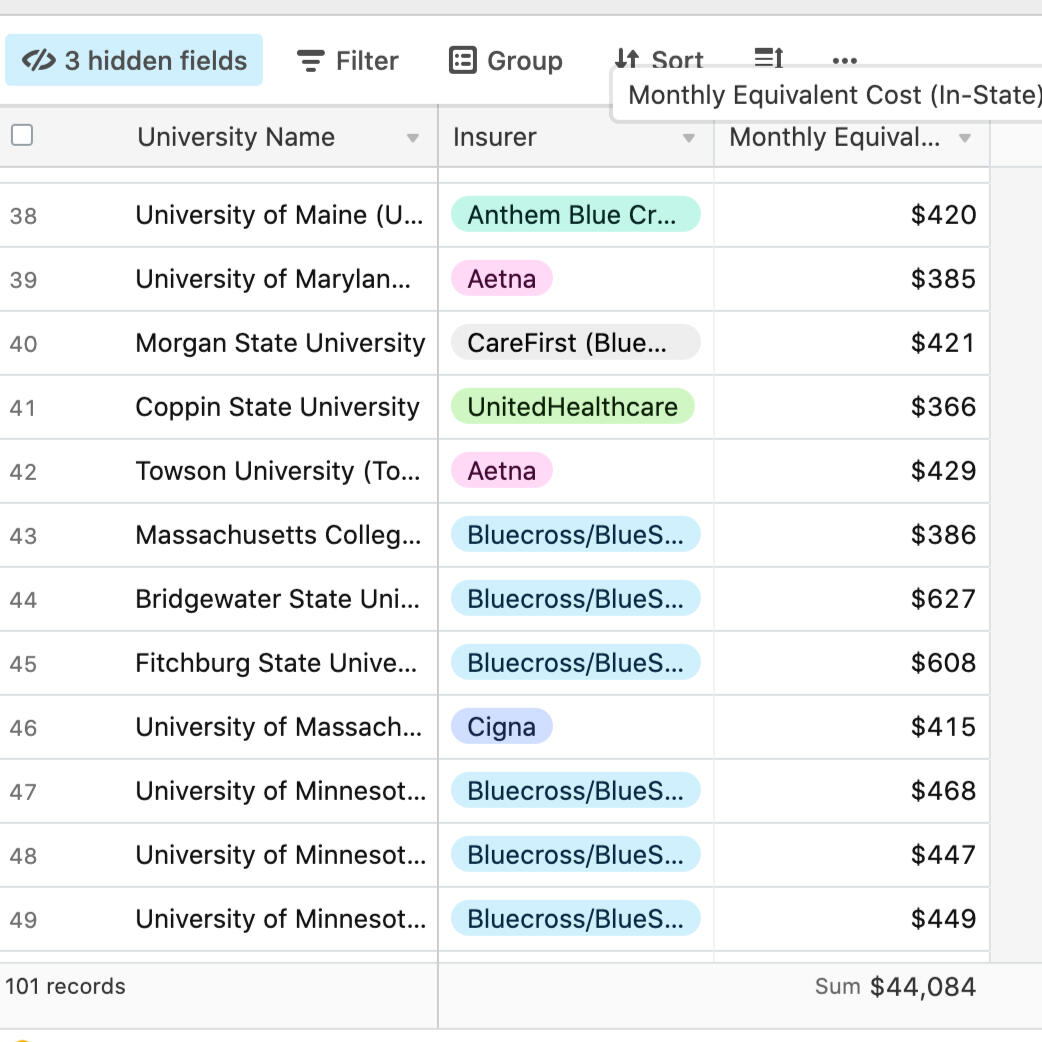
I built a spreadsheet showing how many credits you have to take at a school to qualify for their health insurance plan. In many states, the cost of taking the class + health insurance costs is actually lower than monthly premiums for a plan within the state.
Comments (283) 29 threads
He has a severe chronic condition.
Health insurance for him as a self employed person at the time was $4k/month
Tuition at the local public college at the time came with a senior discount for folks in his age group and insurance for $10k/year.
He loved the classes and saved a bundle on health insurance.
He needed a life flight and weeks of hospitalization related to his chronic illness. The insurance had him covered. I think it was a non-trivial payout for the insurance company.
The following year the insurance company changed the terms with the university to charge more if you didn’t live on campus.
My father went to a different school with a different insurer after that.
He’s finally on Medicare.
We shouldn’t tie healthcare coverage to employment in our country.
It’s stupidly expensive.
Continue this thread — 1 reply
Continue this thread — 9 replies
It's a huge chilling effect on employee turnover. Until ACA pre-existing conditions was a huge aspect of that. Even now IIRC when I changed jobs once I recall any existing conditions would not be covered for 1 month.
And it's the biggest cost increase over the past 2 decades and has soaked up almost all the profits that could have gone to employee salaries.
https://www.pewresearch.org/fact-tank/2018/08/07/for-most-us...
https://www.healthsystemtracker.org/chart-collection/u-s-spe...
Continue this thread — 1 reply
Well, a bit less effective, but sometimes works, you can also complain to HR about the insurance.
I think from that alone you can safely conclude that HR departments don’t or can’t deliver things that employees need.
Employees are not the customers of HR departments and they won’t or can’t fix your health insurance.
This is what markets do. They amplify political and financial inequality.
Anyone who thinks that competition will somehow magically fix this isn't paying attention to how markets actually work.
Continue this thread — 9 replies
Continue this thread — 6 replies
I'm my own employer, and the exchange choices are shitty beyond belief. I pay $15K/yr for a family of 3 (that's excluding the considerable deductibles), and I'm not even sure to what extent I will be covered if I e.g. break a leg. The premiums go up every year like clockwork, and will likely go _way_ up this year, due to C19.
I'm thinking of just finding a clinic somewhere abroad if shit really hits the fan, and going without insurance in the US at all, covering my yearly physical out of pocket. It boggles the mind that politicians are proposing to sink trillions more into the bottomless money pit that is the US "healthcare" system.
Thing is, your boss may know way more about your health than you’d expect.
The entire system is broken.
Perhaps your anecdote is from before the ACA, but is it really productive to still be complaining about the way things were? Maybe spend more time making sure we vote for people who will keep it going.
COBRA is just regular health insurance.
Where do you get your "information"?
Continue this thread — 3 replies
https://www.hhs.gov/healthcare/about-the-aca/pre-existing-co...
The plan you had was $2,000 (wow, that's really a lot though) and your employer was willing to pay $1,980 (again, that's a lot compared to employers I worked for) in addition to your salary.
Also, I think you may be confusing Medicare and Medicaid. I've never been covered under either.
Continue this thread — 1 reply
Continue this thread — 2 more replies
Continue this thread — 2 more replies
As in, if given the choice between building the current system and some alternative, there is no way you'd say, "for sure, build again what we have now, it's great".
Yet that's what we kind of do every year implicitly by continuing through inertia. Healthcare, financial/banking, transportation, rocket launches, etc.
I guess that's how a country gets old and slow -- too many legacy things that have to be supported or can't be changed without disruption to people's established habits or ways that they've come to rely on. (or make a profit from)
And it's not until some outside actor shows you it's possible that you're shocked into knowing that it can be done differently. Or forced to do it differently out of necessity now.
We are currently putting together a software system for managing parking contracts and in doing so are excruciatingly copying how those contracts are currently handled (often to an absurd level). Nobody thinks the current process makes sense, but here we are baking it into a mega project.
https://www.nationalaffairs.com/publications/detail/kludgeoc...
Kludgeocracy in America (2013) https://news.ycombinator.com/item?id=24310523
>The extreme detour of the recurrent laryngeal nerves, about 4.6 metres (15 ft) in the case of giraffes,[26]:74–75 is cited as evidence of evolution, as opposed to Intelligent Design. The nerve's route would have been direct in the fish-like ancestors of modern tetrapods, traveling from the brain, past the heart, to the gills (as it does in modern fish). Over the course of evolution, as the neck extended and the heart became lower in the body, the laryngeal nerve was caught on the wrong side of the heart. Natural selection gradually lengthened the nerve by tiny increments to accommodate, resulting in the circuitous route now observed
Although, in the case of healthcare pricing in the U.S., maybe not.
Continue this thread — 6 more replies
Continue this thread — 10 replies
Continue this thread — 91 replies
All comments shown.
Couldn't load more comments. Check your connection and try again.