The point about minority views no longer being able to take over is a scary one. There has been a great amount of social progress in the past several decades, and that sort of progress wouldn't be possible under the effects of strong social cooling.
White supremacy is a minority view in the US and seems to have gained huge amounts of traction in spite of these believed effects. White supremacists have lost jobs for being caught out attending rallies; it doesn't seem to stop the rallies.
It seems like the definition is "broadened" but no actual definition is provided. All we can look at is who gets labeled as "white supremacist" and draw our own inferences. Notably, a lot of garden-variety egalitarians--people who are against any kind of racial ideology including critical race theory, "anti-racism", and other left-wing racial ideologies--are frequently labeled "white supremacist" (including an awful lot of people of color, jewish people, homosexuals, etc).
We should be very wary of rhetoric that depends on changing definitions of terms without providing precise definitions (see also "racism"). Put differently, everyone's ideas should be criticized on their own terms, but you oughtn't be taken seriously if you don't even define your own terms (and defining them in terms of other poorly defined terms--e.g., "'anti-racism' opposing racism"--doesn't count).
The status quo is not explicitly racist, and a lot of people are comfortable with it. The push by the left is to suggest that just because a system does not have discriminatory laws, that doesn't mean it's not oppressive. Take the prevalence of indentured servitude after the Civil War as an example. I'd recommend "The New Jim Crow: Mass Incarceration in the Age of Colorblindness" for a lucid account of the racial issues in current America.
If you can be convinced that the status quo is oppressive to racial minorities, then it serves to perpetuate white supremacy. I don't follow your first point, since it seems clear to me that people of color, jewish people, and homosexuals are able to hold white supremacist viewpoints.
> If you can be convinced that the status quo is oppressive to racial minorities, then it serves to perpetuate white supremacy.
This is assuming white privilege is the same as white supremacy, when the term white supremacy has been used for KKK and neo-nazis groups, not mainstream white society since after the civil rights era. It also assumes that most whites and only whites benefit from white privilege, otherwise it's not so white, and may be more a combination of class, culture and/or historical consequences. Also the fact that white people are still a majority in countries like the US, where a majority in any country likely has similar privileges just by being the majority. One last assumption (in America) is that white culture is a certain way, when in reality the US is primarily an English dominated culture historically, whereas Europe has a lot of cultural variation. A related issue is that white supremacy is sometimes extended to considering an entire economic system as racist, just because history went a certain way. But there's nothing about an economic system that says any one particular group need benefit more than another.
> there's nothing about an economic system that says anyone one particular group need benefit more than another.
Crony capitalism creates positive feedback loops where the friends of rich people benefit more than strangers to rich people. I doesn't take a lot of analysis to see how that can re-enforce the dominance of one race in a society if there's any small amount of inequality to start(1) and people of a given race are mostly associating with others of the same race, since the positive feedback loops in capitalism are significant. (1) And "small amount of inequality" isn't a fair assumption for the US, where one race started out owning people of the other race.
Fair point. White supremacy is an attitude, whereas white privilege a state of being. I would quibble that white supremacist ideas are quite widespread - see, e.g., references to "thugs" during the BLM protests.
I also agree that white privilege interacts with class, culture and historical consequences, this was well put. If, hypothetically, an economic system admits little class mobility, and if classes are racially biased, then the effect of that economic system is to maintain a racial caste system. What are your thoughts on this? I'd also point that the justice system works similarly. There are few explicit racial biases, but what is the effect of this system? It actively maintains a racial hierarchy. Does that make it racist?
> The push by the left is to suggest that just because a system does not have discriminatory laws, that doesn't mean it's not oppressive. ... If you can be convinced that the status quo is oppressive to racial minorities, then it serves to perpetuate white supremacy.
There are a couple of dynamics at play here: * The distinction between de jure and de facto discrimination. No one disputes that a country can be racially oppressive via de facto discrimination as our country has been in the past. * Whether any kind of discrimination is a necessary condition for a system to be called "oppressive". Of course a system is oppressive if it discriminates at all, even if the discrimination is only de facto. This is a completely uncontroversial opinion--virtually everyone believes this, so I don't think this is the position that the left is espousing (especially given that prominent left-wing voices like Kendi are pretty explicit that this isn't what they're talking about). Moreover, if leftists are taking the uncontroversial interpretation, then it doesn't make sense to call anyone else a "white supremacist" because at worst they are opposed to discrimination to the extent that they are aware that it exists (and no, pointing to disparities does not constitute compelling evidence of discrimination). So presumably leftists believe we live under "white supremacy" because there are disparities at all, irrespective of whether those disparities are attributable to racial discrimination. More likely, it seems to me that leftists are conflating "there was a lot of historical discrimination that created different wealth, crime, marriage/family, etc distributions that the present system acts upon" with "the system today is racist and we've made little progress since the legalization of slavery". If the latter were true then we would indeed be under a 'white supremacist' system, but thankfully it's obviously fallacious. There are certainly still some vestiges of racism that we should continue to work to remove, but we've progressed tremendously--our system is mostly colorblind, everyone of consequence everywhere is in favor of making the system more colorblind (save apparently progressives and a handful of thoroughly marginalized actual white supremacists); however, a perfectly egalitarian (i.e., non-racist) system isn't going to yield equal outcomes. That said, if we want to address historical racism, then let's talk about it as such and not give the impression that we're solving for extant racism (or that extant racism is a primary driver in various disparities). This is unnecessarily dishonest and divisive. Let's talk about reparations instead of advocating for a racialized society and system (in contrast to a colorblind society and system). Let's dispense with viewpoints of racial primacy and essentialism. Let's dispense with DiAngelo's "whites are inherently racist" (not paraphrasing) and Kendi's "anti-racism requires eternal discrimination" (paraphrasing). All of this is nonsense and a distraction if our goal is to address historical discrimination or decrease injustice or even close racial gaps (defunding police or antagonizing whites are not likely to improve yields for minorities). > I don't follow your first point, since it seems clear to me that people of color, jewish people, and homosexuals are able to hold white supremacist viewpoints. My point didn't depend on the ability or inability of people with those identities to hold white supremacist viewpoints; it was literally parenthetical. I only brought it up because there's a lot of overlap between the people who make broad claims of white supremacy and the people who advocate that whites "shut up and listen" to people with these identities such that, you know, they might shut up and listen before writing these people off as white supremacists.
A commenter below helpfully provided links to pages talking about increases in hate group counts. As you suggest, this could mean either more hate groups, a more effective SPLC (that's better at finding them), or a broader definition. The last one might be written in the original reports somewhere. I have no idea how to distinguish the first two.
It is exactly because of social cooling that you heard so little about white supremacy for so many years. The tacit endorsement of one famous person (see if you can guess who!) helped to somewhat raise the ambient temperature for it.
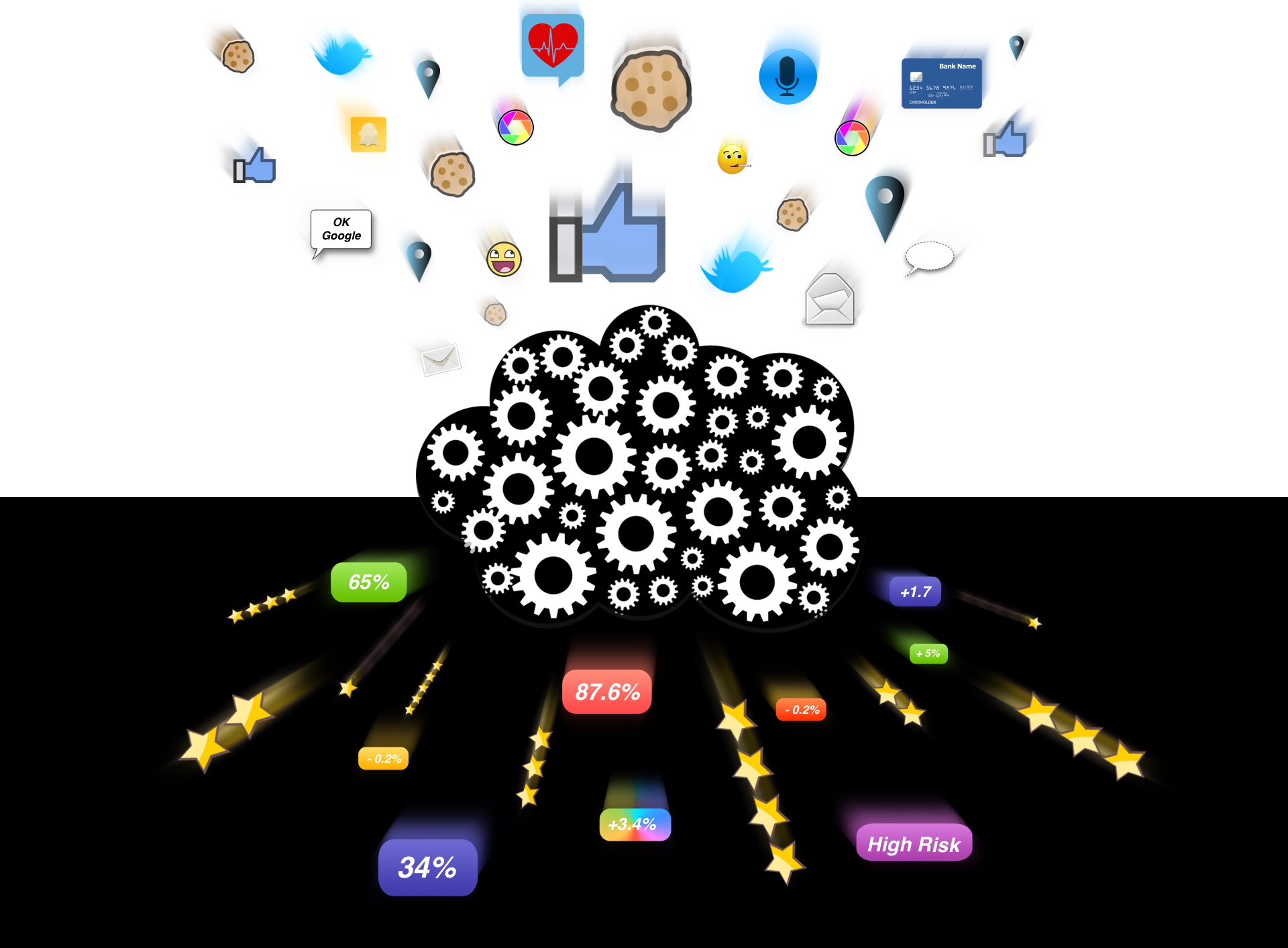
If true, that raises two interesting questions relative to the socialcooling.com content:
1) It begs the question of whether social cooling should be considered a universal ill. After all, white supremacy is bad, and consequences for publicly embracing it are useful. 2) It begs the question of whether the impact of digitally-originated social cooling is particularly relevant if one thought-leader can upend it.
I'm not sure there is causation here. Far-right ultra-nationalistic movements are gaining speed in many places in the world. I think there are many factors at play, one being that we get further and further away from WW2 and people forget how bad it can get (especially here in Europe). Only the military and very old people in the west now know what a real war feels like. On top of that there's general social unrest and increased inequalities (the infamous 1%), software eating the world etc...
I do think that white supremacy, fascism and nazism was really a lot more fringe even only 10 years ago, it wasn't just under-reported.
It's because this page is using "minority views" as a code word for "ruling class threatening views." Which has always been the case. A minority view that doesn't threaten business interests will face little suppression (see: white supremacy)
I don't think we can assume white supremacy doesn't threaten business interests. Particularly not in the US, where approximately 2 out of 5 Americans aren't white. How many companies are willing to put on the table as their business model "We'll be actively hostile to 40% of our potential customers?"
I remember reading a story about a Black man attending KKK rallies to understand their argument and successfully convince some of them to leave the group. I think it was Daryl Davis: https://en.wikipedia.org/wiki/Daryl_Davis
Nowadays this would be very difficult because the mere fact of being around "bad" people ("bad" depends on the context and might be something relatively innocent) would also brand you as "bad" regardless of any good intentions you might have. What ends up happening is that "bad" people are stuck in their own echo-chamber surrounded by like-minded people and anyone outside of the group wouldn't dare to engage with them (and provide counter-arguments) because of consequences for their own career & social circle (as their own friends would distance themselves from him for the same reasons).
Daryl Davis is a really interesting guy. His episode on the JRE is really good and his stories keep you engaged. Even if you don't like Joe Rogan, you should still be able to enjoy his episode because Davis does the majority of the talking.
In the way it might be casted upon supporters of the President, the distinction between white supremacy and white power is largely semantics.
As far as I understand it, "white supremacy" for those that desire it is the idealized end result of "white power." Much of the rhetoric from President Trump is to rally support for white power. [1] Given the most common disagreement in the US is between those who advocate for or oppose President Trump, it makes sense that his followers would be deemed "white supremacists" I believe the broad awakening among many white people in the US currently is the ambient benefits of invisible white power. [1] https://www.youtube.com/watch?v=V6iSgqFahoM
> White supremacists have lost jobs for being caught out attending rallies; it doesn't seem to stop the rallies.
Yesterday, there was a documentary movie on German's private TV station Pro7 about Nazis. An actual Nazi confirmed live on camera: yes, deplatforming Nazis (and that includes them losing jobs, family, friends) works and is a huge source of pain for the movement because many people don't hold up to that pressure and leave. Just imagine how big the rallies would be if there was no social pressure on not being Nazi would no longer be there... at the moment many attendees either don't give a f..k about how they are perceived, or they relish on that being accepted in their social circles.
This depends on how your aggregation function is weighted. If your measure is "how many people in the US are white supremacists?" then, yes, it's definitely a minority view (though still more widely held than it should be!). But if you scale it by each person's power/wealth, you get a very different view. If your question is "what is the total power held by white supremacists?" you'll end up with a larger number. And if you really want to get an accurate measure where you treat each person's white supremacy value as a number that ranges smoothly from positive (actual white supremacist) to zero (not interested in putting effort into race relations one way or another) to negative (anti-white supremacist), your function may produce a number that explains a hell of a lot of US history.
> If your question is "what is the total power held by white supremacists?" you'll end up with a larger number.
I very much doubt so. The richest people in the US are whites (e.g. Besos, Gates, Buffet), but not suprematists. If you have data which proves otherwise, please share.
That one really rings false. Minority opinion holders are gathering online in record numbers. I'm thinking in particular of the nut jobs like anti-vaxxers and flat earthers, but also fan bases for obscure culture (reddit saved The Expanse) or the support for non mainstream political figures like Ron Paul or Andrew Yang. If anything, their ability to brigade online forums makes them seem far more prevalent than they really are.
Comments (1,058) 123 threads
Show all comments
Showing thread 10 of 123
https://www.factcheck.org/2019/03/the-facts-on-white-nationa...
https://www.theguardian.com/world/2020/mar/18/white-national...
Continue this thread — 2 replies
We should be very wary of rhetoric that depends on changing definitions of terms without providing precise definitions (see also "racism"). Put differently, everyone's ideas should be criticized on their own terms, but you oughtn't be taken seriously if you don't even define your own terms (and defining them in terms of other poorly defined terms--e.g., "'anti-racism' opposing racism"--doesn't count).
If you can be convinced that the status quo is oppressive to racial minorities, then it serves to perpetuate white supremacy.
I don't follow your first point, since it seems clear to me that people of color, jewish people, and homosexuals are able to hold white supremacist viewpoints.
This is assuming white privilege is the same as white supremacy, when the term white supremacy has been used for KKK and neo-nazis groups, not mainstream white society since after the civil rights era.
It also assumes that most whites and only whites benefit from white privilege, otherwise it's not so white, and may be more a combination of class, culture and/or historical consequences. Also the fact that white people are still a majority in countries like the US, where a majority in any country likely has similar privileges just by being the majority. One last assumption (in America) is that white culture is a certain way, when in reality the US is primarily an English dominated culture historically, whereas Europe has a lot of cultural variation.
A related issue is that white supremacy is sometimes extended to considering an entire economic system as racist, just because history went a certain way. But there's nothing about an economic system that says any one particular group need benefit more than another.
Crony capitalism creates positive feedback loops where the friends of rich people benefit more than strangers to rich people.
I doesn't take a lot of analysis to see how that can re-enforce the dominance of one race in a society if there's any small amount of inequality to start(1) and people of a given race are mostly associating with others of the same race, since the positive feedback loops in capitalism are significant.
(1) And "small amount of inequality" isn't a fair assumption for the US, where one race started out owning people of the other race.
Continue this thread — 9 replies
I also agree that white privilege interacts with class, culture and historical consequences, this was well put.
If, hypothetically, an economic system admits little class mobility, and if classes are racially biased, then the effect of that economic system is to maintain a racial caste system. What are your thoughts on this? I'd also point that the justice system works similarly. There are few explicit racial biases, but what is the effect of this system? It actively maintains a racial hierarchy. Does that make it racist?
Continue this thread — 1 reply
There are a couple of dynamics at play here:
* The distinction between de jure and de facto discrimination. No one disputes that a country can be racially oppressive via de facto discrimination as our country has been in the past.
* Whether any kind of discrimination is a necessary condition for a system to be called "oppressive". Of course a system is oppressive if it discriminates at all, even if the discrimination is only de facto. This is a completely uncontroversial opinion--virtually everyone believes this, so I don't think this is the position that the left is espousing (especially given that prominent left-wing voices like Kendi are pretty explicit that this isn't what they're talking about). Moreover, if leftists are taking the uncontroversial interpretation, then it doesn't make sense to call anyone else a "white supremacist" because at worst they are opposed to discrimination to the extent that they are aware that it exists (and no, pointing to disparities does not constitute compelling evidence of discrimination).
So presumably leftists believe we live under "white supremacy" because there are disparities at all, irrespective of whether those disparities are attributable to racial discrimination. More likely, it seems to me that leftists are conflating "there was a lot of historical discrimination that created different wealth, crime, marriage/family, etc distributions that the present system acts upon" with "the system today is racist and we've made little progress since the legalization of slavery".
If the latter were true then we would indeed be under a 'white supremacist' system, but thankfully it's obviously fallacious. There are certainly still some vestiges of racism that we should continue to work to remove, but we've progressed tremendously--our system is mostly colorblind, everyone of consequence everywhere is in favor of making the system more colorblind (save apparently progressives and a handful of thoroughly marginalized actual white supremacists); however, a perfectly egalitarian (i.e., non-racist) system isn't going to yield equal outcomes.
That said, if we want to address historical racism, then let's talk about it as such and not give the impression that we're solving for extant racism (or that extant racism is a primary driver in various disparities). This is unnecessarily dishonest and divisive. Let's talk about reparations instead of advocating for a racialized society and system (in contrast to a colorblind society and system). Let's dispense with viewpoints of racial primacy and essentialism. Let's dispense with DiAngelo's "whites are inherently racist" (not paraphrasing) and Kendi's "anti-racism requires eternal discrimination" (paraphrasing). All of this is nonsense and a distraction if our goal is to address historical discrimination or decrease injustice or even close racial gaps (defunding police or antagonizing whites are not likely to improve yields for minorities).
> I don't follow your first point, since it seems clear to me that people of color, jewish people, and homosexuals are able to hold white supremacist viewpoints.
My point didn't depend on the ability or inability of people with those identities to hold white supremacist viewpoints; it was literally parenthetical. I only brought it up because there's a lot of overlap between the people who make broad claims of white supremacy and the people who advocate that whites "shut up and listen" to people with these identities such that, you know, they might shut up and listen before writing these people off as white supremacists.
Continue this thread — 2 replies
1) It begs the question of whether social cooling should be considered a universal ill. After all, white supremacy is bad, and consequences for publicly embracing it are useful.
2) It begs the question of whether the impact of digitally-originated social cooling is particularly relevant if one thought-leader can upend it.
Continue this thread — 1 reply
I do think that white supremacy, fascism and nazism was really a lot more fringe even only 10 years ago, it wasn't just under-reported.
Continue this thread — 11 replies
Continue this thread — 3 replies
Nowadays this would be very difficult because the mere fact of being around "bad" people ("bad" depends on the context and might be something relatively innocent) would also brand you as "bad" regardless of any good intentions you might have.
What ends up happening is that "bad" people are stuck in their own echo-chamber surrounded by like-minded people and anyone outside of the group wouldn't dare to engage with them (and provide counter-arguments) because of consequences for their own career & social circle (as their own friends would distance themselves from him for the same reasons).
https://www.youtube.com/watch?v=oGTQ0Wj6yIg
But people self identifying as such are extremely rare.
It's very hard to support with a straight face that the acceptance of the confederate flag in the south does not have racial overtones.
Continue this thread — 5 replies
As far as I understand it, "white supremacy" for those that desire it is the idealized end result of "white power." Much of the rhetoric from President Trump is to rally support for white power. [1]
Given the most common disagreement in the US is between those who advocate for or oppose President Trump, it makes sense that his followers would be deemed "white supremacists"
I believe the broad awakening among many white people in the US currently is the ambient benefits of invisible white power.
[1] https://www.youtube.com/watch?v=V6iSgqFahoM
Continue this thread — 3 replies
Yesterday, there was a documentary movie on German's private TV station Pro7 about Nazis. An actual Nazi confirmed live on camera: yes, deplatforming Nazis (and that includes them losing jobs, family, friends) works and is a huge source of pain for the movement because many people don't hold up to that pressure and leave.
Just imagine how big the rallies would be if there was no social pressure on not being Nazi would no longer be there... at the moment many attendees either don't give a f..k about how they are perceived, or they relish on that being accepted in their social circles.
Continue this thread — 11 replies
This depends on how your aggregation function is weighted.
If your measure is "how many people in the US are white supremacists?" then, yes, it's definitely a minority view (though still more widely held than it should be!).
But if you scale it by each person's power/wealth, you get a very different view. If your question is "what is the total power held by white supremacists?" you'll end up with a larger number.
And if you really want to get an accurate measure where you treat each person's white supremacy value as a number that ranges smoothly from positive (actual white supremacist) to zero (not interested in putting effort into race relations one way or another) to negative (anti-white supremacist), your function may produce a number that explains a hell of a lot of US history.
I very much doubt so. The richest people in the US are whites (e.g. Besos, Gates, Buffet), but not suprematists. If you have data which proves otherwise, please share.
Continue this thread — 7 replies