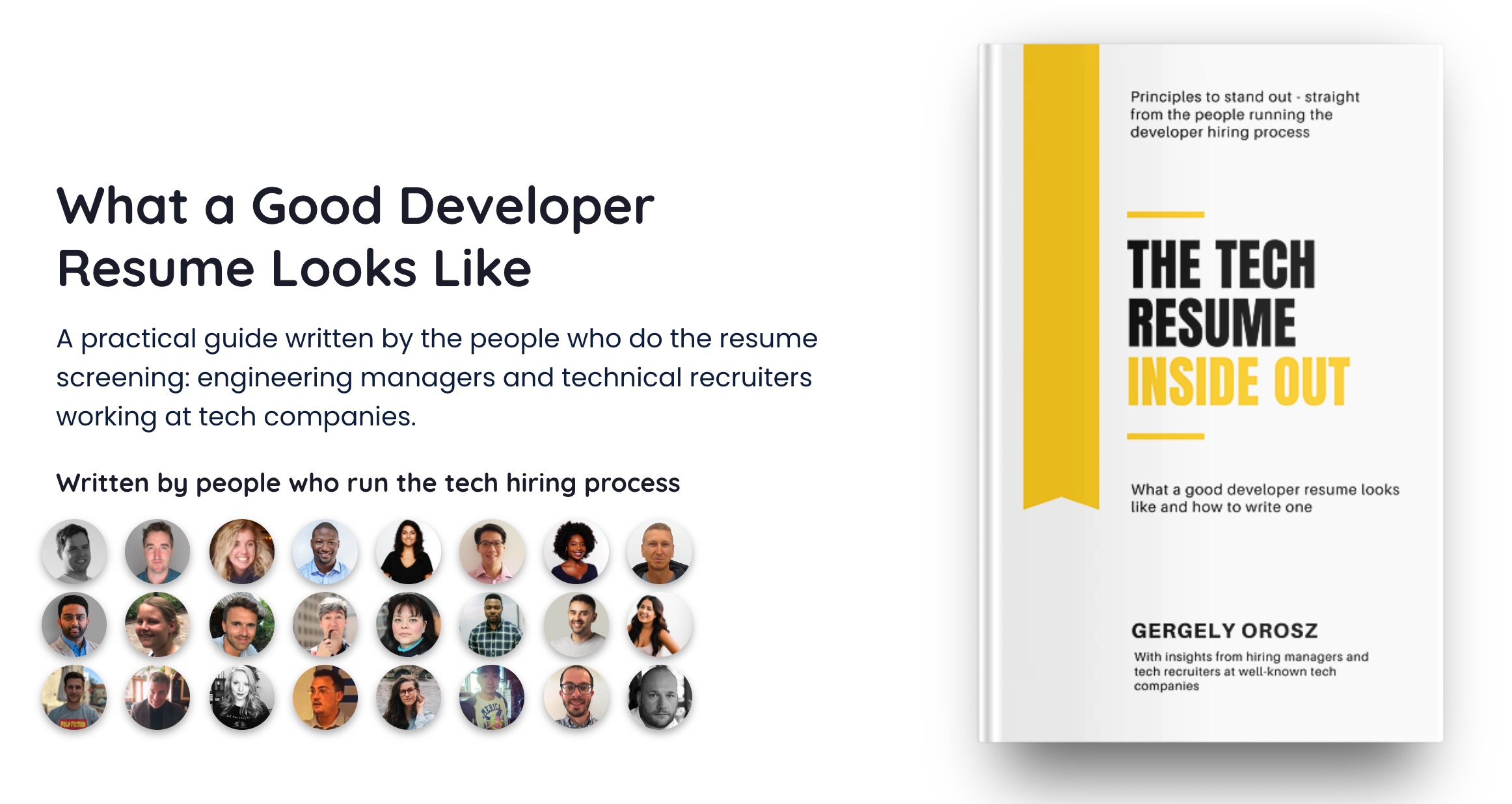
I’m excited to share The Tech Resume Inside Out: a guide on how to write a developer (or engineering manager) resume that represents you fairly. The book is free for any developer currently out of a job [1].
COVID was what triggered me writing this book. At the beginning of the year, I was in the middle of writing a book on growing as a software engineer. However, as COVID started and the tech the layoffs followed in April and May, I found myself wanting to help people impacted. I’ve been a hiring manager for a few years, so I offered to do resume reviews for those laid off or applying for positions[2]. I had more than 300 developers take me up on this offer in a few days. I did in-depth reviews for the first few dozen people, then copied-and-pasted common observations for the next batch, and finally sent over a 15-page PDF with the most common advice, with a few pointers for the bulk of the people. Here’s an early version of this PDF[3] - which also was the basis of this book. I wasn’t that happy with how little backup I had for the advice in that guide, so I started to reach out to tech recruiters and hiring managers for more feedback. I also asked people to share back how their improved resumes worked out, applying the suggestions, and started adding this into a growing guide. Four months and 55,000 words later, the book is ready. I tried to give level-headed, but practical advice, with lots of examples from actual resumes (that are all anonymized). Happy to answer any questions here. [1] https://thetechresume.com/complimentary-copy [2] https://twitter.com/GergelyOrosz/status/1263855589861580800 [3] https://thetechresume.com/A_Good_Tech_Resume.pdf
Hello, I found out about the "Purchasing Power Parity" thing on your site and I want to thank you for that consideration, it helps. Also thanks to all the people who think and then act on such ideas.
I have a few friends who were unfortunate to graduate either right before or during the pandemic, and have had trouble finding jobs since. Would they be eligible for your free copy offer? I know one of the criteria is “lost job due to COVID-19”, but perhaps that could be extended to “...or have been unable to find a job due to COVID-19”?
Just a friendly suggestion/question - wanted to get that clarified before I link those friends to the complimentary copy page.
Yes, please have them send it through. Anyone who has graduated qualifies.
I just clarified it on the site as well: "Lost your job during COVID-19 and are actively looking for your next position OR you have already graduated and are actively looking for your first job."
It is a shame the complimentary copy for those out of work requires having a LinkedIn profile.
What exactly do you hope such a requirement is going to achieve? Surely not to prevent piracy as I found a working PDF link to the final release in seconds. I assume you have some other motive for the LinkedIn requirement and am genuinely interested in what it is.
This was the easiest way I came up with validating people who are actively looking for jobs. As a software engineer, LinkedIn is a place you can also get a bunch of inbound interest (I got my last 3 jobs on this platform, from inbound messages). I don't use it for anything else: the data is deleted after I manually validate them.
But you raise a good point, thank you. I updated instructions, so anyone with no LinkedIn profile can email me directly with some other proof of their online presence. Originally, I got a lot of spam requests from throwaway emails that I could not validate. People who get the book this way also get access to updates: which will be fixes, corrections, and additional content.
I've seen first hand that offering something for free for people experiencing hard times is rarely abused so long as you require someone to ask for it.
"Email me if you are unable to afford this book and would like a free copy" for example, will rarely be abused. (And if it is, it isn't a lost sale, because they wouldn't have purchased it anyway.) I suspect it might actually increase overall conversion rate, because it may trigger many people to consider that they actually can afford the product, and it shows that the merchant has a heart.
Just my opinion but it sounds like you're making a lot of additional manual work for yourself with little to no benefit.
I could understand if you were able to maybe monetise the contact information you collect but as you said you delete everything once you validate it seems you are validating just for the sake of validating? For example how would you deal with someone out of work due to COVID and wanting to use this time to retrain and get into the software engineer field? I can't imagine they would care about (or even know about) having a LinkedIn profile with zero related employment, no contacts to network with, etc. I know I am being a little 'difficult' with my question and I am not criticising I am just interested on your thought process more than anything. ----- Update: Just realised you edited your original reply so my reply doesn't make quite as much sense now :) I think your direct email option is good. If it were me I would automate the direct email with a little bit of weak validation such as "please explain in one or two sentences your situation" then anyone who emails with a few words are automatically validated and any blank or one word emails are either auto-deleted or put aside for manual validation. Just an idea though. I figure posting to HN means you wanted a little feedback :) Best of luck with your book. I don't have a need for it right now (thankfully) but I hope it helps others as it appears you have a put a lot of thought and work into it.
I'm hesitant to spend money on something that may be useful but probably won't save me from homelessness (I'm so unemployable that glowing internal referrals don't even get me a 15-minute phone call), but I don't qualify for your complimentary copy and I really, reallly don't want to out myself (because this will destroy even the tiny bit of employability I might have remaining).
Great job. I didn't read everything, but skimmed some of your materials online and most of this seems to be right on point in my view (having done hundreds of interviews and looked at thousands of resumes).
A few points you touch on that I really like: * Leave out extraneous stuff... photos, references, etc. I don't need to know where you went to high school (assuming you are a college grad). I'll ask for references after I hire you. * Check typos and formatting. I know some hiring managers who will let typos, formatting issues and grammar mistakes slip. Personally, I look for them and will likely disqualify you if I see them (I'll be more lenient if English isn't your first language). If you can't keep bugs out of your resume, which is a one to two page document, how can I expect you'll keep them out of your code? Also pro tip: always PDF resumes so formatting is consistent and doesn't show the squiggly lines that word document spell checkers show. I general, I'm always surprised by resumes that try to stick out with gimmicks like charts or color, or whatnot. I've looked over high hundreds (or low thousands) of resumes and the ones that stick out are usually black and white, well formatted, straight to the point, brief and don't have glaring errors.
I've heard PDFs aren't great in automated resume filters because the OCR doesn't work as well. Is it possible that you prefer PDF because of a survivor bias (PDFs that get past the filter are better for you but fewer PDFs get past it)?
Re: typos, I think you’re shooting yourself in the foot if you bin a resume for one little mistake. But, yes, if it’s more than a couple, that’s probably not a great sign.
What do you think about digital/interactive resumes?
I've been building out a tool to make resumes that let you zoom in to different topics, would love to get your thoughts on whether you'd like to see something like this: https://prototype.profiled.app Looking forward to reading this in any case! I lost my contracting role due to Covid and I think it's great that you're giving away those extra copies to those in need.
Most companies use an ATS to organize inbound applications and ask job seekers to upload their resume. Here, recruiters/hiring managers later view this resume.
You need a PDF or Word doc here (PDF preferred). When applying for larger tech companies, this is the use case 90% of the time. As a hiring manager, I want to see details quickly. The less "fanciness", the better. I can scan traditional resumes much easier than this one. So my view is the same as when choosing a fancy template: you make the job of the hiring manager more difficult, thus lowering your chances. With software developers, boring and simple format is good. Your resume content should sell you, not the presentation.
As further anecdata: where I work, the interviewing system doesn't support random urls to stuff, and only shows the uploaded doc (if any). So unless we checked the linkedin link (almost never provided) and clicked through to projects (or followed links in docs, neither of which I or any I've talked to have ever done AFAIR), we'd never see it.
It might be workable for last-round or very small + "high contact" interview pipelines, but it's probably useless earlier or at larger companies.
One thing about resumes is different companies often like different things. Possibly something that is useful is if you build a digital resume, then have print options that are optimized for different things (even specific optimizations for specific large companies ). This way you can generate whatever Resume you like targeted to different things. For small/mid type companies where I have interviewed 100s, I like extra detail, and I'll look at links if initial content looks promising.
I don’t want a resume that “represents me fairly,” though. I want one that gets me interviewed for high paying tech jobs. Those are related concerns, to be sure, but I’d much rather get interviewed for a job that’s a serious stretch for me than not. I want my resume, which is a marketing document, to get me in the interview room, where I represent myself.
Seems like you could fix that by not relying on what hiring managers think and say, since neither of those necessarily correspond to what they actually choose to hire. After all, no hiring manager will admit to discriminating on race, age, caste, etc... But all of those have been newsworthy factors in the recent past.
It looks awesome, and very necessary. But isn't it sad that we've got to the point that so much effort - and a whole industry - has to go into this very meta side of work, time that is not spent doing something that actually produces something? All of this just to get to the point where you can get an interview to get a job to then start doing something productive for the world?
Again, not to take anything away from the book itself, which looks great. Just a comment on the work world today, I guess.
It's sad but this is just one part of the overall very broken hiring process. Eventually technology will be able to match publicly available data about ones background with open roles well but that seems to be a long way off.
The nice part is most of the time your resume just needs to be good enough. Not having any major red flags is enough for a conversation if you have some experience under your belt.
As the author: I could not agree more. I wish we had a system that's not as dependent on resumes as the current one is. I actually dedicated the last chapter (that I'll probably make public) on advice on how to make the process better, if and when you'll be a hiring manager.
Anyone who feels the pain on how broken the system is: please, try to not forget this. And when you'll have the opportunity, try to improve it. I see solutions along not immediately rejecting when the resume is not a "fit", but carrying on looking for signals. As of today - in 2020 - the best way to not have to rely on a resume is to have a referral. The first part of the book stresses this a lot. A trusted referral "I know this person" will probably make a resume redundant, at least for smaller places.
We're working really hard on solving this specific problem. Resumes show you surface/hard facts, but not the "soft stuff" that really matters for whether or not people will be happy in their new role. Things like shared values, ideal work culture, priorities, etc. Our efforts have been well-received so far - 90k people have signed up to be matched with companies this way.
Companies do depend a lot on referrals and I personally have basically not needed a resume except for pro-forma purposes for 20 years. One downside of that though is that companies hire solely from what would be called the old boys network, which probably wouldn't sound so ideal in other contexts.
I guess it's due to a relatively new, high-skilled profession, but on the other hand, still unregulated. Without a "bar" (like in law), a lot of work will go into screening individuals on a relative basis.
Is there any less individual screening in law? Passing the bar is the minimal standard for an applicant, but I’m sure they still need to demonstrate a lot of other things to get hired.
I'm sure there's plenty of screening for law positions, but probably not for the basic knowledge they studied in college. Asking a lawyer with 10 years of work experience to recite some fundamental law trivia would probably be unusual, while it's common for programming interviews to ask fizzbuzz and standard algorithm questions.
There are 'certification' programs in many areas, but they're not universally viewed as positives. My experiences getting some certifications... gosh - 10 years ago now - I did it, but half the hiring folks I talked to didn't care at all. Given the time/price, I don't think it was a bad cost/benefit ratio. I needed it for a specific job, but outside that specific job it didn't help me much. With that said, I already had... 12 years of experience and had a moderate-sized network of experienced colleagues already. I think certs can help less-experienced folks get a foot in the door, but again, only at places that place any value on certs in the first place...
You could, as in the case of much of civil engineering, have a more widespread requirement for professional engineer and other certifications for people past some minimal level of work experience. (There actually is no software engineering PE at this point or it's at least being phased out.)
But now you're requiring 4-year degrees and making it very difficult for anyone to switch over from another profession.
I think you bring up a great point, and I think especially with the advent of more advanced AIs (like GPT-3), there will be a lot more noise in the system, and the gap between signal and noise will be much smaller.
Therefore, As a society, I think we've reached the point of needing to add extra weight to our real-life connections. They say making deals in business has always hinged on "who you know," and going forward, I think being anonymous is going to actively count _against_ people, rather than personal connections being a plus. Maybe that'll mean having less "meta-work" to deal with, because your real work will stand on its own, and you'll have professional connections who can back you up. This change will make it harder to break into the system, though, and will make it harder for under-performers to succeed.
I'll be honest there are too many contributing experts from Uber, they have/had systemic problems in hiring and culture I would find it hard to accept the book.
The sample "Hiring Pipeline" chapter says that auto-rejections from ATS systems are a "myth" and that most/all resumes are screened by a human. Is this really true? I'm suspicious.
The next sample chapter even contains an anecdote strongly suggesting it's not a myth: > With how the recruitment industry is going with ATS systems, one-touch-tooling, and AI, it’s all about optimizing the top of the funnel to streamline the workflow. In this setup, it is key that you have a resume where a machine can identify that you have 80% of what the company is looking for.
Worked in recruiting most of my career. I've never seen a system that auto rejects anyone. In recent years I have seen systems that puts cold applications into some type of qualified or less qualified bucket.
Easy solution: Ask your recruiting team/hr department if your company has something like this in place. There are only 3-5 major ATS's that are used by ~80% of companies.
Comments (108) 30 threads
COVID was what triggered me writing this book. At the beginning of the year, I was in the middle of writing a book on growing as a software engineer. However, as COVID started and the tech the layoffs followed in April and May, I found myself wanting to help people impacted. I’ve been a hiring manager for a few years, so I offered to do resume reviews for those laid off or applying for positions[2]. I had more than 300 developers take me up on this offer in a few days.
I did in-depth reviews for the first few dozen people, then copied-and-pasted common observations for the next batch, and finally sent over a 15-page PDF with the most common advice, with a few pointers for the bulk of the people. Here’s an early version of this PDF[3] - which also was the basis of this book.
I wasn’t that happy with how little backup I had for the advice in that guide, so I started to reach out to tech recruiters and hiring managers for more feedback. I also asked people to share back how their improved resumes worked out, applying the suggestions, and started adding this into a growing guide.
Four months and 55,000 words later, the book is ready. I tried to give level-headed, but practical advice, with lots of examples from actual resumes (that are all anonymized). Happy to answer any questions here.
[1] https://thetechresume.com/complimentary-copy
[2] https://twitter.com/GergelyOrosz/status/1263855589861580800
[3] https://thetechresume.com/A_Good_Tech_Resume.pdf
I am now thinking of building a service to enable integrating PPP easier for creators [2], as I had to build everything from scratch, including calculating the "right" amount of discounts for 140 countries.
[1] https://twitter.com/GergelyOrosz/status/1315699026445074434
[2] https://twitter.com/GergelyOrosz/status/1315768527895302144
Just a friendly suggestion/question - wanted to get that clarified before I link those friends to the complimentary copy page.
I just clarified it on the site as well: "Lost your job during COVID-19 and are actively looking for your next position OR you have already graduated and are actively looking for your first job."
P.S. I plan to buy this book when the student version goes live, as I’m a bit away from graduating still.
What exactly do you hope such a requirement is going to achieve? Surely not to prevent piracy as I found a working PDF link to the final release in seconds.
I assume you have some other motive for the LinkedIn requirement and am genuinely interested in what it is.
But you raise a good point, thank you. I updated instructions, so anyone with no LinkedIn profile can email me directly with some other proof of their online presence.
Originally, I got a lot of spam requests from throwaway emails that I could not validate.
People who get the book this way also get access to updates: which will be fixes, corrections, and additional content.
"Email me if you are unable to afford this book and would like a free copy" for example, will rarely be abused. (And if it is, it isn't a lost sale, because they wouldn't have purchased it anyway.)
I suspect it might actually increase overall conversion rate, because it may trigger many people to consider that they actually can afford the product, and it shows that the merchant has a heart.
Continue this thread — 1 reply
I could understand if you were able to maybe monetise the contact information you collect but as you said you delete everything once you validate it seems you are validating just for the sake of validating?
For example how would you deal with someone out of work due to COVID and wanting to use this time to retrain and get into the software engineer field? I can't imagine they would care about (or even know about) having a LinkedIn profile with zero related employment, no contacts to network with, etc.
I know I am being a little 'difficult' with my question and I am not criticising I am just interested on your thought process more than anything.
-----
Update: Just realised you edited your original reply so my reply doesn't make quite as much sense now :)
I think your direct email option is good. If it were me I would automate the direct email with a little bit of weak validation such as "please explain in one or two sentences your situation" then anyone who emails with a few words are automatically validated and any blank or one word emails are either auto-deleted or put aside for manual validation.
Just an idea though. I figure posting to HN means you wanted a little feedback :)
Best of luck with your book. I don't have a need for it right now (thankfully) but I hope it helps others as it appears you have a put a lot of thought and work into it.
Continue this thread — 2 replies
So I bought it. Sure hope it's useful.
Continue this thread — 1 reply
A few points you touch on that I really like:
* Leave out extraneous stuff... photos, references, etc. I don't need to know where you went to high school (assuming you are a college grad). I'll ask for references after I hire you.
* Check typos and formatting. I know some hiring managers who will let typos, formatting issues and grammar mistakes slip. Personally, I look for them and will likely disqualify you if I see them (I'll be more lenient if English isn't your first language). If you can't keep bugs out of your resume, which is a one to two page document, how can I expect you'll keep them out of your code? Also pro tip: always PDF resumes so formatting is consistent and doesn't show the squiggly lines that word document spell checkers show.
I general, I'm always surprised by resumes that try to stick out with gimmicks like charts or color, or whatnot. I've looked over high hundreds (or low thousands) of resumes and the ones that stick out are usually black and white, well formatted, straight to the point, brief and don't have glaring errors.
I'm in the staffing industry and deal with automatic resume parsing tools. They have no problem with text PDFs that are saved from the source.
Continue this thread — 1 reply
I've been building out a tool to make resumes that let you zoom in to different topics, would love to get your thoughts on whether you'd like to see something like this: https://prototype.profiled.app
Looking forward to reading this in any case! I lost my contracting role due to Covid and I think it's great that you're giving away those extra copies to those in need.
You need a PDF or Word doc here (PDF preferred). When applying for larger tech companies, this is the use case 90% of the time.
As a hiring manager, I want to see details quickly. The less "fanciness", the better. I can scan traditional resumes much easier than this one. So my view is the same as when choosing a fancy template: you make the job of the hiring manager more difficult, thus lowering your chances.
With software developers, boring and simple format is good. Your resume content should sell you, not the presentation.
It might be workable for last-round or very small + "high contact" interview pipelines, but it's probably useless earlier or at larger companies.
Both. You need both. Because their system or their HR dept may ask for the Word version and you should have it ready on hand.
Again, not to take anything away from the book itself, which looks great. Just a comment on the work world today, I guess.
The nice part is most of the time your resume just needs to be good enough. Not having any major red flags is enough for a conversation if you have some experience under your belt.
Anyone who feels the pain on how broken the system is: please, try to not forget this. And when you'll have the opportunity, try to improve it.
I see solutions along not immediately rejecting when the resume is not a "fit", but carrying on looking for signals.
As of today - in 2020 - the best way to not have to rely on a resume is to have a referral. The first part of the book stresses this a lot. A trusted referral "I know this person" will probably make a resume redundant, at least for smaller places.
Editing to add that we're at http://www.happymonday.com/ & feedback is always welcome.
Continue this thread — 1 reply
But now you're requiring 4-year degrees and making it very difficult for anyone to switch over from another profession.
Therefore, As a society, I think we've reached the point of needing to add extra weight to our real-life connections. They say making deals in business has always hinged on "who you know," and going forward, I think being anonymous is going to actively count _against_ people, rather than personal connections being a plus.
Maybe that'll mean having less "meta-work" to deal with, because your real work will stand on its own, and you'll have professional connections who can back you up. This change will make it harder to break into the system, though, and will make it harder for under-performers to succeed.
If anything gives me hope is a world with more devs!
The next sample chapter even contains an anecdote strongly suggesting it's not a myth:
> With how the recruitment industry is going with ATS systems, one-touch-tooling, and AI, it’s all about optimizing the top of the funnel to streamline the workflow. In this setup, it is key that you have a resume where a machine can identify that you have 80% of what the company is looking for.
Easy solution: Ask your recruiting team/hr department if your company has something like this in place. There are only 3-5 major ATS's that are used by ~80% of companies.
Continue this thread — 3 replies
Continue this thread — 4 more replies
All comments shown.
Couldn't load more comments. Check your connection and try again.