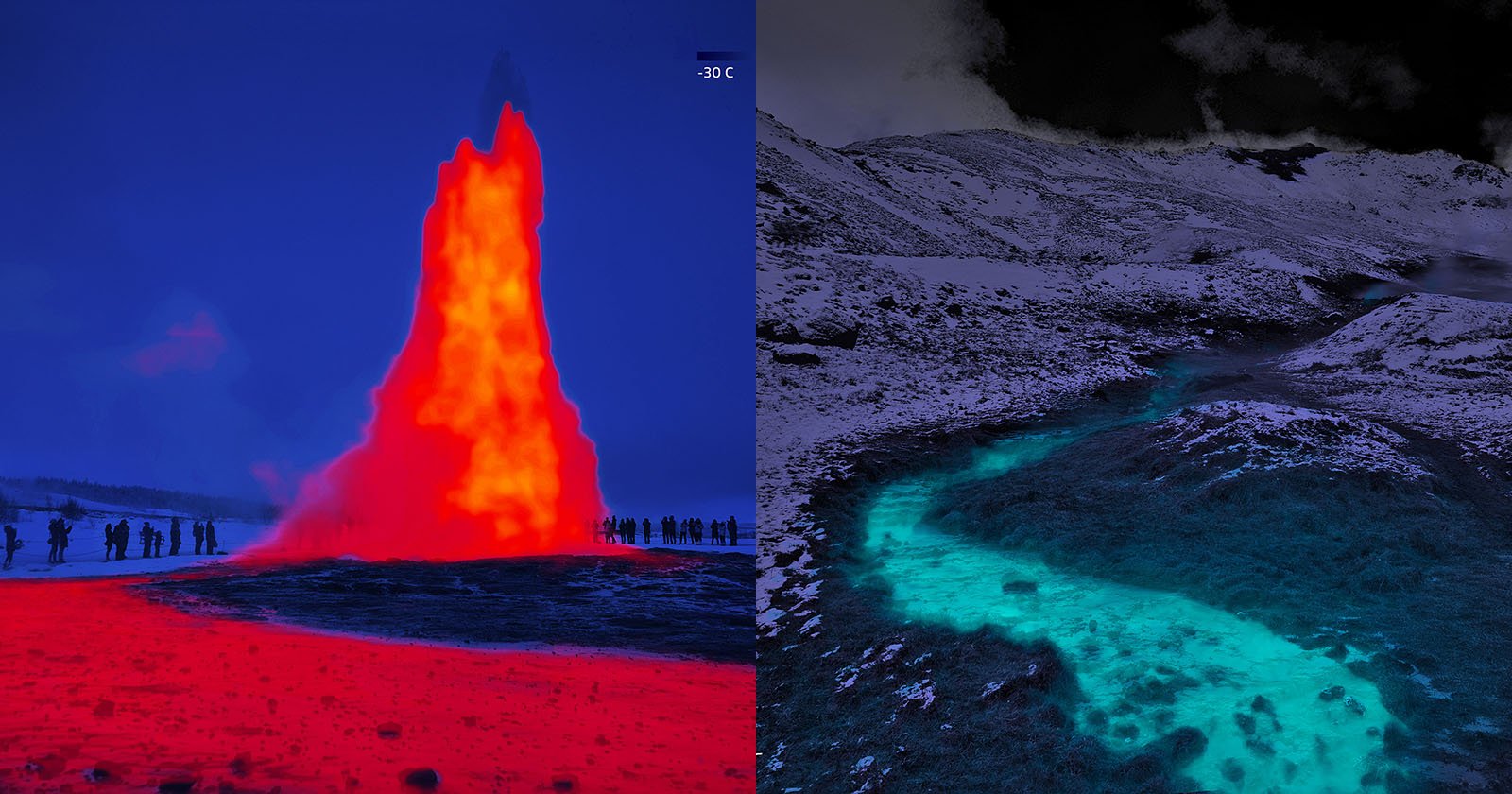
I used a Seek RevealPro which outputs TIFF files that contain 32-bit floating point values. I created a script that takes in a Seek TIFF and outputs an 8-bit greyscale integer TIFF: https://github.com/dheera/iceland-thermal/blob/master/script... I then panoramically stitched those 8-bit TIFFs together (some with the help of hugin, and some manually with GIMP) and distortion-corrected them as best as I could to a black-and-white visible light image. I also created an artistically-chosen color map for each image. For the final output image, hue and saturation are fully based on thermal data, and lightness is a combination of thermal and visible data. Scripts to generate the final output images, along with the panoramically pre-stitched data, and the color maps I used: https://github.com/dheera/iceland-thermal Also, my Instagram, which is mostly astrophotography of late, but I did post thermal images there before and I may do so in the future again if I can find another good set of interesting thermal subjects to do this in! https://instagram.com/dheeranet/
Not too many, for personal projects I'm mostly budget-constrained. I tried the Flir C2 but the thermal data was extremely low resolution, and returned it. I also tried a Flir Lepton 2 module since I could use an RPi and some gadgetry to do the panorama scanning and stitching automatically, but it too was low resolution (80x60).
The Lepton 3 seems to be decent at 160x120 though, which is probably good enough for a project like this, so if I were doing this again I'd probably use a Lepton 3 and a 2-axis servo scanner with a RPi, and maybe even combine it with an RPi HQ camera to automate the entire process into a single push button. The Seek RevealPro is slightly annoying in that it doesn't have programmatic access so I had to press a button to take every piece of the panorama. It's a great general-use device though. I use it when camping or doing astrophotography in remote locations for some peace of mind since I can spot any potential wildlife and people threats from a distance, and I can easily identify whether a parked or seemingly abandoned car has been recently occupied. (My fears may be unfounded, but either way I'm much more at ease when I can see in the dark.)
I was recently looking at the Lepton. I would really like a to make an affordable monocular. It seemed like the image quality was quite low even for the 160. I'm not sure if adding some lenses for magnification would improve them or not. The refresh rate is pretty slow too. I'd love to experiment with it, but $200 is a lot for a project that might not be usable.
The Boson seems like it has great clarity and refresh rate, but at that price I might as well just buy a purpose made device (outside my price range).
Yeah so I tried to get that shot about a dozen times on various farms before I finally found some horses that seemed tired, lethargic, and didn't move too fast.
I also had to stand there for a good 15 minutes in the biting cold before they stopped being interested in me and kind of just stood there. They still occasionally turned their heads though so I quickly snapped my visible light image with a DSLR in one hand on a tripod and scanned over the horse part with the thermal camera in the other, before patiently scanning the rest of the scene. The horses in the distance though still did move, as you can see in the separate thermal/visible images in the repo. I had to do a similar thing for the erupting geyser. 2 quick thermal shots in rapid succession for the eruption in one hand, DSLR in the other, then scanned the rest of the scene. Took about maybe 20 tries at least.
I'm curious what kind of thermal camera he's using.
I bought a Therm-App Pro 640x480 a while back and it's quite good - and reasonably priced compared to Flir - along with a github repo for different false color palettes. But what's really weird is it seems to not be available anymore. I'm guessing export restrictions or massive demand for thermal cameras during Covid along with supply chain issues. IIRC it is also 25 frames a second, which is unusually high for thermal cameras due to export restrictions. Edit: Here's a post on creating panoramic images with therm-app. https://www.flickr.com/groups/therm-app-users/discuss/721576...
I was wondering this too, the author added this info via a reply in the comments (of his site/article , not HN)-
> Author here. The camera was a Seek RevealPro which has 320x240 resolution. The thermal data in the panoramas are stitched together from raw data exported by the camera and represented as color (hue+saturation, as per scale in upper right, represents temperature data). The brightness channel is piecewise-linearly combined with a corresponding visual image taken with a regular SLR to provide a visual reference of what you're looking at.
Thanks OP. Really great work on those Iceland pics. It’s an original concept I haven’t seen before - adding thermal data to panoramas of landscapes with geothermal heat. So cool. I’m a bit jealous I didn’t think of it first.
Sounds like you have a science background and field, but I’d encourage you to think of these as art and chat to a few galleries about an exhibition. At the very least it would be fun, and pretty amazing to see big blowups of your own imagery. They may be able to do a virtual exhibition during Covid.
I would love to! I'm a physics/EE major by training and career-wise I'm focused on ML and robotics, but I love art and especially using art to visualize science in ways that are understandable to the general public. (I'm also doing an astrophotography project to show the visual sizes of various nebulae. Your usual NASA photos don't really provide any sense of scale, and many people have the misconception that you need insane magnification to see them, but there are actually a whole lot of objects that are visually much bigger than the moon, just too dim to see.) Being an engineer by background my network is mostly engineers -- I don't really have any strong connections with galleries and media, but I'll be on the lookout for them! I welcome intros if anyone would be so kind. :) TIA!
You can buy a FLIR Boson at 640x512 for that price. The cost of thermal cameras is roughly linear with the number of pixels. I realise that's not cheap, but you can get double the resolution (e.g. 4x pixels) for the same money.
Cunning. He took panoramas with thermal camera and simultaneous black and white photos and coloured the b&w photos with the data from the thermal camera. Interesting examples of insulation. I wonder how the result compares to the standard Flir auto blended images. Msx?
This would be better than FLIR's MSX, which generally suffers from a lack of precise alignment of the thermal and optical images, particularly for shots with a lot of depth of field.
Beautiful. Eerie. Great work. Thank you for sharing.
Your images look almost like they came out of James Cameron's vivid imagination. If you had told me these were computer-generated images of Pandora at night[a] from the upcoming Avatar sequel, I would have believed it. [a] E.g., see https://www.google.com/search?tbm=isch&q=avatar%20pandora%20...
Comments (95) 19 threads
I used a Seek RevealPro which outputs TIFF files that contain 32-bit floating point values. I created a script that takes in a Seek TIFF and outputs an 8-bit greyscale integer TIFF:
https://github.com/dheera/iceland-thermal/blob/master/script...
I then panoramically stitched those 8-bit TIFFs together (some with the help of hugin, and some manually with GIMP) and distortion-corrected them as best as I could to a black-and-white visible light image. I also created an artistically-chosen color map for each image. For the final output image, hue and saturation are fully based on thermal data, and lightness is a combination of thermal and visible data. Scripts to generate the final output images, along with the panoramically pre-stitched data, and the color maps I used:
https://github.com/dheera/iceland-thermal
Also, my Instagram, which is mostly astrophotography of late, but I did post thermal images there before and I may do so in the future again if I can find another good set of interesting thermal subjects to do this in!
https://instagram.com/dheeranet/
The Lepton 3 seems to be decent at 160x120 though, which is probably good enough for a project like this, so if I were doing this again I'd probably use a Lepton 3 and a 2-axis servo scanner with a RPi, and maybe even combine it with an RPi HQ camera to automate the entire process into a single push button.
The Seek RevealPro is slightly annoying in that it doesn't have programmatic access so I had to press a button to take every piece of the panorama. It's a great general-use device though. I use it when camping or doing astrophotography in remote locations for some peace of mind since I can spot any potential wildlife and people threats from a distance, and I can easily identify whether a parked or seemingly abandoned car has been recently occupied. (My fears may be unfounded, but either way I'm much more at ease when I can see in the dark.)
The Boson seems like it has great clarity and refresh rate, but at that price I might as well just buy a purpose made device (outside my price range).
I also had to stand there for a good 15 minutes in the biting cold before they stopped being interested in me and kind of just stood there.
They still occasionally turned their heads though so I quickly snapped my visible light image with a DSLR in one hand on a tripod and scanned over the horse part with the thermal camera in the other, before patiently scanning the rest of the scene. The horses in the distance though still did move, as you can see in the separate thermal/visible images in the repo.
I had to do a similar thing for the erupting geyser. 2 quick thermal shots in rapid succession for the eruption in one hand, DSLR in the other, then scanned the rest of the scene. Took about maybe 20 tries at least.
I bought a Therm-App Pro 640x480 a while back and it's quite good - and reasonably priced compared to Flir - along with a github repo for different false color palettes. But what's really weird is it seems to not be available anymore. I'm guessing export restrictions or massive demand for thermal cameras during Covid along with supply chain issues. IIRC it is also 25 frames a second, which is unusually high for thermal cameras due to export restrictions.
Edit: Here's a post on creating panoramic images with therm-app. https://www.flickr.com/groups/therm-app-users/discuss/721576...
> Author here. The camera was a Seek RevealPro which has 320x240 resolution. The thermal data in the panoramas are stitched together from raw data exported by the camera and represented as color (hue+saturation, as per scale in upper right, represents temperature data).
The brightness channel is piecewise-linearly combined with a corresponding visual image taken with a regular SLR to provide a visual reference of what you're looking at.
Sounds like you have a science background and field, but I’d encourage you to think of these as art and chat to a few galleries about an exhibition. At the very least it would be fun, and pretty amazing to see big blowups of your own imagery. They may be able to do a virtual exhibition during Covid.
I would love to! I'm a physics/EE major by training and career-wise I'm focused on ML and robotics, but I love art and especially using art to visualize science in ways that are understandable to the general public. (I'm also doing an astrophotography project to show the visual sizes of various nebulae. Your usual NASA photos don't really provide any sense of scale, and many people have the misconception that you need insane magnification to see them, but there are actually a whole lot of objects that are visually much bigger than the moon, just too dim to see.)
Being an engineer by background my network is mostly engineers -- I don't really have any strong connections with galleries and media, but I'll be on the lookout for them! I welcome intros if anyone would be so kind. :) TIA!
Your images look almost like they came out of James Cameron's vivid imagination. If you had told me these were computer-generated images of Pandora at night[a] from the upcoming Avatar sequel, I would have believed it.
[a] E.g., see https://www.google.com/search?tbm=isch&q=avatar%20pandora%20...
All comments shown.
Couldn't load more comments. Check your connection and try again.