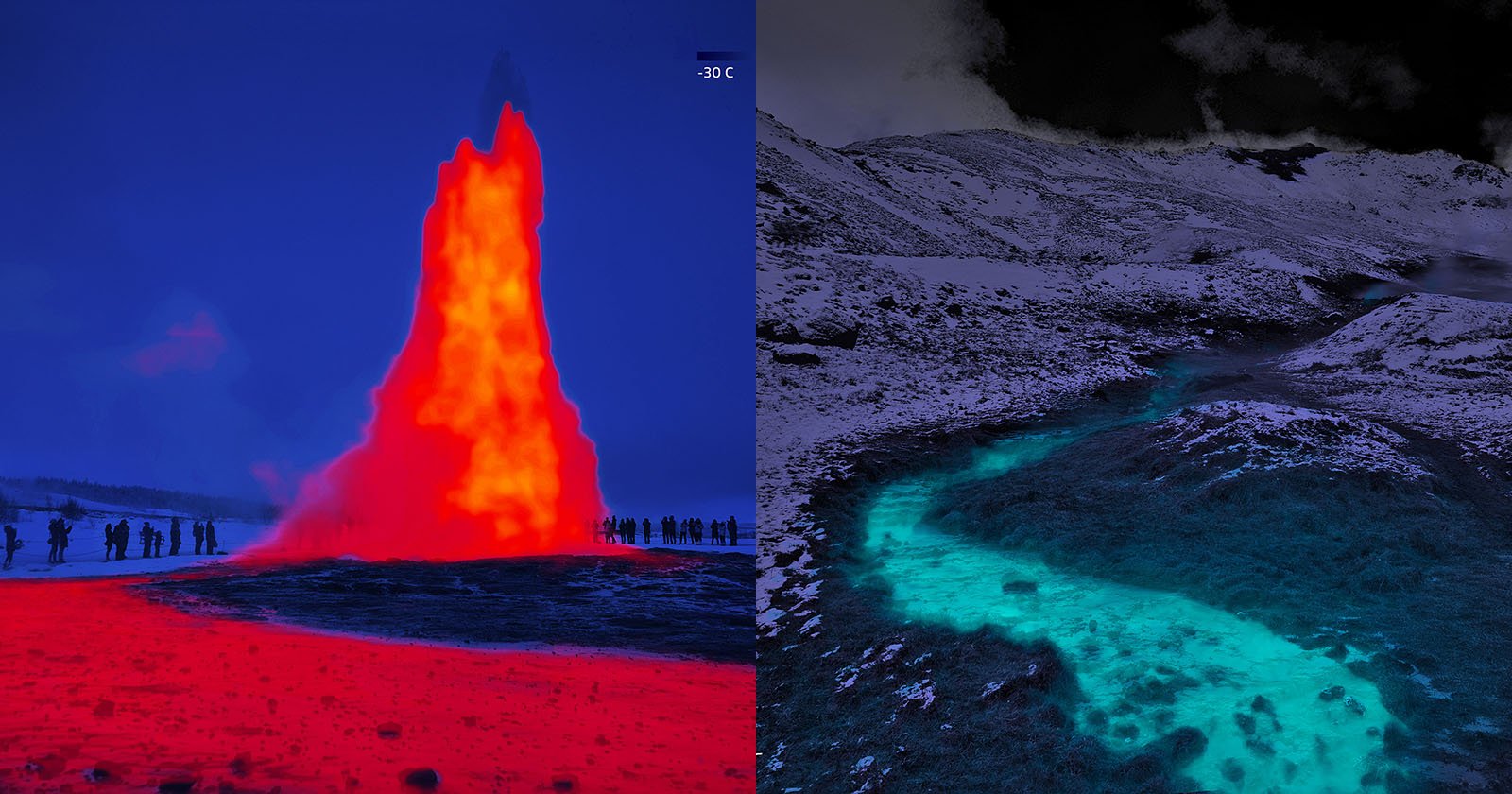
I have done a lot of work with high resolution thermal imagers and never seen any images that look like these so I was curious what was going on.
>I also simultaneously shot a black-and-white photo with a regular camera and a wide-angle lens for comparison. I then wrote my own program to color the black-and-white photograph with the actual thermal data, using a false-color scale which you see in the upper-right corner of every image. Amazing drawings, but these are not actually thermal images.
Pure thermal would have been quite smudged. IMHO the B&W adds really nice context - and it sounds like it's not just a straight overlay, but he's recoloring the B&W pixels, which I think provides a crisper result.
I'm curious what resolutions you've worked with, if you don't mind sharing. High frame rate thermal cameras (above 9hz) are ITAR restricted. Hi-res above 640x480 is not common on the consumer market and is restricted to embargoed countries. Cooled thermal cameras are restricted too IIRC.
The device we had was 1.3MP--rough the same resolution as the composite image discussed in this article. The camera core was expensive, but the lens actually cost more than the sensor. Yes it was ITAR regulated.
Thanks. Interesting link. I must admit I can’t help but admire Lockheed’s marketing with that whitehouse image. There’s a not-so-subtle message in there.
At my previous work I was involved with processing of data from 1024x800 cameras with 16 bit per pixel and nice optics. After proper calibration and trivial image processing they were not particularly blurry since they were able to resolve even tiny temperature differences.
ITAR restricts the export of arms technology from the United States, but the big names in traditional digital cameras are all Japanese. Perhaps naively, I would have thought they'd have the expertise needed to build a high-quality thermal camera without US involvement. I suppose infrared imaging must be quite a bit different from visible light.
OP here -- I added a top-level comment with some more links. In particular you can find the separate thermal and visible images on the repo: https://github.com/dheera/iceland-thermal
Thanks for the clarification! This makes sense, the reason your images look 'off' is that the normal thermal pallets (such as the one in your colorbar) are typically a roughly constant (or at least smoothly varying) luminance with the thermal information stored in the chroma. Your images have that multiplied by the visible light image intensity which gives a very surreal effect. Fun stuff
By that metric, most of the NASA images you see are "drawings" as well. I worked on imaging systems for various NASA spacecraft, and most of the published images are false-color, albedo-adjusted, averaged mosaics of many imaging sources from different orbital passes over months or years. Images of people and everyday things are heavily-processed as well, using techniques like HDR and color correction. Photography has always involved this sort of technical manipulation.
The sensor needs a lot more energy. This produces two types of IR cams: actively and passively cooled.
The passive cooling is easy to take around with you but only possible with a smaller sensor.
As for the price per pixel: I don't know from memory.
I think it's a combination of physics (wavelength is 20x larger than visual light, making optics and sensors trickier) and export control, as you could (literally) weaponize a high-res thermal camera to make an autonomous drone/missile targetting hot exhaust etc.
Thermal cameras measure much larger waves (7-14 microns as described in the article), and their sensitivity to amplitude is high.
A major limiting factor in camera sensor resolution is signal to noise ratio. It is well known that if you bump up the "ISO" (light sensitivity) to make photographs at night, you see more noise. The higher the sensor resolution, the smaller each photosite and therefore the less signal (fewer photons) captured in the short time of one exposure. Larger sensors can solve this problem but these are CMOS devices whose cost increases superlinearly with area (like microprocessors, see die yield). Most customers won't accept dead pixels. Economics is also a major enabler of kilobuck 50 MP visible light cameras, miracles though they are. Industrial users aren't going to re-buy all their cameras every few years like DSLR users do.
Sure but can you sell a thermal camera that takes e.g. one second per exposure? And costs even more than current models? I'm not sure there's much of a market there.
As I recall, IR sensors are also much more expensive to produce, as in, 1Kx1K is already a very large array and costs thousands of $. So any ordinary consumer is not likely to be using something with very high resolution.
This is just slighly informed, please prove me wrong.
The major market so far seems to have been tactical/military, so they have focused on framerates rather than resolution. And then the US blocked high framerates for civilian use... (edit: the US blocked civilian exports.)
> Export of this device described herein is strictly prohibited without a valid export license issued by the U.S. Department of State Directorate of Defense Trade Controls, as prescribed in the International Traffic in Arms Regulations (ITAR) ...
So I guess they only blocked civilian exports from the US.
I bought a HIK Vision Vulkan 35mm Pro [0] in the UK recently which refreshes at 50Hz, and I've seen others that can do 60Hz. One nice thing about the HIK Vision is that it comes with a documented API for controlling it via a wifi hotspot.
Visible wavelength cameras rely on relatively cheap CMOS sensors. CMOS processes have been squeezed for efficiency for decades to make, for example cheap DRAM.
The technologies behind thermal cameras are very different because they need to be sensitive to wavelengths 10x longer than visible light (the silicon in CMOS is basically completely insensitive to light above 2 um, whereas thermal cameras need to image at ~10 um). The pixels are effectively microbolometers and rely on more exotic materials like Germanium.
Funny how once upon a time it was Silicon that was considered to be the rare material for semiconductor manufacture. Then it took over and Germanium was pretty much lost, though at 0.2V forward bias it has a lot of unique applications in sensing gear. It is also why you really want to use a Germanium diode for your crystal radio set!
Because companys pay so much, so why make an cheaper product.
Mike did a real teardown on a Flir E4 many years ago, and saw (with an oscilloscope), even on the cheap camera with the low resolution, the chip has the full resolution. I think one week later the camera was hacked. https://www.youtube.com/watch?v=NtqUE67BUDI
Nice results, thermal cameras aren't easy to work with, especially in terms of artistic result. I've seen problems with stitching resulting with artifacts in panoramas. As I understood (I'm not thermal cameras expert) it's due too the fact that sensor warms up -> thermal camera calibration doesn't correct the result enough -> stitching needs corrections.
Comments (95) 19 threads
Earlier comments>I also simultaneously shot a black-and-white photo with a regular camera and a wide-angle lens for comparison. I then wrote my own program to color the black-and-white photograph with the actual thermal data, using a false-color scale which you see in the upper-right corner of every image.
Amazing drawings, but these are not actually thermal images.
I'm curious what resolutions you've worked with, if you don't mind sharing. High frame rate thermal cameras (above 9hz) are ITAR restricted. Hi-res above 640x480 is not common on the consumer market and is restricted to embargoed countries. Cooled thermal cameras are restricted too IIRC.
As an example of what I would have expected, this product brief (not the device we were using, but similar) has a picture of the white house https://www.lockheedmartin.com/content/dam/lockheed-martin/m...
Sounds like super interesting work!!
Continue this thread — 1 reply
They're right around the corner from FLIR and Seek Thermal is right down the street.
Lots of amazing tech in this little town.
Yes, there is no debate about that.
As for the price per pixel: I don't know from memory.
A major limiting factor in camera sensor resolution is signal to noise ratio. It is well known that if you bump up the "ISO" (light sensitivity) to make photographs at night, you see more noise. The higher the sensor resolution, the smaller each photosite and therefore the less signal (fewer photons) captured in the short time of one exposure.
Larger sensors can solve this problem but these are CMOS devices whose cost increases superlinearly with area (like microprocessors, see die yield). Most customers won't accept dead pixels.
Economics is also a major enabler of kilobuck 50 MP visible light cameras, miracles though they are. Industrial users aren't going to re-buy all their cameras every few years like DSLR users do.
I'd really like a monocular, but anything decent is very expensive.
The major market so far seems to have been tactical/military, so they have focused on framerates rather than resolution. And then the US blocked high framerates for civilian use...
(edit: the US blocked civilian exports.)
[0]: https://www.bhphotovideo.com/c/product/1194041-REG/flir_431_...
So I guess they only blocked civilian exports from the US.
Continue this thread — 2 replies
[0] https://www.hikvision.com/en/products/Thermal-Products/Comme...
The technologies behind thermal cameras are very different because they need to be sensitive to wavelengths 10x longer than visible light (the silicon in CMOS is basically completely insensitive to light above 2 um, whereas thermal cameras need to image at ~10 um). The pixels are effectively microbolometers and rely on more exotic materials like Germanium.
Mike did a real teardown on a Flir E4 many years ago, and saw (with an oscilloscope), even on the cheap camera with the low resolution, the chip has the full resolution. I think one week later the camera was hacked.
https://www.youtube.com/watch?v=NtqUE67BUDI
To put it one dimension higher, in Pix4D we work on 3d models based on the thermal images: https://www.youtube.com/watch?v=x-jp9a1bpVU Example: https://sketchfab.com/3d-models/thermal-model-of-pix4d-headq...
All comments shown.
Couldn't load more comments. Check your connection and try again.