Holy cow, I'm a very casual gamer, I was excited about the game but when it came out I decided I don't want to wait that long and I'll wait until they sort it out. 2 years later it still sucked. So I abandoned it. But.. this... ?! This is unbelievable. I'm certain that many people left this game because of the waiting time. Then there are man-years wasted (in a way different than desired).
Parsing JSON?! I thought it was some network game logic finding session magic. If this is true that's the biggest WTF I saw in the last few years and we've just finished 2020. Stunning work just having binary at hand. But how could R* not do this? GTAV is so full of great engineering. But if it was a CPU bottleneck then who works there that wouldn't just be irked to try to nail it? I mean it seems like a natural thing to try to understand what's going on inside when time is much higher than expected even in the case where performance is not crucial. It was crucial here. Almost directly translates to profits. Unbelievable.
I don’t think the lesson here is “be careful when parsing json” so much as it’s “stop writing quadratic code.” The json quadratic algorithm was subtle. I think most people’s mental model of sscanf is that it would be linear in the number of bytes it scans, not that it would be linear in the length of the input. With smaller test data this may have been harder to catch. The linear search was also an example of bad quadratic code that works fine for small inputs.
Some useful lessons might be: - try to make test more like prod. - actually measure performance and try to improve it - it’s very easy to write accidentally quadratic code and the canonical example is this sort of triangular computation where you do some linear amount of work processing all the finished or remaining items on each item you process. As I read the article, my guess was that it was some terrible synchronisation bug (eg download a bit of data -> hand off to two sub tasks in parallel -> each tries to take out the same lock on something (eg some shared data or worse, a hash bucket but your hash function is really bad so collisions are frequent) -> one process takes a while doing something, the other doesn’t take long but more data can’t be downloaded until it’s done -> the slow process consistently wins the race on some machines -> downloads get blocked and only 1 cpu is being used)
It could be, and the article acknowledges that possibility. For example, a cursory check of the musl sscanf [0] suggests that it does not (though I may have missed something). However, whichever implementation Rockstar used apparently does.
- do not implement your own JSON parser (I mean, really?).
- if you do write a parser, do not use scanf (which is complex and subtle) for parsing, write a plain loop that dispatches on characters in a switch. But really, don't.
I think sscanf is subtle because when you think about what it does (for a given format string), it’s reasonably straightforward. The code in question did sscanf("%d", ...), which you read as “parse the digits at the start of the string into a number,” which is obviously linear. The subtlety is that sscanf doesn’t do what you expect. I think that “don’t use library functions that don’t do what you expect” is impossible advice.
I don’t use my own json parser but I nearly do. If this were some custom format rather than json and the parser still used sscanf, the bug would still happen. So I think json is somewhat orthogonal to the matter.
This is probably good advice but not even relevant. It's down one level from the real problem: when your game spends 6 minutes on a loading screen, *profile* the process first. You can't optimize what you haven't measured. Now, if you've identified that JSON parsing is slow, you can start worrying about how to fix that (which, obviously, should be "find and use a performant and well-tested library".)
> actually measure performance and try to improve it
This really rings truest to me: I find it hard to believe nobody ever plays their own game but I’d easily believe that the internal culture doesn’t encourage anyone to do something about it. It’s pretty easy to imagine a hostile dev-QA relationship or management keeping everyone busy enough that it’s been in the backlog since it’s not causing crashes. After all, if you cut “overhead” enough you might turn a $1B game into a $1.5B one, right?
> actually measure performance and try to improve it
This reminds me that I used to do that all the time when programming with Matlab. I have stopped investigating performance bottlenecks after switching to Python. It is as if I traded performance profiling with unit testing in my switch from Matlab to Python. I wonder if there are performance profilers which I could easily plug into PyCharm to do what I used to do with Matlab's default IDE (with a built-in profiler) and catch up with good programming practices. Or maybe PyCharm does that already and I was not curious enough to investigate.
The JSON parsing is forgivable (I actually didn't know that scanf computed the length of the string for every call) but the deduplication code is a lot less so, especially in C++ where maps are available in the STL.
It also comforts me into my decision of never using scanf, instead preferring manual parsing with strtok_r and strtol and friends. It's just not robust and flexible enough.
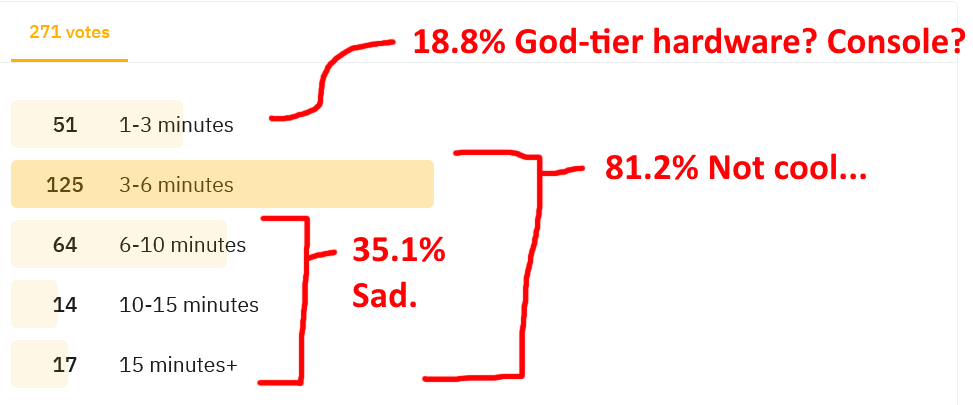
Me and my twice-a-week gaming group enjoyed GTA V but abandoned it years ago simply because of the load times. We have 2x short slots (90-120 minutes) each week to play and don't want to waste them in loading screens.
We all would have picked this game back up in a second if the load times were reduced. Although I must say even with the same results as this author, 2 minutes is still too long. But I'll bet that, given the source code, there are other opportunities to improve.
I wonder if a paid subscription would have fixed this? If you left a paid MMO, they'd probably ask you to fill out an exit survey, and you could say "I'm canceling because load times are terrible", which would (hopefully) raise the priority of reducing load times. But since GTA online is "free", there's not a single exit point where they can ask "why did you stop playing".
Gta has made billions off of its shark card micro transaction system. So the incentives are probably pretty similar for player retention. Granted, the players leaving over load times are probably not the players who are invested enough to spend thousands in micro transactions.
> But how could R* not do this? GTAV is so full of great engineering
I assume there were different people working on the core game engine and mechanics VS loading. It could as well be some modular system, where someone just implemented the task "load items during online mode loading screen screen".
Many developers I have spoken to out there in the wild in my role as a consultant have wildly distorted mental models of performance, often many orders of magnitude incorrect. They hear somewhere that "JSON is slow", which it is, but you and I know that it's not this slow. But "slow" can encompass something like 10 orders of magnitude, depending on context. Is it slow relative to a non-validating linear binary format? Yes. Is it minutes slow for a trivial amount of data? No. But in their mind... it is, and there's "nothing" that can be done about it. Speaking of which: A HTTPS REST API call using JSON encoding between two PaaS web servers in Azure is about 3-10ms. A local function call is 3-10ns. In other words, a lightweight REST call is one million times slower than a local function call, yet many people assume that a distributed mesh microservices architecture has only "small overheads"! Nothing could be further from the truth. Similarly, a disk read on a mechanical drive is hundreds of thousands of times slower than local memory, which is a thousand times slower than L1 cache. With ratios like that being involved on a regular basis, it's no wonder that programmers make mistakes like this...
Tbe funny thing is, as a long time SDET, I had to give up trying to get people to write or architect in a more "local first" manner.
Everyone thinks the network is free... Until it isn't. Every bit move in a computer has a time cost, and yes, it's small... But... When you have processors as fast as what exist today, it seems a sin that we delegate so much functionality out to some other machine across a network boundary when the same work could be done locally. The reason why though? Monetizability and trust. All trivial computation must be done on my services so they can be metered and charged for. We're hamstringing the programs we run for the sole reason that we don't want to make tools. We want to make invoices.
This is why I come to HN, I was going to skip this because I thought it was about video games, but really glad to have read it, and loved every line of the article.
So much to get from this. Even if you don't have the source, you can make a change if you are annoyed enough. If you don't like something, and the source code is out there, really go contribute. Performance matters, know how to profile and if using an external dependency, then figure out their implementation details. Algorithms & Data structures matter, often I see devs talking about how it doesn't matter much but the difference between using a hashmap vs array is evident. Attentive code reviews matter, chances are they gave this to a junior dev/intern, and it worked with a small dataset and no one noticed.
I always tell a story about an application we ran, it generated its own interface based on whatever was in inventory. Someone did something really stupid and duplicated each inventory item for each main unit we sold...so you had recursive mess. Assigning 100,000 items when previously it was 100-ish
Anyway, everyone just rolled their eyes and blamed the fact that the app was written in Java. It ended up generating an XML file during that minute long startup....so we just saved the file to the network and loaded it on startup. If inventory changed, we’d re-generate the file once and be done with it.
There’s also a confound between a language and its communities. I’ve seen so many cases where a “slow” language like Python or (older) Perl smoked Java or C++ because the latter developers were trying to follow cultural norms which said that Real Decelopers™ don’t write simple code and they had huge memory churn with dense object hierarchies and indirection so performance ended up being limited by O(n) XML property lookups for a config setting which nobody had ever changed whereas the “slow” language developer had just implemented a simple algorithm directly and most of the runtime was in highly-optimized stdlib native code, a fast regex instead of a naive textbook parser which devolved into an object churn benchmark, etc.
Languages like Java get a lot of bad reputation for that because of popularity: not just that many people are hired into broken-by-design environments (or ones where they’re using some framework from a big consultancy or a vendor who makes most of their revenue from consulting services) but also because many people learn the language as their first language and often are deeply influenced by framework code without realizing the difference between widely used long-term reusable code and what most projects actually need and are staffed for. It’s easy to see the style of the Java standard frameworks or one of the major Apache projects and think that everyone is supposed to write code like that, forgetting that they have to support a greater number of far more diverse projects over a longer timeframe than your in-house business app nobody else works on. Broader experience helps moderate this but many places choose poor metrics and neglect career development.
Java is RAM guzzler with some a small inability to optimize with value types. In its class (managed programming language without value types) it is pretty much as fast as it gets.
The two performance flaws that exist are: 1. Old Java frameworks were not written with performance in mind 2. Your entire app is written in Java so you don't benefit from C++ libraries
I think this is a perfect example of “algorithms and data structures emphasis is overblown.” Real world performance problems don’t look like LeetCode Hard, they look like doing obviously stupid, wasteful work in tight loops.
And trying to optimize them gets you stink eye at code review time. Someone quotes Knuth, they replace your fast 200 lines with slow-as-molasses 10 lines and head to the bar.
Exactly - though to add a little nuance to your post, it’s about having a million loops in a 10M line code base and exactly one of them is operating maximally slowly. So preventing the loop from entering the code base is tough - finding it is key.
True that it's rare that you need to pull out obscure algorithms or data structures, but in many projects you'll be _constantly_ constructing, composing, and walking data structures, and it only takes one or two places that are accidentally quadratic to make something that should take milliseconds take minutes.
The mindset of constantly considering the big-O category of the code you're writing and reviewing pays off big. And neglecting it costs big as well.
Except that you need to test your software and if you see performance problems, profile them to identify the cause. It's not like you have one single chance to get everything right.
... that's the exact opposite of what I took from this.
The obviously stupid, wasteful work is at heart an algorithmic problem. And it cropped up even in the simplest of data structures. A constant amount of wasteful work often isn't a problem even in tight loops. A linear amount of wasted work, per loop, absolutely is.
It's not something that requires deep algorithms/data structures knowledge, is the point. Knowing how to invert a binary tree won't move the needle on whether you can spot this kind of problem. Knowing how to operate a profiler is a lot more useful.
And here what matters is not your programming skills, it’s your profiling skills. Every dev writes code that’s not the most optimized piece from the start, hell we even say “don’t optimise prematurely”. But good devs know how to profile and flamegraph their app, not leetcode their app.
actually, "don't optimize prematurely" is a poor advice.
just recently I was doing a good review that had the same issue where they were counting the size of an array in a loop, when stuff was being added to the array in the loop too. obvious solution was to track the length and
   arr = []
   while ...:
      if something:
         arr.append(foo)
      ...
      if count(arr) == x:
        stuff
      ...
changed to
   arr=[]
   arr_size = 0
   while ...:
      if something:
         arr.append(foo)
         arr_size++;
      ...
      if arr_size == x:
        stuff
      ...
This is clearly optimization, but it's not premature. The original might just pass code review, but when it wrecks havoc, the amount of time it will cost will not be worth it, jira tickets, figuring out why the damn thing is slower, then having to recreate it in dev, fixing it, reopening another pull request, review, deploy, etc. Sometimes "optimizing prematurely" is the right thing to do if it doesn't cost much time to do or overly completely the initial solution. Of course, this depends on the language, some languages will track the length of the array so checking the size is o(1), but not all languages do, so checking the length can be expensive, knowing the implementation detail matters.
Honestly, while this horrible code is mildly offensive to me, I'm pretty impressed by this person's persistence. It's one thing to identify a bug in a compiled program, but it's another to patch it without fully understanding what's going on. Caching strlen was a particularly clever trick that sidestepped a bunch of more complicated solutions.
I played through GTA V, enjoyed it, and tried out the online mode afterward.
I've logged in exactly twice. Load times like that may be worth it to a hardcore gamer, but I have no patience for it. There's no shortage of entertainment available to someone with a PC, a reasonable internet connection, and a modicum of disposable income. Waste my time and I'll go elsewhere for my entertainment.
Comments (699) 110 threads
Parsing JSON?! I thought it was some network game logic finding session magic. If this is true that's the biggest WTF I saw in the last few years and we've just finished 2020.
Stunning work just having binary at hand. But how could R* not do this? GTAV is so full of great engineering. But if it was a CPU bottleneck then who works there that wouldn't just be irked to try to nail it? I mean it seems like a natural thing to try to understand what's going on inside when time is much higher than expected even in the case where performance is not crucial. It was crucial here. Almost directly translates to profits. Unbelievable.
Some useful lessons might be:
- try to make test more like prod.
- actually measure performance and try to improve it
- it’s very easy to write accidentally quadratic code and the canonical example is this sort of triangular computation where you do some linear amount of work processing all the finished or remaining items on each item you process.
As I read the article, my guess was that it was some terrible synchronisation bug (eg download a bit of data -> hand off to two sub tasks in parallel -> each tries to take out the same lock on something (eg some shared data or worse, a hash bucket but your hash function is really bad so collisions are frequent) -> one process takes a while doing something, the other doesn’t take long but more data can’t be downloaded until it’s done -> the slow process consistently wins the race on some machines -> downloads get blocked and only 1 cpu is being used)
[0]: https://git.musl-libc.org/cgit/musl/tree/src/stdio/vfscanf.c
Continue this thread — 3 replies
- if you do write a parser, do not use scanf (which is complex and subtle) for parsing, write a plain loop that dispatches on characters in a switch. But really, don't.
I don’t use my own json parser but I nearly do. If this were some custom format rather than json and the parser still used sscanf, the bug would still happen. So I think json is somewhat orthogonal to the matter.
Continue this thread — 6 replies
This really rings truest to me: I find it hard to believe nobody ever plays their own game but I’d easily believe that the internal culture doesn’t encourage anyone to do something about it. It’s pretty easy to imagine a hostile dev-QA relationship or management keeping everyone busy enough that it’s been in the backlog since it’s not causing crashes. After all, if you cut “overhead” enough you might turn a $1B game into a $1.5B one, right?
Continue this thread — 3 replies
This reminds me that I used to do that all the time when programming with Matlab. I have stopped investigating performance bottlenecks after switching to Python. It is as if I traded performance profiling with unit testing in my switch from Matlab to Python.
I wonder if there are performance profilers which I could easily plug into PyCharm to do what I used to do with Matlab's default IDE (with a built-in profiler) and catch up with good programming practices. Or maybe PyCharm does that already and I was not curious enough to investigate.
It also comforts me into my decision of never using scanf, instead preferring manual parsing with strtok_r and strtol and friends. It's just not robust and flexible enough.
We all would have picked this game back up in a second if the load times were reduced. Although I must say even with the same results as this author, 2 minutes is still too long. But I'll bet that, given the source code, there are other opportunities to improve.
Continue this thread — 1 reply
I assume there were different people working on the core game engine and mechanics VS loading. It could as well be some modular system, where someone just implemented the task "load items during online mode loading screen screen".
Many developers I have spoken to out there in the wild in my role as a consultant have wildly distorted mental models of performance, often many orders of magnitude incorrect.
They hear somewhere that "JSON is slow", which it is, but you and I know that it's not this slow. But "slow" can encompass something like 10 orders of magnitude, depending on context. Is it slow relative to a non-validating linear binary format? Yes. Is it minutes slow for a trivial amount of data? No. But in their mind... it is, and there's "nothing" that can be done about it.
Speaking of which: A HTTPS REST API call using JSON encoding between two PaaS web servers in Azure is about 3-10ms. A local function call is 3-10ns. In other words, a lightweight REST call is one million times slower than a local function call, yet many people assume that a distributed mesh microservices architecture has only "small overheads"! Nothing could be further from the truth.
Similarly, a disk read on a mechanical drive is hundreds of thousands of times slower than local memory, which is a thousand times slower than L1 cache.
With ratios like that being involved on a regular basis, it's no wonder that programmers make mistakes like this...
Everyone thinks the network is free... Until it isn't. Every bit move in a computer has a time cost, and yes, it's small... But... When you have processors as fast as what exist today, it seems a sin that we delegate so much functionality out to some other machine across a network boundary when the same work could be done locally. The reason why though?
Monetizability and trust. All trivial computation must be done on my services so they can be metered and charged for.
We're hamstringing the programs we run for the sole reason that we don't want to make tools. We want to make invoices.
I love your point that shipping a library (of code to locally execute) with a good API would outperform an online HTTPS API for almost all tasks.
So much to get from this.
Even if you don't have the source, you can make a change if you are annoyed enough.
If you don't like something, and the source code is out there, really go contribute.
Performance matters, know how to profile and if using an external dependency, then figure out their implementation details.
Algorithms & Data structures matter, often I see devs talking about how it doesn't matter much but the difference between using a hashmap vs array is evident.
Attentive code reviews matter, chances are they gave this to a junior dev/intern, and it worked with a small dataset and no one noticed.
Anyway, everyone just rolled their eyes and blamed the fact that the app was written in Java.
It ended up generating an XML file during that minute long startup....so we just saved the file to the network and loaded it on startup. If inventory changed, we’d re-generate the file once and be done with it.
Languages like Java get a lot of bad reputation for that because of popularity: not just that many people are hired into broken-by-design environments (or ones where they’re using some framework from a big consultancy or a vendor who makes most of their revenue from consulting services) but also because many people learn the language as their first language and often are deeply influenced by framework code without realizing the difference between widely used long-term reusable code and what most projects actually need and are staffed for. It’s easy to see the style of the Java standard frameworks or one of the major Apache projects and think that everyone is supposed to write code like that, forgetting that they have to support a greater number of far more diverse projects over a longer timeframe than your in-house business app nobody else works on. Broader experience helps moderate this but many places choose poor metrics and neglect career development.
Continue this thread — 1 reply
The two performance flaws that exist are:
1. Old Java frameworks were not written with performance in mind
2. Your entire app is written in Java so you don't benefit from C++ libraries
The mindset of constantly considering the big-O category of the code you're writing and reviewing pays off big. And neglecting it costs big as well.
Continue this thread — 1 reply
The obviously stupid, wasteful work is at heart an algorithmic problem. And it cropped up even in the simplest of data structures. A constant amount of wasteful work often isn't a problem even in tight loops. A linear amount of wasted work, per loop, absolutely is.
Continue this thread — 6 replies
Well, until you get flagged by the anti cheat and get your account and motherboard banned...
Continue this thread — 3 replies
Continue this thread — 1 more reply
I've logged in exactly twice. Load times like that may be worth it to a hardcore gamer, but I have no patience for it. There's no shortage of entertainment available to someone with a PC, a reasonable internet connection, and a modicum of disposable income. Waste my time and I'll go elsewhere for my entertainment.
All comments shown.
Couldn't load more comments. Check your connection and try again.