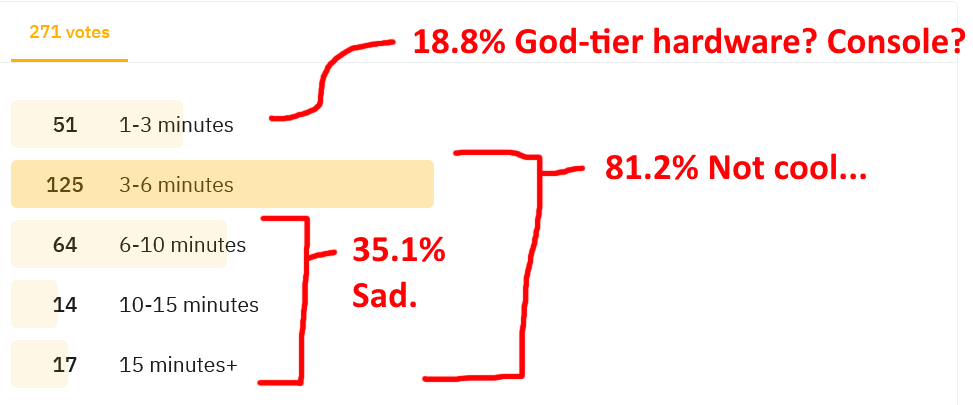
Wow, many people argue how optimized GTA was and then this. I wonder how much money they lost because of this. I often stopped playing because it just took too long to load.
It always fascinates me how sometimes people defend things just because they're a fan, even if the particular aspect they're defending doesn't make sense!
I've seen this happen with some other games which are not the best optimised for PCs, but the fans will still defend the developers, just because they like the brand
It's part of social validation. You inherently want other people to like the things you like, because it validates your choices. This in turn means you'll defend things you like.
Even "rebels", who supposedly relish having fringe tastes, want other rebels to approve of their tastes. The more strongly you stake your identity as "fan of X", the more social disapproval of X hurts.
Yep, sometimes I feel like having a drive around, and then I remember how long it takes to load and play something else instead.
If you end up in a lobby with undesirables and are forced to switch, you've got another long wait.
GTA, at least the core gameplay and the single player mode, is quite well optimised. The game ran well even on the cheaper side of gaming PC hardware.
This... this is GTA online. It's a cash cow designed to suck cash out of your pocket. Ads for things you can spend your money on are shown while "connecting", so if this delay wasn't introduced intentionally, it sure isn't a high priority fix. The code isn't part of the optimised, streamlined, interactive part of the game, it's part of the menu and loader system. Most of these online games/services have so-called "whales" that contribute most if not all of the income the platform makes. If these whales are willing to spend the wads of cash they throw at the platform, they won't even care for another five minutes of ads. The amounts of cash some of these people spend is obscene; the millions Take Two profit from GTA every year are generally generated by only a tiny (usually a single number percentage) of the total player base. In the end, I doubt they've lost much money on this. They might've even made some from the extra ads.
> GTA, at least the core gameplay and the single player mode, is quite well optimised. The game ran well even on the cheaper side of gaming PC hardware.
It's easy to forget that GTA5/GTA:O was originally a 360/PS3 game, getting a game of that scope running at all on a system with just 256MB of RAM and VRAM was an incredible achievement. The A-Team developers who made that happen were probably moved over to Red Dead Redemption 2 though, with GTA5s long tail being handled by the B-Team.
GTA V (the single player game) is quite well optimized and needs a frame rate limiter on most newer systems because it will run at over ~180 fps, at which point the engine starts to barf all over itself.
GTA Online is a huge, enormously buggy and slow mess that will generally struggle to run at 80 fps on a top-of-the-line 2020 system (think 10900K at over 5 GHz with a 3090) and will almost never cross the 120 fps threshold no matter how fast your system is and how low the settings are.
> at which point the engine starts to barf all over itself.
I’m really confused as to why games are determining anything whatsoever based on the refresh rate of the screen. Skyrim has this same problem and not being able to play over 60fps is the reason I haven’t touched the game in years.
It's a coding strategy intended to optimize around console refresh targets first and then "do whatever" for PC build.
Generally, a AAA console game will target 30hz or 60hz. Therefore the timing loop is built to serve updates at a steady pace of 30 or 60, with limiting if it goes faster. Many game engines also interpolate animations separately from the rest of the gameplay, allowing them to float at different refresh rates. Many game engines further will also decouple AI routine tick rates from physics to spread out the load. Many game engines now also interleave updates and kick off the next frame before the first is complete, using clever buffering and multithreaded job code. All told, timing in games is one of those hazard zones where the dependencies are both numerous and invisible. When you bring this piece of intricate engineering over to PC and crank up the numbers, you hit edge cases. Things break. It's usually possible to rework the design to get better framerate independence, but doing do would be invasive - you'd be changing assumptions that are now baked into the content. It isn't just fixing one routine.
Because if you run the simulation at a different frame-rate from the rendering it is a huge amount more work. Suddenly you have to start marshaling data through intermediate data structures and apply interpolation to everything.
If you then try to run the simulation in parallel with the rendering (rather than between some frames) it is even more work, since inter-thread communication is hard. This stuff might seem easy for very good programmers, however on a game you want to hire a wide range of programmer skill and "game-play programmers" tend to be weaker on the pure programming front (their skills lie elsewhere)
Because unfortunately, in order to draw something on the screen, you need to determine what you draw first. So, before each screen refresh, a thing called "game simulation tick" happens.
I disagree. There is no contradiction. JSON can be a different beast for C, C++, Java, backend coders. You can implement complex 3D graphics while struggling with JSON.
For example, my backend Java guys struggled heavily with JSON mappers. It took them forever to apply changes safely. My department consumes a lot of data from backend systems and we have to aggregate and transform them. Unfortunately the consumed structure changes often. While a JSON mapper in our case in JAVA was sort of exceptionally hard to handle, a simple NodeJS layer in JavaScript did the job exceptionally easy and fast. So we used a small NodeJS layer to handle the mapping instead of doing this in Java. Moral of the story: Sometimes there are better tools outside your view. And this seems to be many times the case for JSON. JSON means JavaScript Object Notation. It is still tough for OO languages to handle. This is my observation.
Also note that the way he fixed it, strlen only caches the last call and returns quickly on an immediate second call with the same string.
Another reason why C styled null terminated strings suck. Use a class or structure and store both the string pointer and its length. I have seen other programs where strlen was gobbling up 95% of execution time.
Could this be worked into a compiler/stdlib from the back-end? Could a compiler/stdlib quietly treat all strings as a struct of {length,string} and redefine strlen to just fetch the length field? Perhaps setting a hook to transparently update "length" when "string" is updated is not trivial.
Edit: hah, I'm decades late to the party, here we go: Most modern libraries replace C strings with a structure containing a 32-bit or larger length value (far more than were ever considered for length-prefixed strings), and often add another pointer, a reference count, and even a NUL to speed up conversion back to a C string. Memory is far larger now, such that if the addition of 3 (or 16, or more) bytes to each string is a real problem the software will have to be dealing with so many small strings that some other storage method will save even more memory (for instance there may be so many duplicates that a hash table will use less memory). Examples include the C++ Standard Template Library std::string... https://en.wikipedia.org/wiki/Null-terminated_string
I don't think you could do it transparently, because it's expected to pass the tail of a character array by doing &s[100] or s + 100, etc. I don't think that would be easy to catch all of those and turn them into a string fragment reference.
From c++ class, std::string was easy enough to use everywhere, and just foo.c_str() when you needed to send it to a C library. But that may drags in a lot of assumptions about memory allocation and what not. Clearly, we don't want to allocate when taking 6 minutes to parse 10 megs of JSON! :)
I'm with you. I hate null terminated strings. In my first experiences with C, I specifically hated them because of strlen needing to scan them fully. When C++ introduced string_view, my hate grew when I realized that I could have zero-copy slices all the way up until I needed to interface with a C API. At that point you're forced to copy, even if your string_view came from something that was null terminated!
Not that C strings do not suck, but with pascal strings we could discuss in this thread how implicitly copying a slowly decreasing part of a 10mb string at every tokenizer iteration could miss a developer’s attention. It’s completely unrelated to C strings and is completely related to bytefucking by hand. Once you throw a task like “write a low-level edge-case riddled primitive value shuffling machine” into an usual middle level corporative production pipeline, you’re screwed by default.
Maybe even more surprising to me is that sscanf() relies on strlen().
I would have expected libc to take that use case in consideration and use a different algorithm when the string exceeds a certain size. Even if the GTA parser is not optimal, I would blame libc here. The worst part is that some machines may have an optimized libc and others don't, making the problem apparent only in some configuration. I believe standard libraries should always have a reasonable worst case by default. It doesn't have to be perfectly optimized, but I think it is important to have the best reasonable complexity class, to avoid these kinds of problems. The best implementations usually have several algorithms for different cases. For example, a sort function may do insertion (n^2, good for small n) -> quicksort (avg. nlog(n), worst n^2, good overall) -> heapsort (guaranteed nlog(n), slower than quicksort except in edge cases). This way, you will never hit n^2 but not at the cost of slow algorithm for the most common cases. The pseudo hash table is all GTA devs fault though.
I don't understand why it would need to use strlen anyway. Why wouldn't it treat the string like a stream when scanf is already coded to operate on an actual stream?
> For example, a sort function may do insertion […]
That’s generally called “adaptive”. A famous example of that is timsort. Your version has issues though: insertion sort is stable, which can dangerously mislead users.
I gave up on playing GTA:O because everything took so long to load, having never spent a dime. I have to imagine there is so much lost revenue because of this bug; I hate to be harsh but it is truly an embarrassment that someone external to R* debugged and fixed this before they did (given they had 6 years!).
Same here, being slow as molasses really spoiled the game for me. I wonder if the same software quality caused other unnecessary in-game loading times. I felt that time spent playing GTA:O was about 60% waiting in lobby/playing, and the remaining 40% actual play time. Same with RDR2 by the way.
These problems come down to which programmers were allowed to remain on the team and how much they were allowed to change. So all similar performance problems will remain.
I can stomach a long load time (but that's not to excuse how godawful this load time is), just as long as it's worth it. I need some kind of resolution/ultimate goal, but in GTA:O there really isn't one; it's just grind-grind-grind so that you can get yet another car, or another house, or another thing that you already have plenty of. Lather, rinse, repeat in perpetuity.
I just felt like every time I logged in I went, "So what's the point here?".
Comments (699) 110 threads
Earlier commentsI've seen this happen with some other games which are not the best optimised for PCs, but the fans will still defend the developers, just because they like the brand
And just thinking about the size of the game and popularity, to make it work at all, requires some skill. Which makes the OP even more unbelievable.
Even "rebels", who supposedly relish having fringe tastes, want other rebels to approve of their tastes.
The more strongly you stake your identity as "fan of X", the more social disapproval of X hurts.
This... this is GTA online. It's a cash cow designed to suck cash out of your pocket. Ads for things you can spend your money on are shown while "connecting", so if this delay wasn't introduced intentionally, it sure isn't a high priority fix. The code isn't part of the optimised, streamlined, interactive part of the game, it's part of the menu and loader system.
Most of these online games/services have so-called "whales" that contribute most if not all of the income the platform makes. If these whales are willing to spend the wads of cash they throw at the platform, they won't even care for another five minutes of ads. The amounts of cash some of these people spend is obscene; the millions Take Two profit from GTA every year are generally generated by only a tiny (usually a single number percentage) of the total player base.
In the end, I doubt they've lost much money on this. They might've even made some from the extra ads.
It's easy to forget that GTA5/GTA:O was originally a 360/PS3 game, getting a game of that scope running at all on a system with just 256MB of RAM and VRAM was an incredible achievement.
The A-Team developers who made that happen were probably moved over to Red Dead Redemption 2 though, with GTA5s long tail being handled by the B-Team.
GTA Online is a huge, enormously buggy and slow mess that will generally struggle to run at 80 fps on a top-of-the-line 2020 system (think 10900K at over 5 GHz with a 3090) and will almost never cross the 120 fps threshold no matter how fast your system is and how low the settings are.
I’m really confused as to why games are determining anything whatsoever based on the refresh rate of the screen.
Skyrim has this same problem and not being able to play over 60fps is the reason I haven’t touched the game in years.
Generally, a AAA console game will target 30hz or 60hz. Therefore the timing loop is built to serve updates at a steady pace of 30 or 60, with limiting if it goes faster. Many game engines also interpolate animations separately from the rest of the gameplay, allowing them to float at different refresh rates. Many game engines further will also decouple AI routine tick rates from physics to spread out the load. Many game engines now also interleave updates and kick off the next frame before the first is complete, using clever buffering and multithreaded job code. All told, timing in games is one of those hazard zones where the dependencies are both numerous and invisible.
When you bring this piece of intricate engineering over to PC and crank up the numbers, you hit edge cases. Things break. It's usually possible to rework the design to get better framerate independence, but doing do would be invasive - you'd be changing assumptions that are now baked into the content. It isn't just fixing one routine.
If you then try to run the simulation in parallel with the rendering (rather than between some frames) it is even more work, since inter-thread communication is hard.
This stuff might seem easy for very good programmers, however on a game you want to hire a wide range of programmer skill and "game-play programmers" tend to be weaker on the pure programming front (their skills lie elsewhere)
https://www.nexusmods.com/skyrimspecialedition/mods/34705 >Refresh rate uncap for exclusive fullscreen mode.
For example, my backend Java guys struggled heavily with JSON mappers. It took them forever to apply changes safely. My department consumes a lot of data from backend systems and we have to aggregate and transform them. Unfortunately the consumed structure changes often.
While a JSON mapper in our case in JAVA was sort of exceptionally hard to handle, a simple NodeJS layer in JavaScript did the job exceptionally easy and fast. So we used a small NodeJS layer to handle the mapping instead of doing this in Java.
Moral of the story: Sometimes there are better tools outside your view. And this seems to be many times the case for JSON. JSON means JavaScript Object Notation. It is still tough for OO languages to handle.
This is my observation.
Another reason why C styled null terminated strings suck. Use a class or structure and store both the string pointer and its length.
I have seen other programs where strlen was gobbling up 95% of execution time.
Edit: hah, I'm decades late to the party, here we go:
Most modern libraries replace C strings with a structure containing a 32-bit or larger length value (far more than were ever considered for length-prefixed strings), and often add another pointer, a reference count, and even a NUL to speed up conversion back to a C string. Memory is far larger now, such that if the addition of 3 (or 16, or more) bytes to each string is a real problem the software will have to be dealing with so many small strings that some other storage method will save even more memory (for instance there may be so many duplicates that a hash table will use less memory). Examples include the C++ Standard Template Library std::string...
https://en.wikipedia.org/wiki/Null-terminated_string
From c++ class, std::string was easy enough to use everywhere, and just foo.c_str() when you needed to send it to a C library. But that may drags in a lot of assumptions about memory allocation and what not. Clearly, we don't want to allocate when taking 6 minutes to parse 10 megs of JSON! :)
I would have expected libc to take that use case in consideration and use a different algorithm when the string exceeds a certain size. Even if the GTA parser is not optimal, I would blame libc here. The worst part is that some machines may have an optimized libc and others don't, making the problem apparent only in some configuration.
I believe standard libraries should always have a reasonable worst case by default. It doesn't have to be perfectly optimized, but I think it is important to have the best reasonable complexity class, to avoid these kinds of problems. The best implementations usually have several algorithms for different cases. For example, a sort function may do insertion (n^2, good for small n) -> quicksort (avg. nlog(n), worst n^2, good overall) -> heapsort (guaranteed nlog(n), slower than quicksort except in edge cases). This way, you will never hit n^2 but not at the cost of slow algorithm for the most common cases.
The pseudo hash table is all GTA devs fault though.
That’s generally called “adaptive”. A famous example of that is timsort.
Your version has issues though: insertion sort is stable, which can dangerously mislead users.
I just felt like every time I logged in I went, "So what's the point here?".
All comments shown.
Couldn't load more comments. Check your connection and try again.