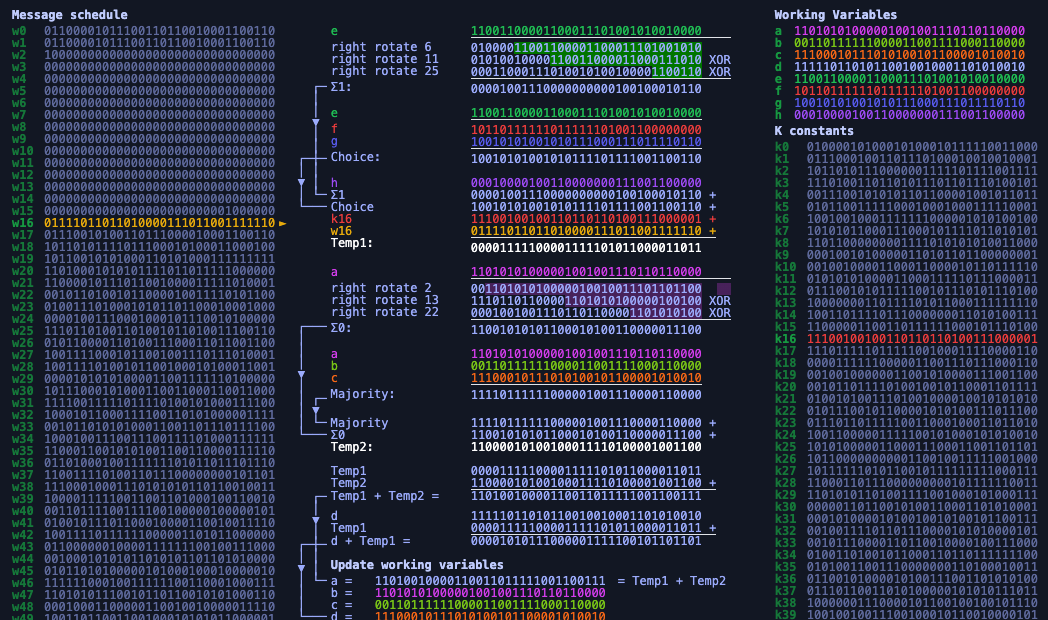
Oh this is great. When we taught SHA-256 last semester, we linked to this YouTube video: https://youtu.be/f9EbD6iY9zI. Next time we do it, we'll probably link to both. Having several different ways to visualize the same thing is very helpful, and I like that this one moves quickly.
A couple of details missing from this visualization are how you pad a message to be a multiple of the block size, and how you chain blocks together to form a longer message. In the pseudocode at https://en.wikipedia.org/wiki/SHA-2#Pseudocode, that's the "Pre-processing (Padding)" part and the "for each chunk" loop just below it. I get why you'd want to leave those things out, since they're not really the interesting part, and the screen is already pretty packed as it is. If anyone's feeling curious about implementing this yourself, take a look at these project notes: https://github.com/oconnor663/applied_crypto_2021_fall/tree/.... At some point I'll clean that up for public consumption, but for now just ignore the parts about grades and cheating :)
Thanks for the feedback and I am glad you'll use it for teaching (which was the main goal of this project)! The padding part it's briefly explained on the "dynamic" notes on the left column, but yes, can be improved. Typing on the input gives you some sense of what is doing on the background, specially if it jumps to two blocks.
The "for each chunk" is also implemented (which was one of the most difficult parts to synchronize with the UI), but I agree too, I should come up with some way to represent it better. Thanks again :)
Was about to reply with the link to the project. If anyone is curious about sha2 highly highly recommend to go thorough the project. Jack did an amazing job explaining everything step by step. Writing the code really helps to understand all the concepts much better.
So, how do people come up with these things? I assume every aspect of the design is carefully considered to defend it against various attacks. For example, why "right rotate 7 XOR right rotate 18 XOR right shift 3" and not "right rotate 2 XOR right rotate 3 XOR right shift 4"?
Visualized like this it feels like security through obscurity, but there must be reason for this.
I did wonder why initialization is like: 1. Initialize hash value h0 to h7: first 32 bits of the fractional parts of the square roots of the first 8 primes 2..19). 2. Initialize array of K constants: first 32 bits of the fractional parts of the cube roots of the first 64 primes 2..311
from what I've seen, there's a lot of "obscurity" to this; there are many seemingly arbitrary choices all over the place.
In the end most encryption algorithms boil down to doing 'random' (arbitrary, hard to justify why) things to data and then undoing them exactly in order to decrypt. the math is all incredibly abstract but not all that complex, the high level of abstraction does make it quite difficult to grasp. What's worse is that I fear there are incentives (mostly political/security interests) to keep the field small and to keep many people far away from this very practical use for all these beautiful, elegant, simple (but extremely abstract) mathematics (refering to the entire cryptography field).
Not all decryption is doing exactly the same things in reverse. For example, with CTR mode (and thus GCM mode, which is CTR plus GMAC), you call the /encryption/ routine regardless of whether you're encrypting or decrypting data. This means in an embedded environment you can save die space because your program doesn't need the e.g. AES decryption routines too.
I doubt there is any concerted effort to keep the field small. That would be like saying tech companies don't want people learning how to code so that they can maintain an advantage.
If anything, governments and companies are encouraging people to study cryptography so that they are able to hire more experts in the future. Now, once you get gatekeeper organizations and special licensing organizations like contractors licensing or beauticians licensing, those are examples of groups trying to keep the pool of experts small.
This seems pretty silly, as there is extensive (one might say tedious) detail on why the decisions in a hash function or block cipher were made; your challenge is that you have to do a literature search to collect all the reasons --- but that's science for you.
> What's worse is that I fear there are incentives (mostly political/security interests) to keep the field small and to keep many people far away from this very practical use for all these beautiful, elegant, simple (but extremely abstract) mathematics (refering to the entire cryptography field).
I mean, everything you want to learn about crypto is available online, in libraries, in textbooks. Including differential cryptoanalysis, the theory behind these mathematical forms (Galois Field makes things _EASIER_, not harder actually. That's why CRC-checks and Reed-Solomon codes were based off of Galois Fields, and AES being based on GF(2^8) is to take advantage of those same properties). -------- What has happened is that the "old generation" of programmers is dying out / retiring. And they aren't passing on their knowledge to the new generation. The "old generation" of programmers were high-math, abstract algebra and more, while "new generation" programmers just never bothered to learn this stuff.
> What's worse is that I fear there are incentives (mostly political/security interests)
Nah its mostly just a mix of laziness, rigor, and salesfolk. Most people don't want nor can properly design a hash algorithm (which works well). Public ones like SHA have received so much scrutiny, they are extremely well vetted...and then there's the mostly valid attitude of "never roll your own crypto" - Don't, not in production or anything that could become production. Unless you are a group of highly skilled cross domain career cryptographers/mathematicians... Which leads to the last bit, people build whole business out of selling "security products" out of publically available crypto, then make the argument you shouldn't do it yourself, buy theirs. Which sometimes makes sense - often it is a shill/marketing ploy. Rarely do these products provide much on top of the core freely available code...and they probably shouldn't, or else there is probably untrustworthy nonsense inside. So yeah, don't assume malice where first incompetence is possible.
> from what I've seen, there's a lot of "obscurity" to this; there are many seemingly arbitrary choices all over the place.
When is a (7-/pk/win)zip compression algo not an encryption algorithm? Do the use of certain mathematical functions make it an encryption algo? I've always found the use of prime numbers in some encryption algo's to be a red herring, namely because in theory there are an infinite number of primes, but in practice your computing device can only use 1 from a finite number of primes otherwise it would take too long to encrypt something. With this in mind, do primes actually make it easier to decrypt encrypted data? >What's worse is that I fear there are incentives (mostly political/security interests) to keep the field small Discussions like this ie communication poke light into those dark crevices of intellectuality.
It's not security through obscurity. In fact, it's the very opposite. You can see the process exactly. The reason this is secure is because the process itself doesn't work backwards. You can create a hash using this algorithm, but you'll never reverse that hash back into the original text.
I'm also wondering, how does this prevent preimaging attacks (or whatever they're called)? That is to say, what's stopping people from reliably producing output based on input?
1. You want an invertible operation. Invertible operations do _NOT_ lose information, and therefore have the maximum amount of entropy per step.
2. You want the invertible operation to pass a statistical test called "differential cryptography analysis". Over multiple rounds, it must be difficult / impossible to "predict" how 1-bit of difference changes the state. (ie: 1-bit of difference should lead to 50.0000000% change in every output bit. If its 50.1% or 49.9% change of bits, you fail because someone running cryptoanalysis will pick that up). ---------- #1 is somewhat easy. It turns out that Data XOR (Rotate-left Data) XOR (Rotate-right Data) is all you need to make an invertible operation. 5-operations, no more (any more is redundant and therefore unnecessary use of compute power), no less (any less is not invertible and therefore loses information / entropy each step). #2 is complicated: you gotta understand differential cryptoanalysis and run a bunch of tests. ----------- The discovery that (Data) XOR (Rotate-left Data) XOR (Rotate-right Data) was invertible became extremely popular in the 2010s through 2020s, and has become the cornerstone of XOR / Rotate / Add ciphers (aka: chacha), pseudorandom generators, and hash functions. I don't know quite when it was originally discovered, but Jenkins was blogging about the importance of invertibility and playing with invertible xor/rotate stuff in (non-crypto) hash functions way back in the 90s. I know Knuth's "Art of Computer Programming" book 2, Seminumerical Algorithms, discusses the importance of invertibility in random number generators, which is closely related to hashing / cryptographic procedures. So this "understanding" has been around for decades, but has only "become popular" in the SHA256 / Blake3 / pcg-random era. ------ In the 90s, ciphers were mostly using SBoxes for this step ("confusion", to grossly change a value to another value without losing information). But today, modern CPUs are much faster at add/xor/bitshift operations than reading/writing to memory. So SBoxes are no longer a high-speed methodology / primitive for these kinds of operations. It makes more sense to change our algorithms to use a new "invertible confusion operation" (aka: what SBoxes did before, and what ((Data) XOR (Rotate-left Data) XOR (Rotate-right Data)) does today). -------- EDIT: Remember: the modern crypto-primitive is just a combination of "confusion" principles and "diffusion" principles. 1. Confusion "lossless transforms" numbers into other numbers. (A "set permutation" of sorts) 2. Diffusion "moves" bits from one number into other numbers. Iterating over confusion + diffusion many times (IIRC, SHA256 is 64 rounds) is all you need to make a cryptographic cipher. If you "just" need a pseudo-random number generator or hash function, maybe 5 to 10 rounds is all you need.
The information in the above post is a merger of like, 20 different sources of information.
Your standard cryptographic books from any undergraduate program will tell you about the basics of confusion / diffusion, but I don't think the concept is very difficult at all. Invertibility is hugely important but not discussed very much. It seems like crypto-experts 'obviously' know about it so they just don't talk about it? Knuth and Bob Jenkins both talked about the importance of invertibility to random number generators. EDIT: Invertibility is the basis of bijective / 1-to-1 and onto permutation functions. To be fair, I think everyone discusses the concept but maybe with different words. Here's Jenkin's discussion on (non-crypto) hash functions, including a few paragraphs on "invertibility" (or "funnels" as they put it): http://www.burtleburtle.net/bob/hash/doobs.html The "pcg-random" generator also has a large discussion on invertibility. Honestly, one of the best writeups on the subject, and I felt like my IQ went up severely after reading the paper end-to-end: https://www.pcg-random.org/paper.html -------- The study of the invertibility of (data XOR (rotate-right data) XOR (rotate-left data)) is covered in many blogposts. https://marc-b-reynolds.github.io/math/2017/10/13/XorRotate.... The study of invertibility in general was covered by Lemire: https://lemire.me/blog/2016/08/09/how-many-reversible-intege... ----- So as you can see, invertibility is "important", but rarely discussed as important. Its just assumed that everyone knows how important it is. Once you realize that invertibility / lack of funnels is important, everything else makes sense. Galois field multiplication is useful in AES because its invertible (multiply by the GF(2^8) reciprocal). Aaaaah. I see. Why didn't my undergrad teacher just start with the importance of invertibility before talking about prime numbers and extension fields? ----- Ah right. Once you know that these things have great properties (ie: invertible), then you can just read the SHA256 paper directly and the rest is just "obviously" confusion + diffusion principles. ----- Linear Cryptoanalysis is the "standard" run a distribution kinda thing. Anyone who has done Chi-squared tests over random numbers kinda-gets this principle. Honestly, your standard non-crypto RNGs are roughly at this level at this point, so the study of any statistical-test for any random-number generator is good. Knuth / Art of Computer Programming Vol2 is one source of information on Chi-squared tests, but the study of statistics in general also results in Chi-squared tests and the like. Differential Cryptoanalysis is more difficult and looks at the change-of-bits at each step of every operation. I don't quite remember how I was introduced to the concept, but differential-cryptoanalysis of many popular ciphers is a well-studied thing throughout the field. -------- Knowledge of "what is fast" and "what is not fast" is... not really easy to come by, and seems to change as computer architectures change. I know that memory has gotten relatively slower compared to CPU-speeds in the past 30 years. I can imagine that in the 90s, an XOR-rotate-add cipher would take "relatively more" time than today, and that SBox-based / lookup table based ciphers were far more popular back then. I'm not sure where I learned that information. Maybe software optimization manuals in general?
Not sure if I understand you right, but sha256 is not invertible, there are a couple of steps where you actually just 'cut off' information that is lost afterwards.
The primitive (data) XOR (rotate-data) XOR (rotate-data) is invertible, which means there's no "bit funnel" (Bob Jenkin's term).
You want your "primitives" to be invertible, so that your one source of "non-invertible" operations is controlled very carefully. Hash functions are non-invertible. But all operations on the "internal state" should be invertible (!!!!) to maximize the entropy per round. -------- All good hash-functions have invertable operations (aka: a bijective (1-to-1 and onto) operation) over its state to "distribute" the bits around in some manner. You then perform a non-reversable XOR over the input message data (this is the one and only non-reversible step), maybe after operating over the input data somehow. Whenever you're "mixing" bits around in a cipher or hash, you need every step to be invertible to maximize your entropy. If you have 2^256 possible input states, you want to have 2^256 output states. By the pigeon-hole principle, this only happens if you have a bijective / 1-to-1 and onto invertible operation. -------- Lets look at the opposite. Lets say we have a non-invertible function. That is, 2^256 possible inputs become only 2^128 outputs. Guess what? We've just lose 128-bits of information (!!!). It doesn't matter how complex your operation is. If you have 256-bits of input and only 128-bits of output, you've "lost information". You _NEVER_ want to lose internal-state information. The hash-function's internal state should be at a maximum 256-bits (with 256-bits of entropy) every step. Sure, the input might be 512-bits, 4096-bits, or 100-MBs long, but each "step" of a 256-bit hash should retain 256-bits of state to be maximally "difficult" to reverse. That's kinda-sorta obvious if you think of it from a pigeon-hole perspective.
MD5 and SHA-1 are predecessors, and they are simpler, so certainly by starting from the understanding of the simpler ones. Just to say it wasn't all conceived in one go.
You may not get an exact answer for SHA-1 or SHA-2, because they were designed by NSA, and I'm not sure whether a complete design doc has been published. SHA-3, by contrast, was designed in an open competition, and is completely different from SHA-1 and SHA-2. But here's a rough go at it.
First of all, the overall form. SHA-2 is a Merkle-Damgård construction, meaning that it has a "compression function" which takes an algorithm state and a message block, and outputs a new algorithm state. The final block gets some padding, so that eg "x" and "x\000" don't have the same hash, and then the final algorithm state is the output. (This is a known weakness: from H(x) you can calculate H(x concat padding(x) concat other stuff). SHA-3 doesn't have this weakness. This weakness doesn't itself break collision resistance, but it can be dangerous for other uses of SHA2 if you aren't careful.) The compression function is a Davies-Meyer construction, which means that given an input state, it: * Copies the state. * Encrypts the state with a "cipher" of sorts (the "cipher" extracted from SHA-2 is known as SHACAL-2), using the message as a "key". * Adds the copied state to the encrypted state to produce a new state. Davies and Meyer proved that, for an ideal cipher, this would make a collision-resistant hash function. Note that because the update is a "cipher", it must be internally invertible. This is a good idea anyway, because any non-invertibility is by definition a collision, and you want to push that out as far as possible to make collisions hard to find. The step that isn't invertible is the final "add the copied state to the encrypted state". Within that design, the SHA-2 cipher is based on a shift register. Basic shift registers have been used in crypto for many decades; traditionally you get almost all of the bits in the register by shifting its current state, and at least one (typically only the one shifting in) by computing a function of the other bits. To extend this to general-purpose computers, you can do the same thing for words (32-bit words for SHA-224 and -256 and 64-bit words for SHA-384 -512). So you have A shifting to B shifting to C etc, with a final value that's computed and shifted back into A. You can see there's a slight twist, which is that instead of E=D you get E=D+stuff. I expect that this mitigates issues where the same stuff is used in the same way throughout the whole round. The "message schedule" is likewise based on a cipher's key schedule. The idea in a cipher is that each round needs a different version of the key to avoid "slide" attacks, so you mix the key during the round as well as mixing the cipher state. I'm not sure what the corresponding theory is for a hash function, but it's also pretty clear that you want a single byte of the message to be used in many places throughout the operation, so mixing the message is a must. For the operations, the biggest constraint is that they need to be as nonlinear as cheaply, because doing a bunch of linear functions in a row still gets you a linear function, and those are easy to break. They need to be nonlinear both as bits and as integers, so a popular design is to mix addition (linear over ints) with xor (linear over bits) and rotations (linear over both, but you need it to propagate changes from the top of a number to the bottom). That way the whole operation won't be linear over bits, nor over the integers, but all three operations are cheap on PCs. This is called an "ARX" (Add-Rotate-Xor) design. Picking the exact operations and rotation constants is something of a black art, and while you can trace descent from MD5-SHA0-SHA1-SHA2, the exact design criteria for the SHAs might not even be public. But you can see how some of the decisions may have been made. Consider the rotations in sigma0 and sigma1. The rotation constants in these designs are typically chosen so that if you look at any slice of the output, it will have many different input bits affecting it, which in turn means that small changes diffuse rapidly thoughout the design. This is not done perfectly in SHA2, in that the same bits are used for the Maj and Ch in successive iterations (i.e. you compute Maj(A,B,C) and then Maj(newA,A,B) next time since they shifted over), so you'd get correlated outputs of those steps from round to round, but apparently it's good enough. The setup constants are chosen as the square and cube roots of prime numbers, as "nothing-up-my-sleeve" numbers. The idea is that if the initialization were random numbers with no rationale given, then it would be a possible place that NSA could have hidden a backdoor. But it would be difficult to create a backdoor where the initialization is the square roots of the primes.
About linearity, that just means that there's no "multiply" or "exponent" function equivalent to our primitives.
For example: if "add Foo" were our primitive, then 64-rounds of "add-Foo" could be broken by simply "data + 64 * Foo". IE: We found a "trivial shortcut" and someone else can break our cipher way faster than we can use it. Addition is linear over numbers, because of multiplication. XOR is linear over numbers: because XOR undoes itself. (5 x (XOR-Foo) is equivalent to 1x (XOR-Foo)). It turns out that combining addition and XOR together results in a non-linear function over numbers and non-linear function over bits. We can't "shortcut numbers", because the XOR-messes up our "number math". We can't "shortcut bits" because Add has this really annoying "carry" that basically has a 50% chance of shuffling bits around. As such, we "expect" that combinations of Addition, XOR, and Shifts are non-linear. I'm not sure if it's been mathematically proven however, but no one has been able to show a "shortcut" thus far.
Generally, come up with a set of operations that you want to use that meet your design criteria (fast in hardware, fast in software, fast in SIMD, whatever), then brute-force the instruction order and/or arbitrary constants (rotations) to minimize known attacks and maximize diffusion
> (fast in hardware, fast in software, fast in SIMD, whatever)
"Slow to compute in GPUs" has been another design criterion for a while. It helps against brute force attacks. Of course, you might want your hash to be fast on GPUs too, if you're trying to accelerate something, bu cryptographic hashes usually aim for attack resistance.
No, no, no. That's a criteria for password hashes, which are a totally different construction than standard cryptographic hashes. You can't brute force a cryptographic hash, practically by definition.
That's really cool. I made a terrible one for SHA1 years ago, yours is 1000x better.
https://lock.cmpxchg8b.com/sha1/visualize.html I read a paper at the time where someone described a tool they made to find a near-collision, they explained they were just flipping bits and visually observing the affects. That sounded kinda fun, but they didn't release it, so I tried to replicate it from their description!
Your tool seems to understand the gist of differential cryptography better though.
You can track a 1-bit change or 3-bit change to "M" and see how it propagates through the SHA256 rounds in your tool. ---------- So your tool is probably better at understanding the underlying design of SHA2. We know that SHA2 was created well into the era of differential-analysis for example, so the designers would have inevitably done analysis similar to how your tool works.
> "How can any cryptographer EVER figured out any trick to crack these hash algorithms?!"
More so, "How can any cryptographer EVER figure out any trick to come up with these hash algorithms?!"
Seriously, they are incredibly impressive mathematical algorithms. Even coming up with an algorithm that is able to show the avalanche effect is mind boggling. To make sure that the algorithm is not biased to a set of samples AND shows the avalanche effect is tremendously mind blowing.
Comments (137) 40 threads
A couple of details missing from this visualization are how you pad a message to be a multiple of the block size, and how you chain blocks together to form a longer message. In the pseudocode at https://en.wikipedia.org/wiki/SHA-2#Pseudocode, that's the "Pre-processing (Padding)" part and the "for each chunk" loop just below it. I get why you'd want to leave those things out, since they're not really the interesting part, and the screen is already pretty packed as it is.
If anyone's feeling curious about implementing this yourself, take a look at these project notes: https://github.com/oconnor663/applied_crypto_2021_fall/tree/.... At some point I'll clean that up for public consumption, but for now just ignore the parts about grades and cheating :)
The "for each chunk" is also implemented (which was one of the most difficult parts to synchronize with the UI), but I agree too, I should come up with some way to represent it better. Thanks again :)
I did wonder why initialization is like:
1. Initialize hash value h0 to h7: first 32 bits of the fractional parts of the square roots of the first 8 primes 2..19).
2. Initialize array of K constants: first 32 bits of the fractional parts of the cube roots of the first 64 primes 2..311
It seems like a "nothing up my sleeve" way to initialize the variables.
In the end most encryption algorithms boil down to doing 'random' (arbitrary, hard to justify why) things to data and then undoing them exactly in order to decrypt.
the math is all incredibly abstract but not all that complex, the high level of abstraction does make it quite difficult to grasp.
What's worse is that I fear there are incentives (mostly political/security interests) to keep the field small and to keep many people far away from this very practical use for all these beautiful, elegant, simple (but extremely abstract) mathematics (refering to the entire cryptography field).
https://upload.wikimedia.org/wikipedia/commons/4/4d/CTR_encr...
https://upload.wikimedia.org/wikipedia/commons/3/3c/CTR_decr...
(Note the bold text)
Continue this thread — 1 reply
If anything, governments and companies are encouraging people to study cryptography so that they are able to hire more experts in the future.
Now, once you get gatekeeper organizations and special licensing organizations like contractors licensing or beauticians licensing, those are examples of groups trying to keep the pool of experts small.
Continue this thread — 1 reply
I mean, everything you want to learn about crypto is available online, in libraries, in textbooks. Including differential cryptoanalysis, the theory behind these mathematical forms (Galois Field makes things _EASIER_, not harder actually. That's why CRC-checks and Reed-Solomon codes were based off of Galois Fields, and AES being based on GF(2^8) is to take advantage of those same properties).
--------
What has happened is that the "old generation" of programmers is dying out / retiring. And they aren't passing on their knowledge to the new generation. The "old generation" of programmers were high-math, abstract algebra and more, while "new generation" programmers just never bothered to learn this stuff.
Continue this thread — 1 reply
Nah its mostly just a mix of laziness, rigor, and salesfolk.
Most people don't want nor can properly design a hash algorithm (which works well). Public ones like SHA have received so much scrutiny, they are extremely well vetted...and then there's the mostly valid attitude of "never roll your own crypto" - Don't, not in production or anything that could become production. Unless you are a group of highly skilled cross domain career cryptographers/mathematicians...
Which leads to the last bit, people build whole business out of selling "security products" out of publically available crypto, then make the argument you shouldn't do it yourself, buy theirs. Which sometimes makes sense - often it is a shill/marketing ploy. Rarely do these products provide much on top of the core freely available code...and they probably shouldn't, or else there is probably untrustworthy nonsense inside.
So yeah, don't assume malice where first incompetence is possible.
When is a (7-/pk/win)zip compression algo not an encryption algorithm?
Do the use of certain mathematical functions make it an encryption algo?
I've always found the use of prime numbers in some encryption algo's to be a red herring, namely because in theory there are an infinite number of primes, but in practice your computing device can only use 1 from a finite number of primes otherwise it would take too long to encrypt something.
With this in mind, do primes actually make it easier to decrypt encrypted data?
>What's worse is that I fear there are incentives (mostly political/security interests) to keep the field small
Discussions like this ie communication poke light into those dark crevices of intellectuality.
Continue this thread — 1 reply
2. You want the invertible operation to pass a statistical test called "differential cryptography analysis". Over multiple rounds, it must be difficult / impossible to "predict" how 1-bit of difference changes the state. (ie: 1-bit of difference should lead to 50.0000000% change in every output bit. If its 50.1% or 49.9% change of bits, you fail because someone running cryptoanalysis will pick that up).
----------
#1 is somewhat easy. It turns out that Data XOR (Rotate-left Data) XOR (Rotate-right Data) is all you need to make an invertible operation. 5-operations, no more (any more is redundant and therefore unnecessary use of compute power), no less (any less is not invertible and therefore loses information / entropy each step).
#2 is complicated: you gotta understand differential cryptoanalysis and run a bunch of tests.
-----------
The discovery that (Data) XOR (Rotate-left Data) XOR (Rotate-right Data) was invertible became extremely popular in the 2010s through 2020s, and has become the cornerstone of XOR / Rotate / Add ciphers (aka: chacha), pseudorandom generators, and hash functions.
I don't know quite when it was originally discovered, but Jenkins was blogging about the importance of invertibility and playing with invertible xor/rotate stuff in (non-crypto) hash functions way back in the 90s.
I know Knuth's "Art of Computer Programming" book 2, Seminumerical Algorithms, discusses the importance of invertibility in random number generators, which is closely related to hashing / cryptographic procedures. So this "understanding" has been around for decades, but has only "become popular" in the SHA256 / Blake3 / pcg-random era.
------
In the 90s, ciphers were mostly using SBoxes for this step ("confusion", to grossly change a value to another value without losing information). But today, modern CPUs are much faster at add/xor/bitshift operations than reading/writing to memory. So SBoxes are no longer a high-speed methodology / primitive for these kinds of operations.
It makes more sense to change our algorithms to use a new "invertible confusion operation" (aka: what SBoxes did before, and what ((Data) XOR (Rotate-left Data) XOR (Rotate-right Data)) does today).
--------
EDIT: Remember: the modern crypto-primitive is just a combination of "confusion" principles and "diffusion" principles.
1. Confusion "lossless transforms" numbers into other numbers. (A "set permutation" of sorts)
2. Diffusion "moves" bits from one number into other numbers.
Iterating over confusion + diffusion many times (IIRC, SHA256 is 64 rounds) is all you need to make a cryptographic cipher. If you "just" need a pseudo-random number generator or hash function, maybe 5 to 10 rounds is all you need.
Your standard cryptographic books from any undergraduate program will tell you about the basics of confusion / diffusion, but I don't think the concept is very difficult at all.
Invertibility is hugely important but not discussed very much. It seems like crypto-experts 'obviously' know about it so they just don't talk about it? Knuth and Bob Jenkins both talked about the importance of invertibility to random number generators. EDIT: Invertibility is the basis of bijective / 1-to-1 and onto permutation functions. To be fair, I think everyone discusses the concept but maybe with different words.
Here's Jenkin's discussion on (non-crypto) hash functions, including a few paragraphs on "invertibility" (or "funnels" as they put it): http://www.burtleburtle.net/bob/hash/doobs.html
The "pcg-random" generator also has a large discussion on invertibility. Honestly, one of the best writeups on the subject, and I felt like my IQ went up severely after reading the paper end-to-end: https://www.pcg-random.org/paper.html
--------
The study of the invertibility of (data XOR (rotate-right data) XOR (rotate-left data)) is covered in many blogposts. https://marc-b-reynolds.github.io/math/2017/10/13/XorRotate....
The study of invertibility in general was covered by Lemire: https://lemire.me/blog/2016/08/09/how-many-reversible-intege...
-----
So as you can see, invertibility is "important", but rarely discussed as important. Its just assumed that everyone knows how important it is. Once you realize that invertibility / lack of funnels is important, everything else makes sense.
Galois field multiplication is useful in AES because its invertible (multiply by the GF(2^8) reciprocal). Aaaaah. I see. Why didn't my undergrad teacher just start with the importance of invertibility before talking about prime numbers and extension fields?
-----
Ah right. Once you know that these things have great properties (ie: invertible), then you can just read the SHA256 paper directly and the rest is just "obviously" confusion + diffusion principles.
-----
Linear Cryptoanalysis is the "standard" run a distribution kinda thing. Anyone who has done Chi-squared tests over random numbers kinda-gets this principle. Honestly, your standard non-crypto RNGs are roughly at this level at this point, so the study of any statistical-test for any random-number generator is good. Knuth / Art of Computer Programming Vol2 is one source of information on Chi-squared tests, but the study of statistics in general also results in Chi-squared tests and the like.
Differential Cryptoanalysis is more difficult and looks at the change-of-bits at each step of every operation. I don't quite remember how I was introduced to the concept, but differential-cryptoanalysis of many popular ciphers is a well-studied thing throughout the field.
--------
Knowledge of "what is fast" and "what is not fast" is... not really easy to come by, and seems to change as computer architectures change. I know that memory has gotten relatively slower compared to CPU-speeds in the past 30 years. I can imagine that in the 90s, an XOR-rotate-add cipher would take "relatively more" time than today, and that SBox-based / lookup table based ciphers were far more popular back then.
I'm not sure where I learned that information. Maybe software optimization manuals in general?
Continue this thread — 3 replies
You want your "primitives" to be invertible, so that your one source of "non-invertible" operations is controlled very carefully.
Hash functions are non-invertible. But all operations on the "internal state" should be invertible (!!!!) to maximize the entropy per round.
--------
All good hash-functions have invertable operations (aka: a bijective (1-to-1 and onto) operation) over its state to "distribute" the bits around in some manner. You then perform a non-reversable XOR over the input message data (this is the one and only non-reversible step), maybe after operating over the input data somehow.
Whenever you're "mixing" bits around in a cipher or hash, you need every step to be invertible to maximize your entropy. If you have 2^256 possible input states, you want to have 2^256 output states. By the pigeon-hole principle, this only happens if you have a bijective / 1-to-1 and onto invertible operation.
--------
Lets look at the opposite. Lets say we have a non-invertible function. That is, 2^256 possible inputs become only 2^128 outputs. Guess what? We've just lose 128-bits of information (!!!).
It doesn't matter how complex your operation is. If you have 256-bits of input and only 128-bits of output, you've "lost information". You _NEVER_ want to lose internal-state information.
The hash-function's internal state should be at a maximum 256-bits (with 256-bits of entropy) every step. Sure, the input might be 512-bits, 4096-bits, or 100-MBs long, but each "step" of a 256-bit hash should retain 256-bits of state to be maximally "difficult" to reverse.
That's kinda-sorta obvious if you think of it from a pigeon-hole perspective.
Continue this thread — 4 replies
First of all, the overall form. SHA-2 is a Merkle-Damgård construction, meaning that it has a "compression function" which takes an algorithm state and a message block, and outputs a new algorithm state. The final block gets some padding, so that eg "x" and "x\000" don't have the same hash, and then the final algorithm state is the output. (This is a known weakness: from H(x) you can calculate H(x concat padding(x) concat other stuff). SHA-3 doesn't have this weakness. This weakness doesn't itself break collision resistance, but it can be dangerous for other uses of SHA2 if you aren't careful.)
The compression function is a Davies-Meyer construction, which means that given an input state, it:
* Copies the state.
* Encrypts the state with a "cipher" of sorts (the "cipher" extracted from SHA-2 is known as SHACAL-2), using the message as a "key".
* Adds the copied state to the encrypted state to produce a new state.
Davies and Meyer proved that, for an ideal cipher, this would make a collision-resistant hash function. Note that because the update is a "cipher", it must be internally invertible. This is a good idea anyway, because any non-invertibility is by definition a collision, and you want to push that out as far as possible to make collisions hard to find. The step that isn't invertible is the final "add the copied state to the encrypted state".
Within that design, the SHA-2 cipher is based on a shift register. Basic shift registers have been used in crypto for many decades; traditionally you get almost all of the bits in the register by shifting its current state, and at least one (typically only the one shifting in) by computing a function of the other bits. To extend this to general-purpose computers, you can do the same thing for words (32-bit words for SHA-224 and -256 and 64-bit words for SHA-384 -512). So you have A shifting to B shifting to C etc, with a final value that's computed and shifted back into A. You can see there's a slight twist, which is that instead of E=D you get E=D+stuff. I expect that this mitigates issues where the same stuff is used in the same way throughout the whole round.
The "message schedule" is likewise based on a cipher's key schedule. The idea in a cipher is that each round needs a different version of the key to avoid "slide" attacks, so you mix the key during the round as well as mixing the cipher state. I'm not sure what the corresponding theory is for a hash function, but it's also pretty clear that you want a single byte of the message to be used in many places throughout the operation, so mixing the message is a must.
For the operations, the biggest constraint is that they need to be as nonlinear as cheaply, because doing a bunch of linear functions in a row still gets you a linear function, and those are easy to break. They need to be nonlinear both as bits and as integers, so a popular design is to mix addition (linear over ints) with xor (linear over bits) and rotations (linear over both, but you need it to propagate changes from the top of a number to the bottom). That way the whole operation won't be linear over bits, nor over the integers, but all three operations are cheap on PCs. This is called an "ARX" (Add-Rotate-Xor) design.
Picking the exact operations and rotation constants is something of a black art, and while you can trace descent from MD5-SHA0-SHA1-SHA2, the exact design criteria for the SHAs might not even be public. But you can see how some of the decisions may have been made. Consider the rotations in sigma0 and sigma1. The rotation constants in these designs are typically chosen so that if you look at any slice of the output, it will have many different input bits affecting it, which in turn means that small changes diffuse rapidly thoughout the design. This is not done perfectly in SHA2, in that the same bits are used for the Maj and Ch in successive iterations (i.e. you compute Maj(A,B,C) and then Maj(newA,A,B) next time since they shifted over), so you'd get correlated outputs of those steps from round to round, but apparently it's good enough.
The setup constants are chosen as the square and cube roots of prime numbers, as "nothing-up-my-sleeve" numbers. The idea is that if the initialization were random numbers with no rationale given, then it would be a possible place that NSA could have hidden a backdoor. But it would be difficult to create a backdoor where the initialization is the square roots of the primes.
For example: if "add Foo" were our primitive, then 64-rounds of "add-Foo" could be broken by simply "data + 64 * Foo". IE: We found a "trivial shortcut" and someone else can break our cipher way faster than we can use it.
Addition is linear over numbers, because of multiplication.
XOR is linear over numbers: because XOR undoes itself. (5 x (XOR-Foo) is equivalent to 1x (XOR-Foo)).
It turns out that combining addition and XOR together results in a non-linear function over numbers and non-linear function over bits.
We can't "shortcut numbers", because the XOR-messes up our "number math". We can't "shortcut bits" because Add has this really annoying "carry" that basically has a 50% chance of shuffling bits around.
As such, we "expect" that combinations of Addition, XOR, and Shifts are non-linear. I'm not sure if it's been mathematically proven however, but no one has been able to show a "shortcut" thus far.
e.g. the Chacha20 design document explains the choices made in a fairly high level and easy to understand way: https://cr.yp.to/chacha/chacha-20080128.pdf
"Slow to compute in GPUs" has been another design criterion for a while. It helps against brute force attacks. Of course, you might want your hash to be fast on GPUs too, if you're trying to accelerate something, bu cryptographic hashes usually aim for attack resistance.
Speeding up hashing by, what, a few orders of magnitude shouldn’t break your ≥ 128 bits of preimage protection, surely?
Continue this thread — 3 replies
Continue this thread — 2 replies
Continue this thread — 2 more replies
https://lock.cmpxchg8b.com/sha1/visualize.html
I read a paper at the time where someone described a tool they made to find a near-collision, they explained they were just flipping bits and visually observing the affects. That sounded kinda fun, but they didn't release it, so I tried to replicate it from their description!
You can track a 1-bit change or 3-bit change to "M" and see how it propagates through the SHA256 rounds in your tool.
----------
So your tool is probably better at understanding the underlying design of SHA2. We know that SHA2 was created well into the era of differential-analysis for example, so the designers would have inevitably done analysis similar to how your tool works.
After watching this: "How can any cryptographer EVER figured out any trick to crack these hash algorithms?!"
More so, "How can any cryptographer EVER figure out any trick to come up with these hash algorithms?!" Seriously, they are incredibly impressive mathematical algorithms. Even coming up with an algorithm that is able to show the avalanche effect is mind boggling. To make sure that the algorithm is not biased to a set of samples AND shows the avalanche effect is tremendously mind blowing.
All comments shown.
Couldn't load more comments. Check your connection and try again.