This reminds me that I've always wanted to make a huge interactive combinatorial circuit that computes SHA-256 and shows all its internal state, then put it on a site with the claim that anyone who can make its output match a certain clearly-constructed value (e.g. 0123456...ABCD...) will win a prize. No mentions of hash algorithms or other such phrasing to deter anyone. I wonder how many people would try such a "logic puzzle", how much time they'd spend on it, and if we might even get the first successful preimage attack from that.
I actually started this because my first idea was: can I implement SHA-256 with just TTL logic gates? which should be possible, but it would take months to do.
I think making a problem more accessible like that is the fastest path to a solution.
It reminds me of the Stephen J Gould quote: "I am, somehow, less interested in the weight and convolutions of Einstein’s brain than in the near certainty that people of equal talent have lived and died in cotton fields and sweatshops."
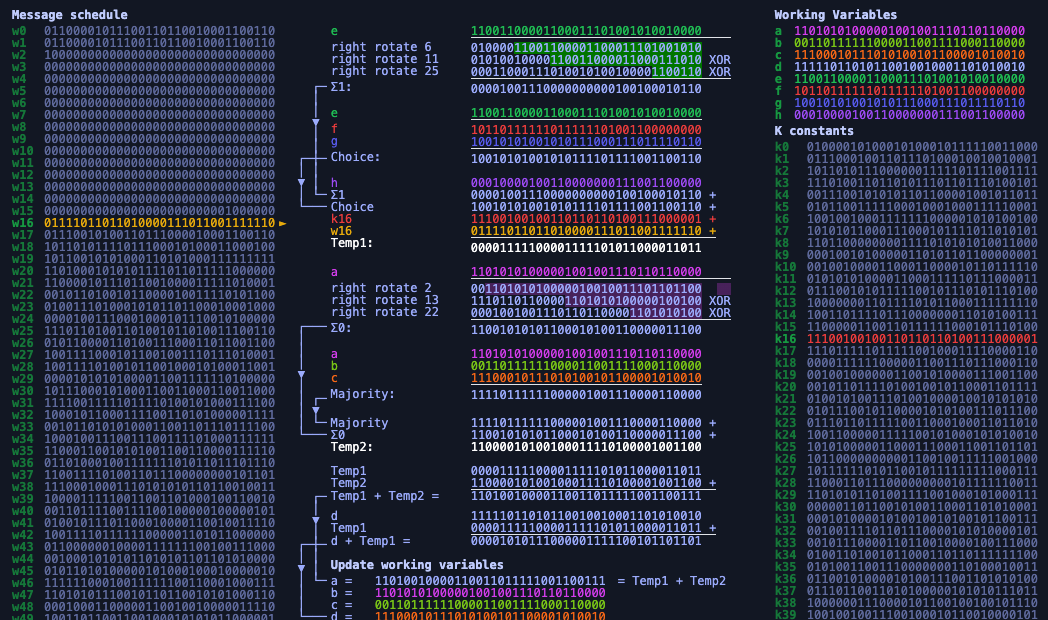
There also exists a written description showing the process in Python, step by step, which I consider more helpful, because you do not need to stop and play the video.
I think it's a reference to the written human language of the blog post, which when I attempt to view, is in German. I realize both of the parent comments could be read in jest; I'm mentioning this here very clearly since tone and implication sometimes may not translate, and passing readers may stumble on the context(s) here.
An n-bit cryptographic hash function should ideally cover every n-bit output value, given slightly more than n bits of input, but I don't know whether this has been proven for any real-world functions.
A hash function aims to replicate the properties of a truly random function.
The probability that a random function does _not_ output 0 given some specific input block is (1 - 1/2^n). Taking each of the possible 2^b input values into account this means that 0 is not an output for any input with probability (1 - 1/2^n)^(2^b) ~ e^(-2^(b-n)). For SHA-256 with n = 256 and b = 512 (one can treat the compression function as a 768 to 256 bit random function, but we can stick to the worst-case single-block message case here) we have that the probability of 0 _being_ an output for a single-block message is 1-e^(-256) which effectively means it exists, but the probability never quite reaches 1.
Maybe I'm being incredibly naive, but it seems like this would be trivial. Can you just start with the output hash and then essentially run the algorithms backwards? Obviously the resulting "input" would be random-ish garbage, but it seems like if all you care about is the output, you can pretty much just "pick" any data for the last step that produces the output. Then do likewise for the step prior, and so on.
As a comment above stated, part of the "input" is the initialized values:
> Initialize hash value h0 to h7: first 32 bits of the fractional parts of the square roots of the first 8 primes 2..19). My guess is h0 to h7 change throughout the algorithm. If you perform each step in "reverse" as you suggest, "picking" any input at each step that produces the required output for that step, then you may not arrive to the correct initial state with the square roots of the first 8 primes. You'll arrive at "random-ish garbage".
One way to prove it might be to actually find the "null hash"; turn it into a challenge/puzzle, don't mention hashing or crypto or that it's really hard, and let all the bored people of the world play with it. Perhaps someone might notice something that all the highly-trained cryptographers have missed all along: https://news.ycombinator.com/item?id=30245419
Comments (137) 40 threads
Earlier commentsfor puzzles try 12037465 for some coffee :)
It reminds me of the Stephen J Gould quote:
"I am, somehow, less interested in the weight and convolutions of Einstein’s brain than in the near certainty that people of equal talent have lived and died in cotton fields and sweatshops."
Also relevant: https://www.righto.com/2014/09/mining-bitcoin-with-pencil-an...
https://nickyreinert.medium.com/wie-funktioniert-der-sha256-...
If I were omnipotent and wanted people to believe in me, I would write a book that hashes to 0, so that anyone could verify its authenticity.
Maybe an omnipotent cryptographer would find flaws in SHA-256, but then they could design a better function and include it in the book.
Continue this thread — 1 reply
An n-bit cryptographic hash function should ideally cover every n-bit output value, given slightly more than n bits of input, but I don't know whether this has been proven for any real-world functions.
The probability that a random function does _not_ output 0 given some specific input block is (1 - 1/2^n). Taking each of the possible 2^b input values into account this means that 0 is not an output for any input with probability (1 - 1/2^n)^(2^b) ~ e^(-2^(b-n)).
For SHA-256 with n = 256 and b = 512 (one can treat the compression function as a 768 to 256 bit random function, but we can stick to the worst-case single-block message case here) we have that the probability of 0 _being_ an output for a single-block message is 1-e^(-256) which effectively means it exists, but the probability never quite reaches 1.
Continue this thread — 2 replies
> Initialize hash value h0 to h7: first 32 bits of the fractional parts of the square roots of the first 8 primes 2..19).
My guess is h0 to h7 change throughout the algorithm. If you perform each step in "reverse" as you suggest, "picking" any input at each step that produces the required output for that step, then you may not arrive to the correct initial state with the square roots of the first 8 primes.
You'll arrive at "random-ish garbage".
Continue this thread — 2 replies
All comments shown.
Couldn't load more comments. Check your connection and try again.