Does anyone have any good references, preferably a book but a good detailed website is fine, on cryptography, hashing, public/private keys, tokens, encryption, etc. as it relates to a software engineer? I don't necessarily want to know all the nitty gritty details of how these things are implemented. Rather, I think I would prefer simply understanding them and how to use them, piece them together, etc. to build something out of them.
I just have very little knowledge in this area. I'm going through a how to build a blockchain book right now, and I find myself struggling a little bit where I'm just calling some library functions but not necessarily knowing how to compose things properly.
I have an odd request regarding e.g. SHA-3. Can anyone tell me if it is implemented in a way that is in a sense 'one-pass' over its input, i.e. each byte of its input in memory is accessed only once, after which all of the algorithm state is held in registers and the original input is never accessed again? My scenario is one where I'm concerned about TOCTOU-like attacks on the memory where the input is stored, but I don't want to pay the overhead of first copying the whole input to a 'safe' memory location, e.g. imagine I have kernel code wanting to compute a hash over data stored in userspace.
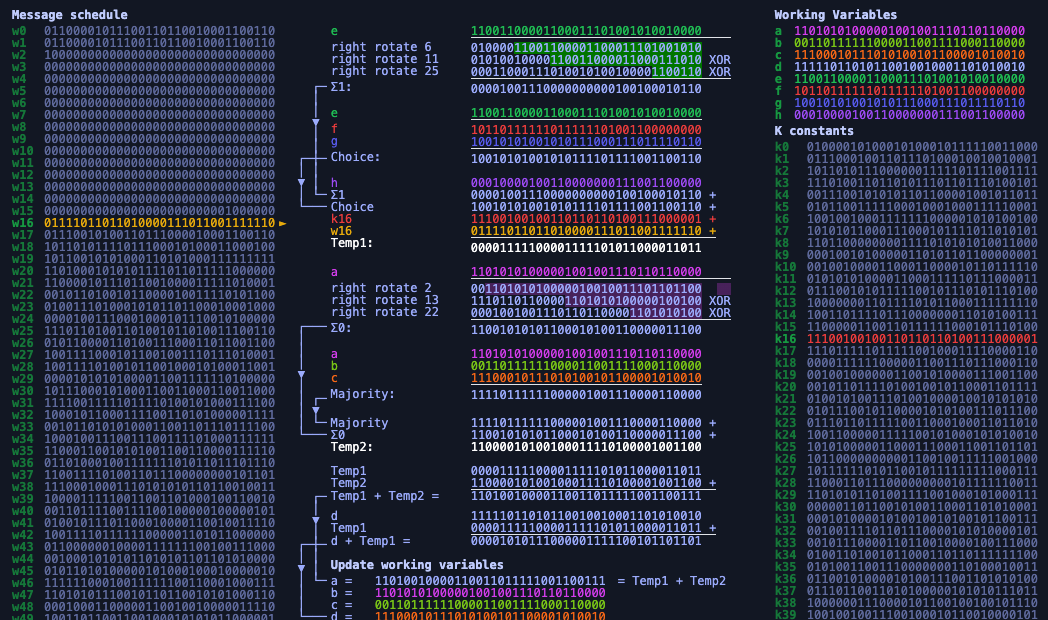
this is funny. when i first learned the algorithm, i found some matlab code that computes it with bit vectors. i added support for displaying them as an image and used the movie feature to generate step by step movies to build intuition.
nice to see someone build something polished that visualizes it in the same way. once you look at the mechanics for each round of the compression function and see the bits get swirled around for yourself, it starts to make intuitive sense. the other big intuitions are of course, the trapdoor nature of add mod 2^32 (which is implicit in unsigned integer overflow on many machines) and the fact that some operations (like xor) operate in galois field 2, while others (like addition) operate in galois field 32 and the repeated stacking of the operations in different fields gives the function it's nonlinear trapdoor property. i remember reading a pretty good paper on the arx (add, rotate, xor) family of ciphers back in the day (sort of in the vein of, is that all you need?)...
Man, this is amazing. I had to hand-unroll bit packing in a binary encoding scheme we used in a game. Rare enough that making a tool wasn't worth it, but damn I love your visualizations! Doing something like that would have helped others understand how I was "seeing the matrix."
Comments (137) 40 threads
Earlier commentsI just have very little knowledge in this area. I'm going through a how to build a blockchain book right now, and I find myself struggling a little bit where I'm just calling some library functions but not necessarily knowing how to compose things properly.
https://www.amazon.com/Serious-Cryptography-Practical-Introd...
it's a crypto course where you write the solutions in Go. you might enjoy it :)
nice to see someone build something polished that visualizes it in the same way. once you look at the mechanics for each round of the compression function and see the bits get swirled around for yourself, it starts to make intuitive sense.
the other big intuitions are of course, the trapdoor nature of add mod 2^32 (which is implicit in unsigned integer overflow on many machines) and the fact that some operations (like xor) operate in galois field 2, while others (like addition) operate in galois field 32 and the repeated stacking of the operations in different fields gives the function it's nonlinear trapdoor property.
i remember reading a pretty good paper on the arx (add, rotate, xor) family of ciphers back in the day (sort of in the vein of, is that all you need?)...
All comments shown.
Couldn't load more comments. Check your connection and try again.