Ah, young whipper snappers, everything old is new again, and clearly the world is always getting worse.
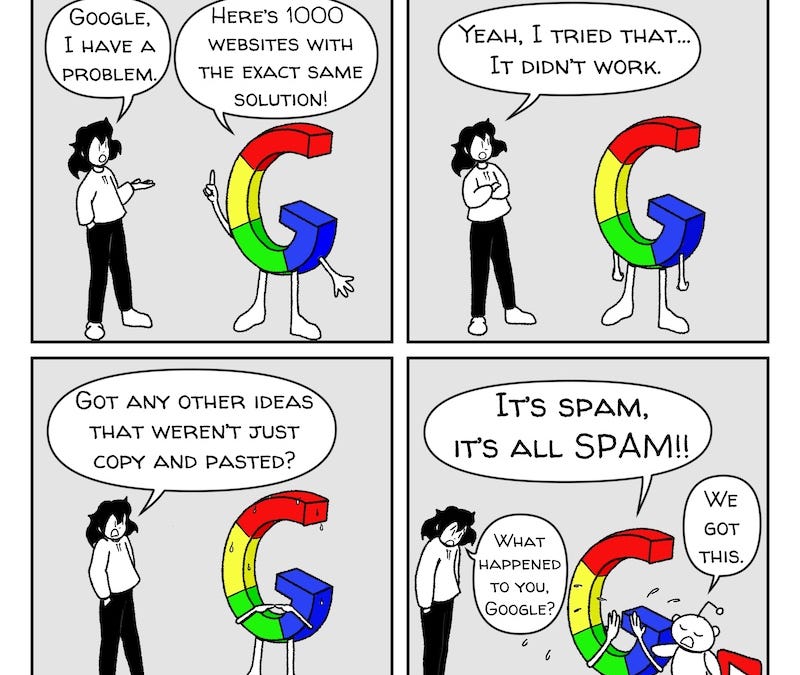
Well, some things are (reverse image search, ease of accessing 'Cached' pages -- now I have to go to archive.org Wayback, etc), but forum search has always been bad. Long before Reddit was big, USENET/DejaNews and forum software like PHPbb/UBB ruled supreme (and before Markdown there was UBB Code). Google, despite owning DejaNews, did not often surface links into USENET content, and a lot of forums, for whatever reason, were not indexed by Google. For example, I used to spend a lot of time reading the latest on PC/3D Hardware stuff on Beyond3D, Overclockers, Rage3D, etc and I almost always had either use site specific search (dejanews.com or say, PHP BB's built in local search), or I had to add site:beyond3d.com for example. And is a large amount of confirmation bias going on in these Google threads that appear. Some people make assumptions that their search patterns are representative of the billions of searchers ("argh, I searched for pytorch k-means and a GitHub wrapper site appeared!") and that their experience is a representative sample, while others focus only on what has gotten worse, and not what has gotten better. What's clearly gotten worse is webspam. But while it has degraded the Googlee experience, it's not clear any of the other search engines are any better at filtering it out, except by luck because perhaps they don't crawl as many sites as often.
I think this is very important to note and I agree.
Whether or not google search right now is as good as it could be should not be the main point of discussion. We have to remember to acknowledge that the web google is indexing now differs drastically from the web it was indexing 20 years ago. Web pages are now less likely than ever to be freely accessible plain text put forth in good faith for public consumption. Google (in addition to dealing with big walled gardens designed explicitly to hide content from google) is trying to sift through basic spam, industrial scale SEO exploitation, and nation-state cyber warfare. Bitching about google search being bad almost feels like yelling at the canary in the coal mine when it passes out.
The issue (at least for me) is that google is no longer actually searching for the thing I ask for, and it's being blatantly disrespectful of users who cared enough to learn how to actually use the search features. Quick example from today? I did a literal two word search - gulp admzip - and while the result are okish, an increasing amount of space is taken up by results with this handy little blob at the bottom: "Missing: gulp | Must include: gulp" "Missing: admzip | Must include: admzip" WTF are they smoking? I asked for two fucking words, and the top result doesn't include one of them. Then the second result doesn't include the other. So then I add quotes around the phrase I want "gulp admzip" because I'd really only like to actually see results that include that EXACT phrase, and... drumroll... IT DOES IT FUCKING AGAIN: "Missing: gulp | Must include: gulp" And that literally has nothing to do with the quality of the items it's searching, and everything to do with Google deciding what I meant - Clearly I meant the npmjs.com package adm-zip, because that item gets vastly more views than any of the real search results. I couldn't have possibly meant to restrict the search to the actual fucking phrase I told it to search for, because there aren't that many results, and they don't get many views.
I highly agree that "Missing", "Must include", has to be one of the worst hijacks of search functionality I've ever seen. Please just respect my search terms, as it doesn't fully respect them even when I put them in double quotes! It takes far longer to scan my eyes across the results dump and then retroactively see that my results are absolutely not what I am looking for, than to just see that there aren't many results for my exact query.
Decreasing the feedback loop time is essential to modifying my query quickly so that I can eventually find what I am looking for. The "Missing", "Must include" pages have always, always, ALWAYS, in every case, never given me what I am looking for. If it did, then I would have just taken out my search term.
This is the exact angle of discussion I'm saying we should try to avoid because this behavior from Google is an effect of an underlying problem with the entire web.
Most sites that include the exact phrase "gulp admzip" are empty spam of regurgitated word lists of every build tool or dev package designed to attract errant clicks that help boost ad metrics. That is why Google can't "just grep the entire internet". Incidentally, I agree with Google here that whatever problem you're trying to solve is more likely to be an issue with either gulp or admzip and you will be better served by content specifically about one or the other.
Have you considered that there may not actually be any good results for the exact phrase "gulp admzip"? Especially considering "admzip" is a misspelling as you admit?
> I asked for two fucking words, and the top result doesn't include one of them
You are aware that it has always been like this? That's why the "+" operator even exists. Even 10 years ago or more (before Google+ stole the "+" operator), you could get back results that don't actually include your search terms and you'd have to do +gulp +admzip to force their inclusion>
Woah that's a weird test case! fwiw now that you've posted this, this link shows up for that search. But similar searches like "gulp adimzip" show similar issues. Is this simply a bug? Clicking on Missing: adimzip" | Must include: adimzip" now makes Google search for gulp "adimzip""
> What's clearly gotten worse is webspam. But while it has degraded the Googlee experience, it's not clear any of the other search engines are any better at filtering it out
The problem as I see it is Google has created a bunch of perverse incentives to make your page rank higher. One big problem is Google gives higher rank to "comprehensive" articles. On the one hand that would seem like a good thing right? But what you end up getting is endless affiliate articles that don't seem to be written for humans. And they are really easy to spot if you know what to look for. A great example is webhosting reviews. Search "best web hosting" and click any of the 1st page results and you will almost always get an article that just rambles on and on and on with headings like: best web hosting for email, best web hosting for blogs, best web hosting for email marketing. To a human, it's an incredibly disorganized mess, but to Google's bots, its "highly comprehensive and authoritative".
While that may be true, it’s also true regardless of the ranking algorithm or which web search is the winner.
Webspam will seek to game whichever search company has dominant market share and they will structure their spam to overcome the filter and ranking specifics of that engine. Considering tools like GPT-3, one could easily imagine in the limit, a spammer running a large number of searches through a search engine, finding out what ranks high, and the training a generative model on that dataset to produce similar articles. Auxiliary signals like inbound links and DNS records they can also usually work around by purchasing domains or buying inbound links. It will always be a war and there is never going to be a victory over webspam. Even with something like web3 where posting content costs money I can imagine ways spam.
I guess in the perfect magical world where the algorithm detected "suitability for humans for the given query" then if gpt-3 spat out a bunch of stuff and it ranked highly, it would mean this wasn't really spam, because it was useful to humans, even if it was generated in a spammy way.
Just heavily penalize presence of affiliate links and ads on the page and the 90% of the problem will go away. But of course it's something Google will never do. It all comes down to their perverse incentives.
I think the biggest sentiment shared with everyone against Google search at the moment is the eagerness to see better competition.
While it may be true (and certainly easy) to paint everything with this large brush of 'nothing has changed, we've seen this before' - it misses the point just a tad, which is (imo) aimed at the disdain for constantly being tracked, and wanted to have a much more hacker friendly web experience (like the old days).
Things such as https:/serx.cf/ (https://searx.space) or https://github.com/benbusy/whoogle-search (https://whoogle.dcs0.hu) should prevail on a site such as HN - and furthermore, we should be setting the path with these tools for the future use of internet by non-power users.
The other day I was searching for a specific kind of jewelry and realized I don't know of a search engine that can do what I needed, which is to just find good results for my search. Searches for jewelry-related keywords triggered Google to go 90+% ads, and their results (and other search engines' results) were so junked up with spam and the same couple sites over and over that they were useless.
We're back to the Web needing a search engine. [EDIT] I should add that the ads Google was showing me didn't even do a very good job of showing me the very specific kind of thing I was looking for, even though there must be thousands of stores around the world selling pieces that fit the keywords. The ads were for jewelry, but most of them weren't anything like what I was trying to find. In this case an entire page of ads but all from different sites and mostly the thing I was looking for would have been better than nothing, but it couldn't even do that.
I know normal people would never use it but I sorely wish there was a way for me to just grep the web instead of using "search" as offered by Google et al.
I feel like that this has not changed the last 20 years. Yes - google was at some point like a miracle that seemed to solve lots of problems around searching the www for information. While google "refined" its search and monetarized it the web still evolved and is evolving to something.. different. Many of websites most people already know, competing around google top rankings and ad revenue; there are even people dedicated to "make $website more visible to the web (what they really mean is google)" for lots of money while the real internet goes on in the background. We need more ways to search the web. We need lots of different search engines that are competing and working together also. The web is still young and no one really knows what it will be in the future. (I fear it has to do with ads. Lots. Of. Ads)
>The web is still young and no one really knows what it will be in the future.
My fear is that walled gardens might win in the future because who guarantees you that websites won't move to Facebook Pages, Facebook Groups, Slack and Discord channels etc. Open web is weaker than ever just look at LinkedIn; walled garden, throws you Register form in the face when you try to access it and won't let anybody crawl or scrape their content except Google who drives more traffic to their walled garden.
Am I the only one who just skips the search engines and go straight to the source? If I want factual information, I just go to Wikipedia and use their search. If I want to shop I'll go to respected online stores and again use their inbuilt search feature.
Obviously I've just built up a list of good sites in my head which I trust... Google search is good for discoverability if you're new to the web I guess? Although in the old days that's what web directories where good for: https://en.wikipedia.org/wiki/List_of_web_directories
> Google search is good for discoverability if you're new to the web I guess?
This is almost certainly not true. I don't think kids (who make up the vast majority of 'new to the web') care about using Google for discoverability. They'll use YouTube, Twitch and Instagram to find things they care about. Google is for answering questions, not finding new things. And honestly, it's not generally that good at answering questions. Source: my 10-year old.
It's much easier to type "searchterm" or "searchterm wiki" in your web browser address bar and then click through to the Wikipedia result than it is to first navigate to every individual site and use their non-standard search bar.
Wikipedia is the perfect contrast to google search results.
- It contains 100% signal- no noise- and provides helpful related links if you need more information. - Pages are organized and brutalist. - Every page has a steward who (thanklessly) keeps the information accurate, up-to-date, and ad-free. Contrast this to Google: - 50-100% noise (depending on the query; more information requires more queries and therefore less signal) - SERP pages are disorganized and absolutely riddled with UX dark patterns (modals, banners, autoplaying video, etc). Many pages with good info are over-styled/over-javascripted/over-languaged, and finding the one or two sentences you're looking for is a chore. - One-off SEO spam plagues everything; ads and affiliate links are pervasive. Stewardship is a waste of time.
As people turn to Wikipedia for information the same momentum that ruined Google is sure to follow. It's already happened to Wikipedia pages that even tangentially touch anything political. If you go on the talk pages you see a slow motion battle between good faith editors that want an encyclopedia of information with a neutral tone, vs bad faith editors that want to use Wikipedia to represent their idealogical narrative. It's even spilled over into historical pages that don't carry the "correct" judgement on the past.
It's probably worth noting that Wikipedia breaks character occasionally and does the banner panhandling, intentionally nosediving UX to put an ad front-and-center.
This is the behavior that should be penalized by search engines- however difficult it is to quantify. Wikipedia is some of the highest quality info on the internet, so they should be able to afford the penalty themselves.
>- It contains 100% signal- no noise- and provides helpful related links if you need more information.
This is not true anymore. From Wikipedia founder Larry Sanger: >Wikipedia Is Badly Biased https://larrysanger.org/2020/05/wikipedia-is-badly-biased/ It's completely untrustworthy on anything remotely political. Very, very mainstream narrative compliant/reinforcing. - Every page has a steward who (thanklessly) keeps the information accurate, up-to-date, and ad-free And many of them inject their personal biases. For hard science stuff, math, and celebrities, it's pretty trustworthy but as I said, anything remotely politicized will always have the same slant.
>If I want factual information, I just go to Wikipedia and use their search.
Wikiepedia is a very good resource for a lot of things, and a good jumping off point, but you shouldn't assume that you are getting "factual information", especially when it comes to hot button social or geopolitical issues. https://www.craigmurray.org.uk/archives/2018/05/the-philip-c...
I've found Brave Search[1] and Kagi Search[2] to be great alternatives to Google. I know exactly the sort of thing you're describing and both of them are a breath of fresh air in the space.
They have the buyer ready to buy and still missed the sale because they wanted to make a profit on ads. How ironic. And this kind of experience probably turns a lot of buyers off from using Google search.
We don't need your unrelated ads, we already know what to buy, don't patronize us. We need help getting to the product page from keywords. We need real reviews. We need a shopping experience we can trust.
It's already dead. Google mined all the links that were curated by the initial internet communities for all it was worth and turned them into profits for Google's earliest employees and shareholders. Now that no one is curating useful links anymore their search quality, unsurprisingly, is deteriorating. Without human curation there is no signal for Google to use anymore and whatever signal is there is just SEO spam that is optimized for serving ads. It's like an ouroboros eating its own tail.
It's interesting, and quite concerning, that Reddit has cemented its position as a key repository of useful information on just about everything just as its drive towards monetisation really kicks into gear. It's concerning because, as part of that monetisation strategy, Reddit is becoming increasingly walled off and anti-user. I am sure I am only one of many long-time Redditors who have vowed to stop using the site completely once old.reddit.com goes, and it's only a matter of time.
It's probable that a huge amount of useful information will soon become much more difficult to access, and/or diluted by stealth advertising, as Reddit looks to aggressively monetise its position. I'm interested to see if a credible alternative emerges and if there is any effort to move some of the existing useful data off the platform.
Comments (1,561) 373 threads
Earlier commentsWell, some things are (reverse image search, ease of accessing 'Cached' pages -- now I have to go to archive.org Wayback, etc), but forum search has always been bad.
Long before Reddit was big, USENET/DejaNews and forum software like PHPbb/UBB ruled supreme (and before Markdown there was UBB Code). Google, despite owning DejaNews, did not often surface links into USENET content, and a lot of forums, for whatever reason, were not indexed by Google. For example, I used to spend a lot of time reading the latest on PC/3D Hardware stuff on Beyond3D, Overclockers, Rage3D, etc and I almost always had either use site specific search (dejanews.com or say, PHP BB's built in local search), or I had to add site:beyond3d.com for example.
And is a large amount of confirmation bias going on in these Google threads that appear. Some people make assumptions that their search patterns are representative of the billions of searchers ("argh, I searched for pytorch k-means and a GitHub wrapper site appeared!") and that their experience is a representative sample, while others focus only on what has gotten worse, and not what has gotten better.
What's clearly gotten worse is webspam. But while it has degraded the Googlee experience, it's not clear any of the other search engines are any better at filtering it out, except by luck because perhaps they don't crawl as many sites as often.
Whether or not google search right now is as good as it could be should not be the main point of discussion.
We have to remember to acknowledge that the web google is indexing now differs drastically from the web it was indexing 20 years ago. Web pages are now less likely than ever to be freely accessible plain text put forth in good faith for public consumption. Google (in addition to dealing with big walled gardens designed explicitly to hide content from google) is trying to sift through basic spam, industrial scale SEO exploitation, and nation-state cyber warfare.
Bitching about google search being bad almost feels like yelling at the canary in the coal mine when it passes out.
The issue (at least for me) is that google is no longer actually searching for the thing I ask for, and it's being blatantly disrespectful of users who cared enough to learn how to actually use the search features.
Quick example from today? I did a literal two word search - gulp admzip - and while the result are okish, an increasing amount of space is taken up by results with this handy little blob at the bottom:
"Missing: gulp | Must include: gulp"
"Missing: admzip | Must include: admzip"
WTF are they smoking? I asked for two fucking words, and the top result doesn't include one of them. Then the second result doesn't include the other.
So then I add quotes around the phrase I want "gulp admzip" because I'd really only like to actually see results that include that EXACT phrase, and... drumroll... IT DOES IT FUCKING AGAIN: "Missing: gulp | Must include: gulp"
And that literally has nothing to do with the quality of the items it's searching, and everything to do with Google deciding what I meant - Clearly I meant the npmjs.com package adm-zip, because that item gets vastly more views than any of the real search results.
I couldn't have possibly meant to restrict the search to the actual fucking phrase I told it to search for, because there aren't that many results, and they don't get many views.
Decreasing the feedback loop time is essential to modifying my query quickly so that I can eventually find what I am looking for.
The "Missing", "Must include" pages have always, always, ALWAYS, in every case, never given me what I am looking for. If it did, then I would have just taken out my search term.
Most sites that include the exact phrase "gulp admzip" are empty spam of regurgitated word lists of every build tool or dev package designed to attract errant clicks that help boost ad metrics. That is why Google can't "just grep the entire internet".
Incidentally, I agree with Google here that whatever problem you're trying to solve is more likely to be an issue with either gulp or admzip and you will be better served by content specifically about one or the other.
Continue this thread — 2 replies
Continue this thread — 2 replies
You are aware that it has always been like this? That's why the "+" operator even exists. Even 10 years ago or more (before Google+ stole the "+" operator), you could get back results that don't actually include your search terms and you'd have to do +gulp +admzip to force their inclusion>
Continue this thread — 2 replies
Yes, that's double quotes at the end. Weird.
The problem as I see it is Google has created a bunch of perverse incentives to make your page rank higher. One big problem is Google gives higher rank to "comprehensive" articles. On the one hand that would seem like a good thing right? But what you end up getting is endless affiliate articles that don't seem to be written for humans. And they are really easy to spot if you know what to look for.
A great example is webhosting reviews. Search "best web hosting" and click any of the 1st page results and you will almost always get an article that just rambles on and on and on with headings like: best web hosting for email, best web hosting for blogs, best web hosting for email marketing. To a human, it's an incredibly disorganized mess, but to Google's bots, its "highly comprehensive and authoritative".
Webspam will seek to game whichever search company has dominant market share and they will structure their spam to overcome the filter and ranking specifics of that engine.
Considering tools like GPT-3, one could easily imagine in the limit, a spammer running a large number of searches through a search engine, finding out what ranks high, and the training a generative model on that dataset to produce similar articles. Auxiliary signals like inbound links and DNS records they can also usually work around by purchasing domains or buying inbound links.
It will always be a war and there is never going to be a victory over webspam. Even with something like web3 where posting content costs money I can imagine ways spam.
Continue this thread — 1 reply
Man, that's almost an understatement haha. I always wonder if it's just a "Hard Problem", as I still don't know any forum software that solved it.
We're back to the Web needing a search engine.
[EDIT] I should add that the ads Google was showing me didn't even do a very good job of showing me the very specific kind of thing I was looking for, even though there must be thousands of stores around the world selling pieces that fit the keywords. The ads were for jewelry, but most of them weren't anything like what I was trying to find. In this case an entire page of ads but all from different sites and mostly the thing I was looking for would have been better than nothing, but it couldn't even do that.
I feel like that this has not changed the last 20 years. Yes - google was at some point like a miracle that seemed to solve lots of problems around searching the www for information.
While google "refined" its search and monetarized it the web still evolved and is evolving to something.. different. Many of websites most people already know, competing around google top rankings and ad revenue; there are even people dedicated to "make $website more visible to the web (what they really mean is google)" for lots of money while the real internet goes on in the background.
We need more ways to search the web. We need lots of different search engines that are competing and working together also. The web is still young and no one really knows what it will be in the future. (I fear it has to do with ads. Lots. Of. Ads)
My fear is that walled gardens might win in the future because who guarantees you that websites won't move to Facebook Pages, Facebook Groups, Slack and Discord channels etc. Open web is weaker than ever just look at LinkedIn; walled garden, throws you Register form in the face when you try to access it and won't let anybody crawl or scrape their content except Google who drives more traffic to their walled garden.
Obviously I've just built up a list of good sites in my head which I trust... Google search is good for discoverability if you're new to the web I guess? Although in the old days that's what web directories where good for:
https://en.wikipedia.org/wiki/List_of_web_directories
This is almost certainly not true. I don't think kids (who make up the vast majority of 'new to the web') care about using Google for discoverability. They'll use YouTube, Twitch and Instagram to find things they care about. Google is for answering questions, not finding new things.
And honestly, it's not generally that good at answering questions.
Source: my 10-year old.
*better = more predictable in my case
So `w fish` will produce `https://en.wikipedia.org/w/index.php?search=fish&title=Speci...` which auto-forwards to https://en.wikipedia.org/wiki/Fish
- It contains 100% signal- no noise- and provides helpful related links if you need more information.
- Pages are organized and brutalist.
- Every page has a steward who (thanklessly) keeps the information accurate, up-to-date, and ad-free.
Contrast this to Google:
- 50-100% noise (depending on the query; more information requires more queries and therefore less signal)
- SERP pages are disorganized and absolutely riddled with UX dark patterns (modals, banners, autoplaying video, etc). Many pages with good info are over-styled/over-javascripted/over-languaged, and finding the one or two sentences you're looking for is a chore.
- One-off SEO spam plagues everything; ads and affiliate links are pervasive. Stewardship is a waste of time.
https://www.wired.com/story/one-womans-mission-to-rewrite-na...
This is the behavior that should be penalized by search engines- however difficult it is to quantify. Wikipedia is some of the highest quality info on the internet, so they should be able to afford the penalty themselves.
Continue this thread — 2 replies
This is not true anymore. From Wikipedia founder Larry Sanger:
>Wikipedia Is Badly Biased
https://larrysanger.org/2020/05/wikipedia-is-badly-biased/
It's completely untrustworthy on anything remotely political. Very, very mainstream narrative compliant/reinforcing.
- Every page has a steward who (thanklessly) keeps the information accurate, up-to-date, and ad-free
And many of them inject their personal biases.
For hard science stuff, math, and celebrities, it's pretty trustworthy but as I said, anything remotely politicized will always have the same slant.
Continue this thread — 1 reply
... such as? The only general-purpose online store available to me is Amazon as far as I know, and I certainly wouldn't call them respected.
General "stuff": Argos Clothes: next, M&S Electronics: https://uk.rs-online.com/
Wikiepedia is a very good resource for a lot of things, and a good jumping off point, but you shouldn't assume that you are getting "factual information", especially when it comes to hot button social or geopolitical issues.
https://www.craigmurray.org.uk/archives/2018/05/the-philip-c...
[1] https://search.brave.com/ [2] Beta at the moment - https://kagi.com/
https://twitter.com/vladquant/status/1494076266508537858
We don't need your unrelated ads, we already know what to buy, don't patronize us. We need help getting to the product page from keywords. We need real reviews. We need a shopping experience we can trust.
Continue this thread — 1 reply
Continue this thread — 3 more replies
Continue this thread — 51 replies
It's probable that a huge amount of useful information will soon become much more difficult to access, and/or diluted by stealth advertising, as Reddit looks to aggressively monetise its position. I'm interested to see if a credible alternative emerges and if there is any effort to move some of the existing useful data off the platform.
Continue this thread — 18 replies
All comments shown.
Couldn't load more comments. Check your connection and try again.